How Does Deep Learning Classify Skin Cancer Images?
TL;DR
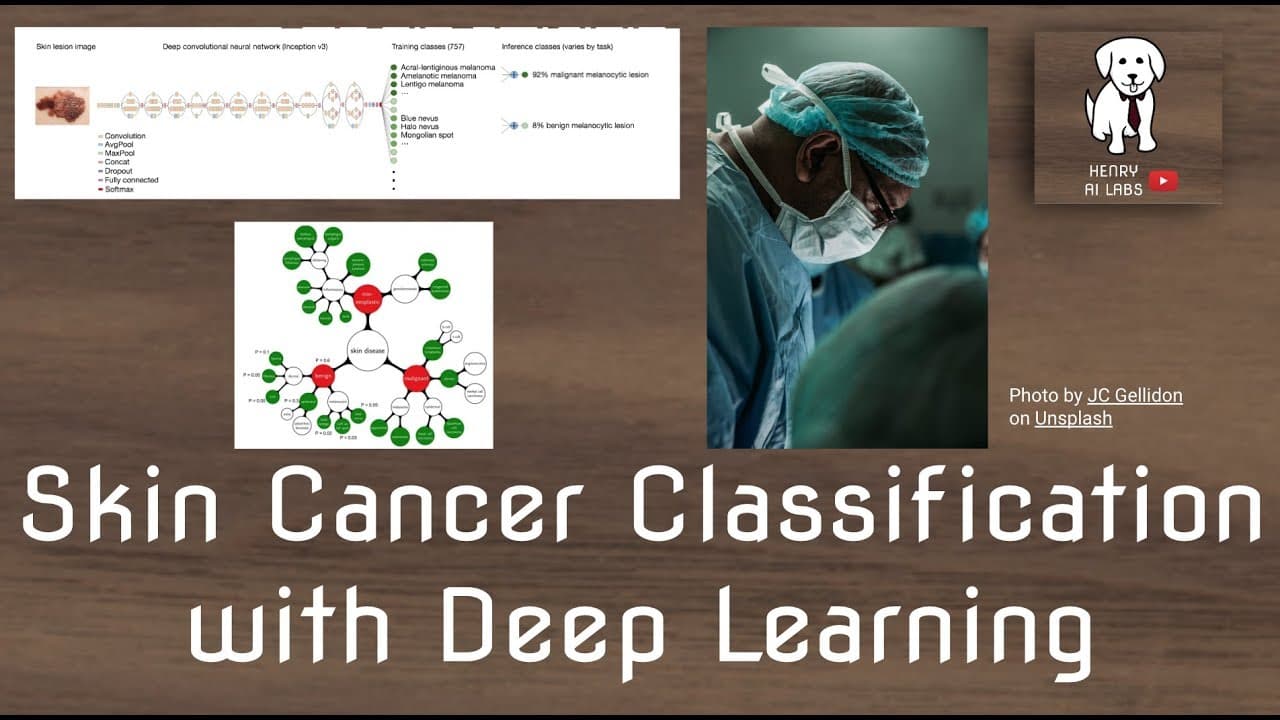
Deep learning utilizes convolutional neural networks (CNNs) to classify skin cancer images, significantly enhancing diagnosis accuracy. By employing transfer learning with pre-trained models, CNNs effectively analyze smaller datasets, often outperforming dermatologists in multi-class predictions. This technology offers a promising tool for early skin cancer detection while highlighting the need for continuous evaluation in clinical settings.
Transcript
this video will present dermatologist level classification of skin cancer with deep neural networks convolutional neural networks are a branch of deep learning that Maps images to class labels of really popular way of understanding this is through examples of classifying images of cats and dogs as shown in this image the convolutional neural networ... Read More
Key Insights
- 😷 Convolutional neural networks are powerful tools for classifying images in medical applications, specifically in detecting skin cancer.
- 😒 The use of transfer learning significantly enhances the capability of CNNs, allowing them to function effectively even when trained on smaller datasets of clinical images.
- ❓ A hierarchical output structure in CNNs enables nuanced predictions by categorizing outputs into multiple layers, improving understanding and accuracy in diagnosis.
- ✋ Visualization techniques, like t-SNE, aid in understanding how the CNN classifies skin lesions by reducing high-dimensional data to a more interpretable format.
- 🧑🏭 The CNN demonstrated clear strengths and weaknesses compared to dermatologists, indicating that AI could act as an auxiliary tool rather than a complete replacement for human experts.
- 🤩 Saliency maps serve as an important interpretative tool in computer vision, providing insights into the decision-making processes of CNNs by highlighting key features in the images used for diagnosis.
- 😷 Regular monitoring of class performance, particularly in imbalanced datasets, is crucial for refining the predictive capabilities of AI models in the medical field.
Install to Summarize YouTube Videos and Get Transcripts
Explore YouTube Video Summarizer or Get YouTube Transcript Extractor
Questions & Answers
Q: What is the significance of using convolutional neural networks for skin cancer detection?
Convolutional neural networks (CNNs) are particularly suited for image analysis, allowing for efficient classification of skin lesions by mapping input images to specific class labels. This method enhances the speed and accuracy of skin cancer detection, potentially enabling early diagnosis and treatment, which are critical for patient outcomes.
Q: How does transfer learning enhance the performance of CNNs in this study?
Transfer learning enables the CNN to leverage knowledge gained from large datasets, like ImageNet, in classifying skin lesions, which may be limited in quantity. By adapting pre-trained networks, the study compensates for the smaller dataset of 129,450 clinical images, allowing the model to learn effectively and improve predictive accuracy.
Q: Can you explain the hierarchical output space used in the CNN’s classification?
The hierarchical output space allows the CNN to predict probabilities across various classes, aggregating predictions from 'leaf nodes' (like specific skin lesions) to 'high-level nodes' (like benign or malignant). This architecture enhances the model's ability to make nuanced predictions by categorizing images more accurately based on a hierarchy of classifications.
Q: What were the findings regarding the performance of CNNs compared to dermatologists?
The study found that while CNNs outperformed dermatologists in predicting high-level classifications, they performed comparably at the more detailed leaf node level. Such results suggest that AI can complement human expertise, particularly in recognizing broad categories, but highlights the need for continued refinement in complex classifications.
Q: What challenges do class imbalance datasets pose for the CNN's performance?
Class imbalance can skew classification performance, as CNNs may become biased towards more frequently represented classes. To tackle this, metrics such as sensitivity and specificity are employed, allowing researchers to adjust the decision boundary to optimize for detection accuracy across all classes, thus minimizing false positives and negatives.
Summary & Key Takeaways
-
The video explains the application of convolutional neural networks (CNNs) in classifying skin lesions to aid in skin cancer detection, with a focus on how deep learning techniques can enhance dermatological diagnostics.
-
The researchers employed transfer learning, utilizing a pre-trained network with a large dataset to train on a comparatively smaller dataset of skin images. This method improves classification accuracy despite limited data.
-
Results indicate that the CNN outperforms dermatologists in three-way classifications and matches their performance at more granular leaf node classifications, highlighting both the potential and limitations of AI in medical diagnostics.
Read in Other Languages (beta)
Share This Summary 📚
Summarize YouTube Videos and Get Video Transcripts with 1-Click
Try YouTube Summary with ChatGPT & Claude or YouTube Transcript Generator
Explore More Summaries from Connor Shorten 📚

Summarize YouTube Videos and Get Video Transcripts with 1-Click
Try YouTube Summary with ChatGPT & Claude or YouTube Transcript Generator