Python math and stocks: Chaikin Volatility intro
TL;DR
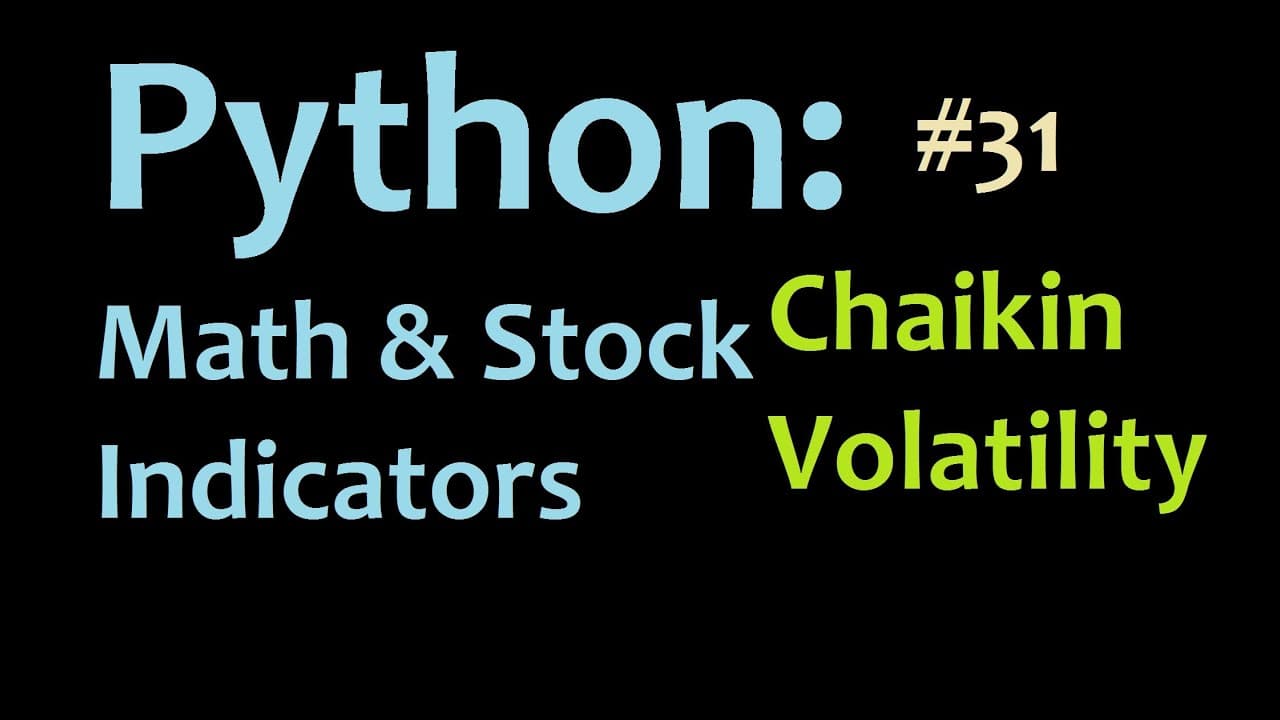
In this Python tutorial, we learn about shaken volatility as a measure of volatility in the stock market and compare it to the average true range.
Transcript
hello everybody welcome to another python mathematics and stock indicators tutorial video in this video we're going to be discussing shaken volatility if you couldn't guess shaken volatility is a measure of volatility so it's kind of like average true range and in fact i would probably prefer average true range over shaken volatility uh as far as y... Read More
Key Insights
- 🫥 Shaken volatility is a useful tool in measuring stock market volatility, especially for those who need a single line indicator.
- 🤝 The calculation of shaken volatility involves three simple steps: difference calculation, exponential moving average calculation, and percent change calculation.
- 🔇 Shaken volatility can be compared to the volume line, with spikes in volume often corresponding to spikes in volatility.
- 🧡 Average true range (ATR) is another popular volatility indicator that may be preferred over shaken volatility by some traders.
- ⌛ Shaken volatility can be plotted on a chart to visually analyze volatility patterns over time.
- 🎚️ Shaken volatility does not indicate trends; it only measures the level of price fluctuation.
- 🤝 The Python programming language can be used to calculate and chart shaken volatility.
Install to Summarize YouTube Videos and Get Transcripts
Explore YouTube Video Summarizer or Get YouTube Transcript Extractor
Questions & Answers
Q: What is shaken volatility and how does it compare to other volatility indicators?
Shaken volatility is a measure of volatility in the stock market, similar to average true range and Bollinger bands. It provides a single line that can be used in various formulas. While average true range may be preferred by some, shaken volatility's simplicity and compatibility make it user-friendly.
Q: How is shaken volatility calculated?
Shaken volatility is calculated in three steps. First, the difference between the high and low prices is calculated. Next, the exponential moving average (EMA) of this difference is calculated. Finally, the percent change of the EMA is calculated, representing a moving percent change over a specified number of periods.
Q: How can shaken volatility be visualized on a chart?
Shaken volatility can be plotted on a chart alongside stock price data. It tends to reflect periods of high volatility, corresponding to spikes in stock market volume. The line representing shaken volatility may fluctuate above or below the zero line.
Q: Is shaken volatility a trending indicator?
No, shaken volatility purely measures volatility and does not indicate trends in the stock market. It provides insight into the level of price fluctuation but does not reflect whether prices are rising or falling.
Summary & Key Takeaways
-
Shaken volatility is a measure of volatility in the stock market, similar to average true range and Bollinger bands.
-
The calculation of shaken volatility involves three steps: calculating the difference between the high and low, calculating the exponential moving average (EMA) of that difference, and calculating the percent change of the EMA.
-
Shaken volatility can be plotted on a chart and tends to reflect spikes in volume.
Read in Other Languages (beta)
Share This Summary 📚
Summarize YouTube Videos and Get Video Transcripts with 1-Click
Try YouTube Summary with ChatGPT & Claude or YouTube Transcript Generator
Explore More Summaries from sentdex 📚


Summarize YouTube Videos and Get Video Transcripts with 1-Click
Try YouTube Summary with ChatGPT & Claude or YouTube Transcript Generator