Unraveling CNS Preceptor Competencies
TL;DR
Research explores CNS preceptor competencies and training needs.
Transcript
Kimberly pate and we are um going to present to you our research on CNS preceptor competencies and we were glad that you chose to come see our our session and our objectives we have three primary objectives we wanted to share with you we um by the end of our presentation today we want you to be able to outline the available information that we foun... Read More
Key Insights
- The study aims to outline available information on CNS preceptors, describe research results, and explain how findings can enhance preceptor preparation.
- CNS preceptors play a crucial role in transitioning students from clinical nurses to specialists, impacting their confidence and success.
- Preceptors face increased workloads and stress, with limited organizational support and formal training, often relying on self-fulfillment as motivation.
- The study used the Preceptor Self-Assessment Tool (PSAT) to evaluate CNS preceptor competencies, focusing on interpersonal skills, knowledge, and administrative support.
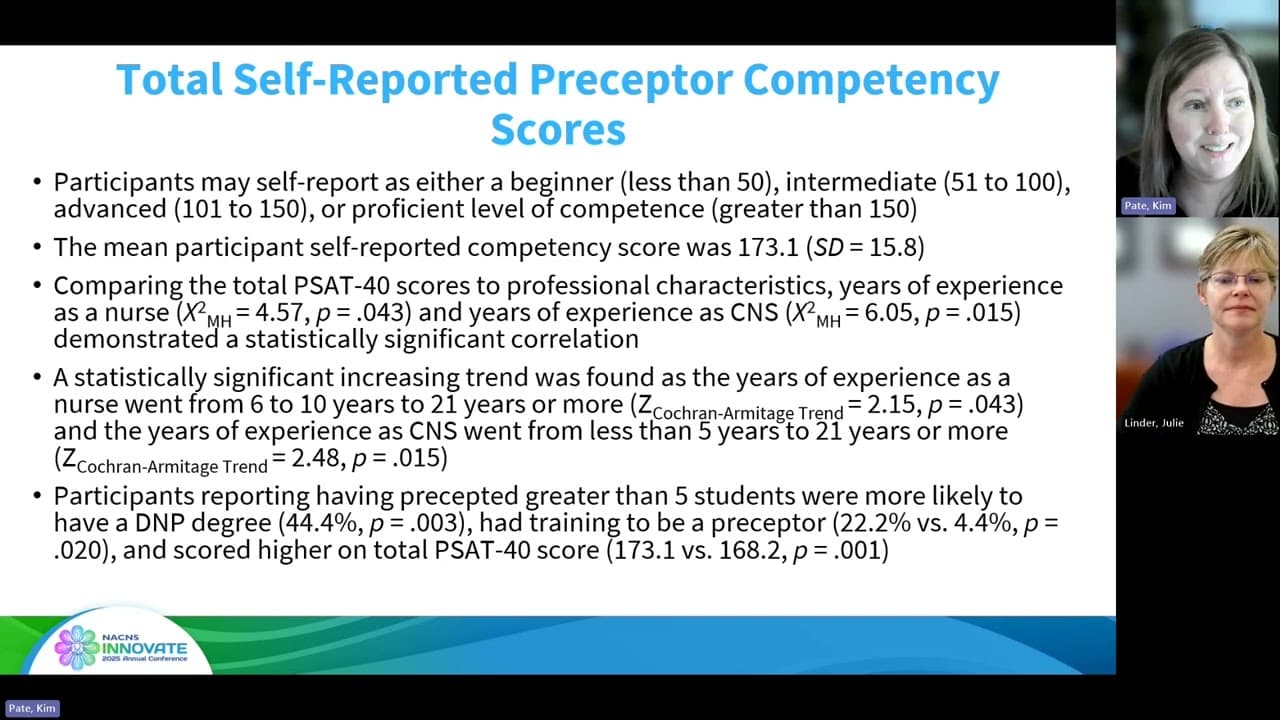
- Findings reveal that CNS preceptors with more experience and formal training score higher in competencies, indicating a need for structured training programs.
- The study highlights the eagerness of less experienced CNS preceptors to work with students, suggesting opportunities for mentorship and development.
- Administrative support is a critical area for improvement, as preceptors report lower competence in this domain, reflecting time and institutional support challenges.
- Limitations include a small sample size and potential survey fatigue, but the study provides valuable insights for enhancing CNS preceptor training and support.
Install to Summarize YouTube Videos and Get Transcripts
Explore YouTube Video Summarizer or Get YouTube Transcript Extractor
Questions & Answers
Q: What are the main objectives of the research?
The research aims to outline available information on CNS preceptors, describe the results of a study on preceptor competencies, and explain how these findings can be used to better prepare and support preceptors. It seeks to enhance understanding of preceptor roles and improve the transition of students to clinical nurse specialists.
Q: Why is preceptor competency important in CNS education?
Preceptor competency is crucial in CNS education as it significantly influences the successful transition of students from clinical nurses to clinical nurse specialists. Competent preceptors help students apply theoretical knowledge to real-life clinical experiences, boosting their confidence and facilitating their progression and success as new clinicians.
Q: What challenges do CNS preceptors face?
CNS preceptors face challenges such as increased workloads and stress due to dual responsibilities of performing their duties and mentoring students. They often lack organizational support, formal training, and incentives, relying primarily on self-fulfillment as motivation. These challenges can impact their effectiveness and the success of the students they mentor.
Q: How was the study conducted?
The study was a descriptive correlational study using the Preceptor Self-Assessment Tool (PSAT) to evaluate CNS preceptor competencies. It involved a survey distributed via email to a sample of clinical nurse specialists in North Carolina, with a focus on interpersonal skills, knowledge, and administrative support. The study analyzed correlations between competencies and professional characteristics.
Q: What were the key findings regarding CNS preceptor competencies?
Key findings indicate that CNS preceptors with more experience and formal training score higher in competencies. The study also found that less experienced preceptors are eager to mentor students, suggesting opportunities for mentorship. Administrative support emerged as a critical area for improvement, with preceptors reporting lower competence in this domain.
Q: What are the implications of the study for CNS preceptor training?
The study implies a need for structured training programs to enhance CNS preceptor competencies, particularly in administrative support. It suggests developing enduring training materials and providing institutional support to prepare preceptors effectively. These measures can help ensure successful student transitions and improve overall CNS education outcomes.
Q: What limitations did the study face?
The study faced limitations such as a small sample size, limited to one state, and potential survey fatigue, which may have affected response rates. Additionally, while the PSAT tool was used, it has not been formally validated for CNS populations. These factors may impact the generalizability of the findings, but the study still provides valuable insights.
Q: How can the study's findings be utilized in practice?
The study's findings can be utilized to inform the development of targeted training programs for CNS preceptors, focusing on identified competency gaps, particularly in administrative support. Institutions can use these insights to provide better support and resources for preceptors, ultimately enhancing the quality of CNS education and the successful transition of students into clinical nurse specialists.
Summary & Key Takeaways
-
The research focuses on CNS preceptor competencies, emphasizing the importance of competent preceptors in transitioning students to clinical nurse specialists. It identifies challenges such as increased workloads, limited support, and the need for formal training, using the Preceptor Self-Assessment Tool to evaluate competencies.
-
Key findings show experienced and formally trained CNS preceptors score higher in competencies, while less experienced preceptors demonstrate eagerness to mentor students. The study highlights administrative support as a critical area for improvement, suggesting structured training programs to enhance preceptor effectiveness.
-
Despite limitations like a small sample size, the research offers valuable insights for improving CNS preceptor training and support. It underscores the need for enduring training materials and institutional support to prepare preceptors and facilitate successful role transitions for students.
Read in Other Languages (beta)
Share This Summary 📚
Summarize YouTube Videos and Get Video Transcripts with 1-Click
Try YouTube Summary with ChatGPT & Claude or YouTube Transcript Generator
Explore More Summaries from NACNS 📚

Summarize YouTube Videos and Get Video Transcripts with 1-Click
Try YouTube Summary with ChatGPT & Claude or YouTube Transcript Generator