What Is the Difference Between Listen and Hear?
TL;DR
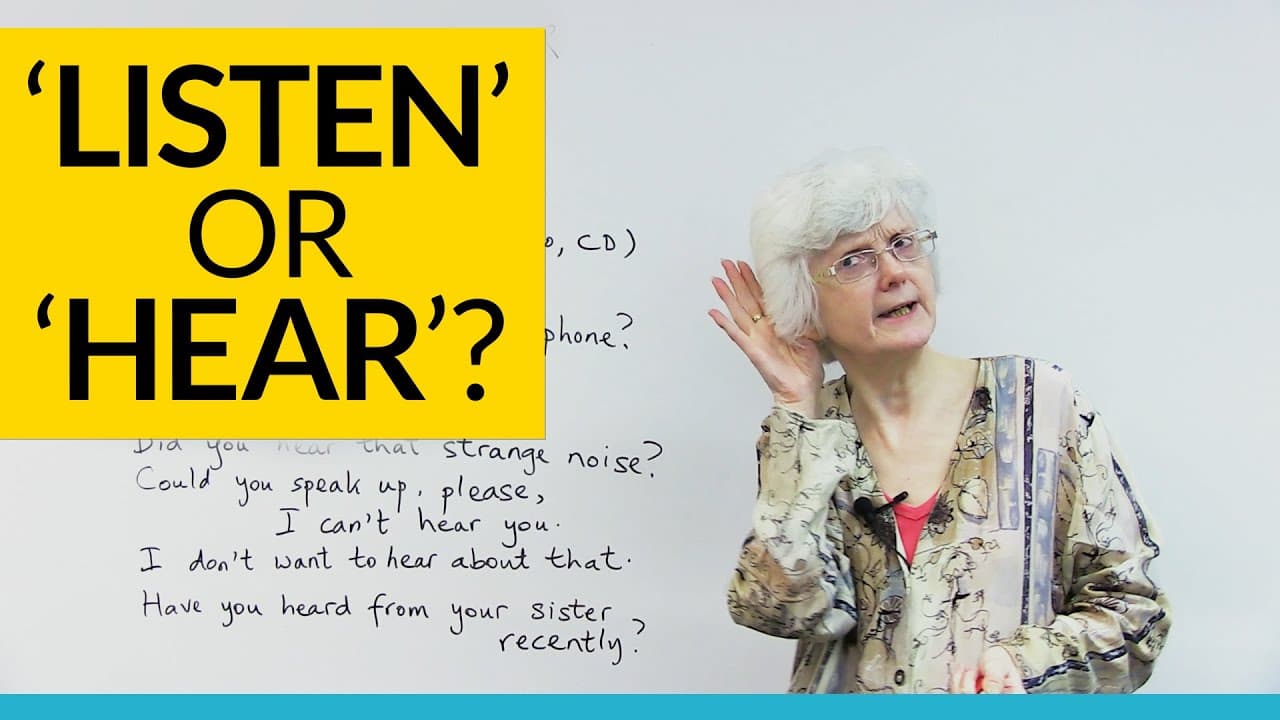
The difference between 'listen' and 'hear' lies in the level of engagement: 'listen' is an active process requiring concentration, while 'hear' is a passive act of perceiving sound. For example, you 'listen' to music (actively), but you can 'hear' a noise without focusing on it (passively).
Transcript
Hi. I'm Gill at www.engvid.com, and today we have a lesson on two verbs: "listen" and "hear", and we're going to look at the ways that you use them, because they're a bit similar; they're both to do with your hearing and listening. You... When you're using your ears. So, it's a little confusing sometimes for people to know when to use "listen" and ... Read More
Key Insights
- 👂 "Listen" requires active concentration, while "hear" involves passive reception.
- 👂 Using the preposition "to" denotes active listening with "listen" (e.g., listening to music).
- 👂 The phrase "Listen out for" implies actively focusing on a specific sound.
- 🇭🇲 "Hear" is used passively to denote the reception of soundwaves.
- 🥰 "Speak up, please" is used when someone cannot hear properly.
- 🥰 The phrase "I don't want to hear about that" expresses disinterest in specific information.
- 🥰 The past tense "heard" pertains to receiving communication from someone.
Install to Summarize YouTube Videos and Get Transcripts
Explore YouTube Video Summarizer or Get YouTube Transcript Extractor
Questions & Answers
Q: What is the primary difference between "listen" and "hear"?
The main disparity lies in their level of activity - "listen" involves active concentration, while "hear" is more passive reception.
Q: How can you use "listen out" in a sentence?
You can say, "Could you listen out for the doorbell while I'm in the garden?" to imply actively focusing on a specific sound.
Q: When is it appropriate to use the past tense "heard"?
"Heard" is used when referring to past instances of receiving information, like in the question, "Have you heard from your friend recently?"
Q: How can you explain the phrase "I don't want to hear about it"?
This phrase indicates a lack of interest in receiving certain information, conveying a passive approach to the content being discussed.
Summary & Key Takeaways
-
"Listen" requires active concentration, such as listening to music or radio, while "hear" is passive reception of soundwaves.
-
Examples illustrate the difference between "listen" (actively focusing) and "hear" (passively receiving).
-
The past tense "heard" pertains to receiving communication, like hearing from someone.
Read in Other Languages (beta)
Share This Summary 📚
Summarize YouTube Videos and Get Video Transcripts with 1-Click
Try YouTube Summary with ChatGPT & Claude or YouTube Transcript Generator
Explore More Summaries from Learn English with Gill · engVid 📚






Summarize YouTube Videos and Get Video Transcripts with 1-Click
Try YouTube Summary with ChatGPT & Claude or YouTube Transcript Generator