Lecture 3.4: Laura Schulz - Childrens' Sensitivity to Cost and Value of Information
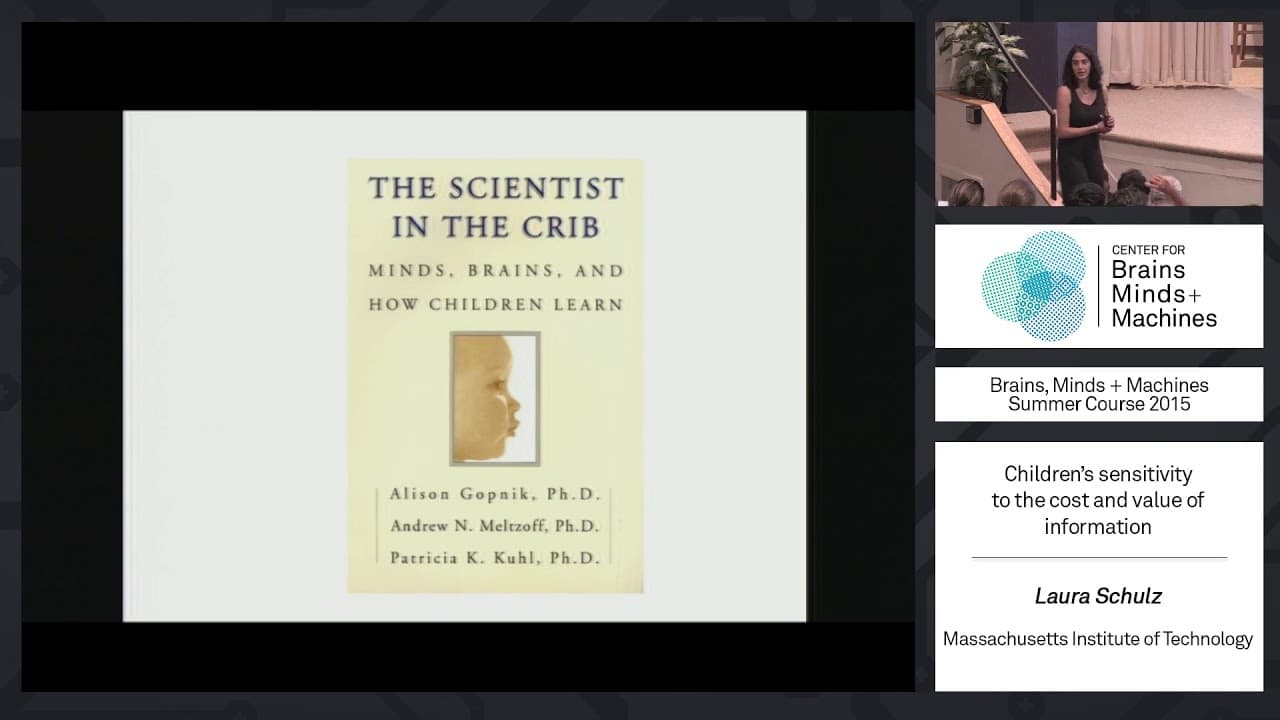
TL;DR
Children use abstract knowledge to make inferences from sparse data, navigate social interactions, and understand the costs and value of information.
Transcript
The following content is provided under a Creative Commons license. Your support will help MIT OpenCourseWare continue to offer high-quality educational resources for free. To make a donation or view additional materials from hundreds of MIT courses, visit MIT OpenCourseWare at ocw.mit.edu. LAURA SCHULZ: So what you've heard by now is that the hard... Read More
Key Insights
- ❓ Common sense intelligence is a problem of drawing inferences from limited and underdetermined data.
- 👶 Children can navigate the costs and value of information, adjusting their exploration and decision-making based on the perceived utility.
- 🖐️ Abstract knowledge plays a crucial role in children's ability to make inferences from sparse data.
Install to Summarize YouTube Videos and Get Transcripts
Explore YouTube Video Summarizer or Get YouTube Transcript Extractor
Questions & Answers
Q: How do children acquire common sense intelligence?
Children acquire common sense intelligence through unsupervised learning, using limited data to draw rich inferences about the world.
Q: Why can't computers solve the hard problems of cognitive science?
Computers struggle with common sense intelligence because it requires drawing inferences that are underdetermined by the data, something human children excel at.
Q: How do children navigate the costs and value of information?
Children are sensitive to the costs of information and adjust their exploration and decision-making based on their perceived utility and the costs involved.
Q: How do children use abstract knowledge to make inferences?
Children use abstract knowledge to constrain their interpretations of sparse data and make rich inferences, enabling them to navigate the world effectively.
Summary & Key Takeaways
-
The problem of cognitive science is the problem of common sense reasoning, which computers cannot solve as effectively as human children.
-
Children acquire common sense intelligence through unsupervised learning, drawing rich inferences from limited data.
-
Common sense intelligence is a problem of drawing inferences that are underdetermined by data, requiring abstract structured representations.
-
The cost of information is important in learning, teaching, and social interactions, and children are able to navigate and make inferences based on these costs.
Read in Other Languages (beta)
Share This Summary 📚
Summarize YouTube Videos and Get Video Transcripts with 1-Click
Try YouTube Summary with ChatGPT & Claude or YouTube Transcript Generator
Explore More Summaries from MIT OpenCourseWare 📚



Summarize YouTube Videos and Get Video Transcripts with 1-Click
Try YouTube Summary with ChatGPT & Claude or YouTube Transcript Generator