Scales of the hydrogen atom
TL;DR
The professor explains the potential energy and size of a hydrogen atom and provides key calculations and constants related to its properties.
Transcript
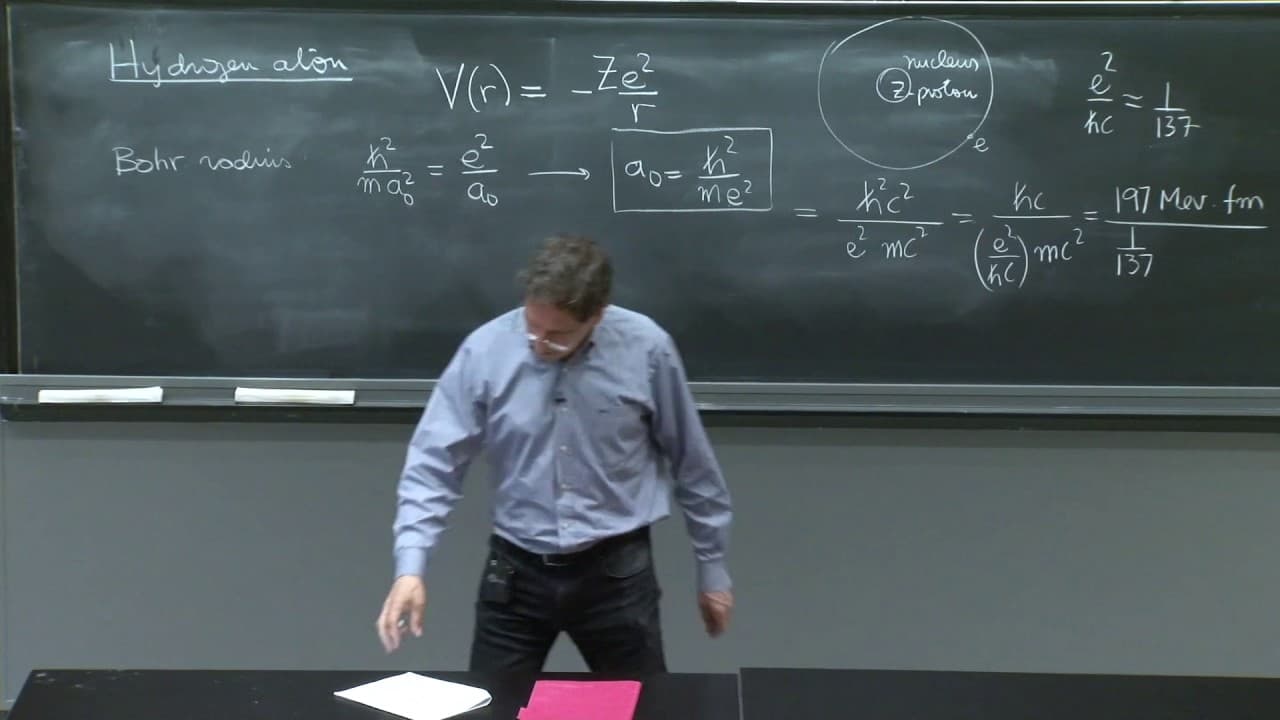
PROFESSOR: Hydrogen atom, the first thing to do is to describe the potential V or r. And it would be in the units that we'd like to use minus e squared over r. e is the charge of the electron, and the electron and proton with the same charge. The potential energy is negative. And that sign you should be comfortable with. It's suggesting that you go... Read More
Key Insights
- 🫀 The potential energy of a hydrogen atom is described by the equation -e^2/r, where e is the charge of the electron and r is the distance from the nucleus.
- 😚 The potential energy becomes more negative as the particles get closer, indicating that the energy is favored and the two particles can overlap.
- 🤪 The concept of hydrogen-like atoms allows for the calculation of potential energy using a proton with charge Z instead of an electron.
- 🫀 The Bohr radius is a constant that represents the size of a hydrogen atom and can be calculated as h^2/(me^2).
- 🖐️ The fine-structure constant, alpha, plays a role in determining the size and energy of a hydrogen atom.
- 😌 The ground state energy of a hydrogen atom is approximately 13.6 electron volts (ev).
- 🫀 The Compton wavelength of the electron and the classical electron radius are related constants that provide insight into the size and structure of atoms.
Install to Summarize YouTube Videos and Get Transcripts
Explore YouTube Video Summarizer or Get YouTube Transcript Extractor
Questions & Answers
Q: How is the potential energy of a hydrogen atom calculated?
The potential energy of a hydrogen atom is calculated using the equation -e^2/r, where e is the charge of the electron and r is the distance from the nucleus.
Q: What happens to the potential energy as the particles get closer?
As the particles get closer, the potential energy becomes more negative, indicating that the energy is favored and the two particles can overlap.
Q: What is a hydrogen-like atom?
A hydrogen-like atom is a generalization of a hydrogen atom where a proton with charge Z replaces the electron, and the potential energy can be calculated as Z*e^2/r.
Q: How is the Bohr radius calculated?
The Bohr radius can be calculated as h^2/(me^2), where h is Planck's constant and me is the mass of an electron.
Summary & Key Takeaways
-
The potential energy of a hydrogen atom is described by the equation -e^2/r, where e is the charge of the electron and r is the distance from the nucleus.
-
The potential energy is negative, meaning that when the particles get closer, the energy is favored and the two particles can overlap.
-
The professor introduces the concept of hydrogen-like atoms, where a proton with charge Z replaces the electron, and the potential energy can be calculated as Z*e^2/r.
Read in Other Languages (beta)
Share This Summary 📚
Summarize YouTube Videos and Get Video Transcripts with 1-Click
Try YouTube Summary with ChatGPT & Claude or YouTube Transcript Generator
Explore More Summaries from MIT OpenCourseWare 📚


Summarize YouTube Videos and Get Video Transcripts with 1-Click
Try YouTube Summary with ChatGPT & Claude or YouTube Transcript Generator