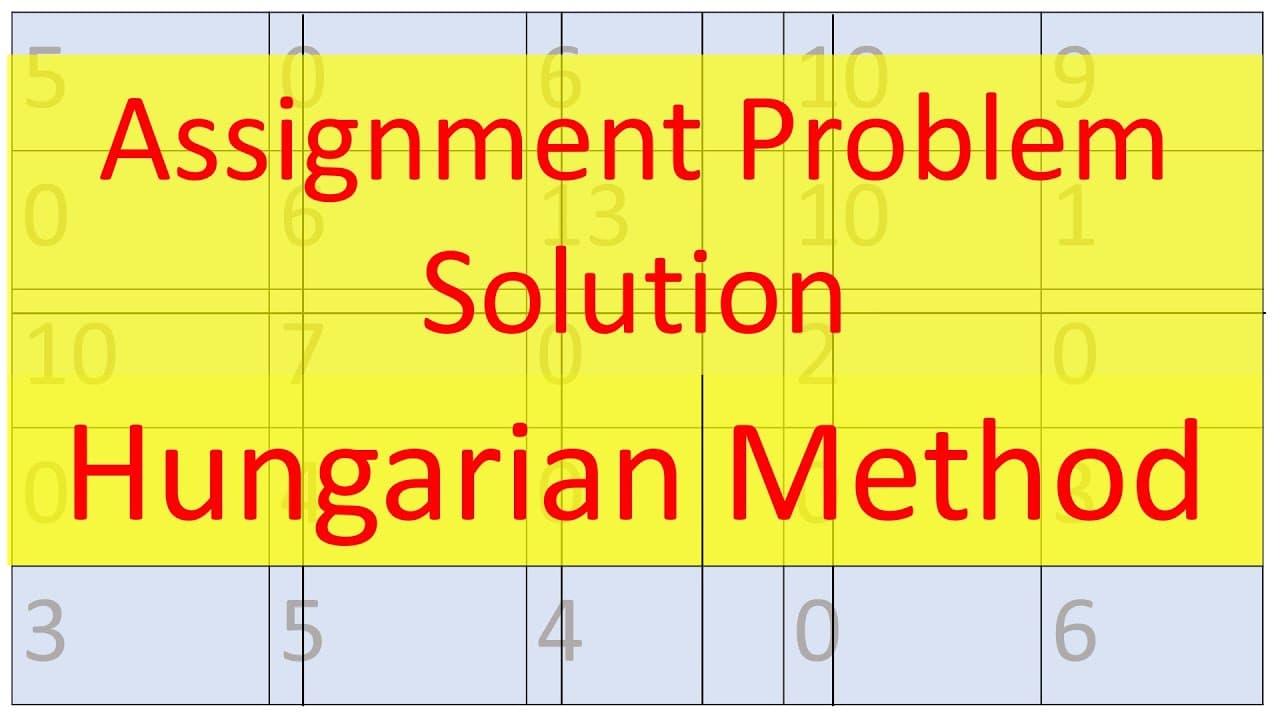
How to Solve Assignment Problems with Hungarian Method
TL;DR
The Hungarian method efficiently solves assignment problems by first reducing the original matrix through row and column minimization, and then optimizing the assignments. It ensures the best solution by comparing the number of zeros covered to the number of rows, achieving optimality when these numbers match.
Transcript
hello everybody and welcome to lesson 18 solution of assignment problem using hungarian method previously in lesson 17 we have discussed about how to solve or how to find the solution of assignment problem using enumeration method the learning objective of this lesson is to find the optimum solution using hungarian method for the assignment problem... Read More
Key Insights
- 🌥️ The Hungarian method is an efficient approach for solving assignment problems with a large number of possibilities.
- 🤨 The method involves reducing the original matrix by subtracting row and column minimums.
- #️⃣ Optimality is achieved when the number of lines used to cover zeros is equal to the number of rows.
- 🇨🇷 The method can be used to minimize costs or maximize profits in assignment problems.
- 🤨 Row and column scanning helps identify potential assignments and ineligible zeros.
- 🇨🇷 The Hungarian method provides an optimal solution for assignment problems by minimizing the overall cost or maximizing the overall profit.
- 🌥️ The method is particularly useful when the number of employees and jobs is large, making visual or enumeration methods impractical.
Install to Summarize YouTube Videos and Get Transcripts
Explore YouTube Video Summarizer or Get YouTube Transcript Extractor
Questions & Answers
Q: What is the goal of the Hungarian method for solving assignment problems?
The goal of the Hungarian method is to find the optimum solution for assignment problems by minimizing the total cost or maximizing the total profit.
Q: How does the row and column reduction phase of the Hungarian method work?
In the row reduction phase, each row's minimum value is identified and subtracted from all entries in the row. Similarly, in the column reduction phase, the minimum value of each column is subtracted from all entries in the column.
Q: What is the purpose of row scanning in the optimization phase of the Hungarian method?
Row scanning involves checking each row for a single zero. If a row contains only one zero, it is marked as a potential assignment, and other zeros in the same column are marked as ineligible.
Q: How is optimality determined in the Hungarian method?
Optimality is determined by comparing the number of lines used to cover zeros with the number of rows. If the number of lines is equal to the number of rows, optimality is achieved. Otherwise, the method continues with further iterations.
Summary & Key Takeaways
-
The Hungarian method for solving assignment problems involves two phases: row and column reduction, and optimization.
-
Row reduction includes identifying each row's minimum and subtracting it from all entries in the row, while column reduction involves subtracting the column's minimum from all entries.
-
Optimization involves row and column scanning, covering zeros with minimal lines, and comparing the number of lines to the number of rows to determine optimality.
Read in Other Languages (beta)
Share This Summary 📚
Summarize YouTube Videos and Get Video Transcripts with 1-Click
Try YouTube Summary with ChatGPT & Claude or YouTube Transcript Generator
Explore More Summaries from Solomon Getachew 📚



Summarize YouTube Videos and Get Video Transcripts with 1-Click
Try YouTube Summary with ChatGPT & Claude or YouTube Transcript Generator