PEGASUS Explained!
TL;DR
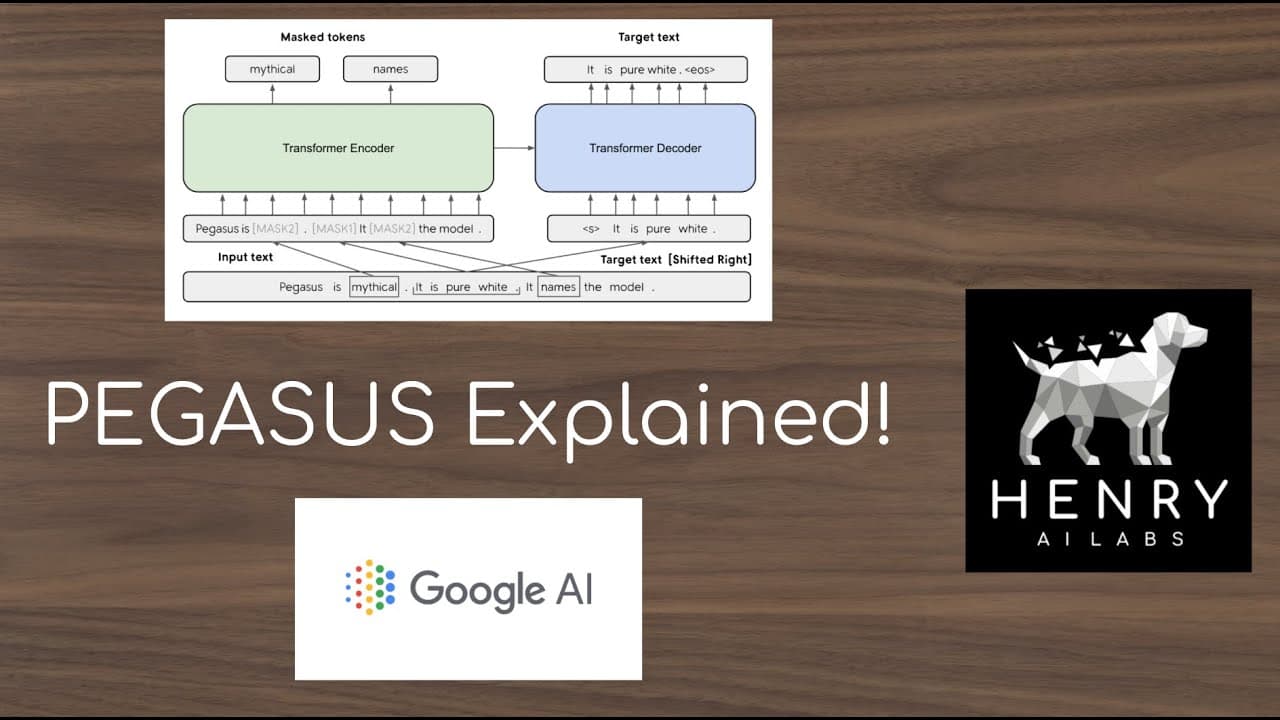
Pegasus introduces a novel pre-training approach for improved abstractive summarization in NLP.
Transcript
this video will explore the Pegasus model for abstractive summarization presented by researchers at Google AI abstractive summarization is one of the most exciting downstream tasks from natural language processing where a model is asked to write a unique summary of a document or collection of source documents a recent example that is gained interes... Read More
Key Insights
- 😑 Pegasus introduces a pre-training objective that emphasizes synthesizing entire sentences, increasing alignment with the downstream summarization task.
- 😷 Traditional language model training typically involves masking individual tokens, which may not capture the complexities of summarizing documents effectively.
- ✋ Fine-tuning on high-quality datasets is critical for achieving substantial performance gains, particularly in NLP applications like summarization.
- 📣 The gap sentence generation method encourages models to develop a deeper understanding of document structure and content relationships, enhancing summary quality.
- 👨🔬 Research shows that optimal masking strategies can significantly affect model performance, highlighting the need for careful experimental design in NLP tasks.
- 😘 Pegasus shows promising results in low-resource scenarios, making it a valuable tool for practitioners needing to summarize content without extensive datasets.
- ⏮️ The extensive performance improvements in comparison to previous models reflect the potential of tailored pre-training objectives in advancing NLP tasks.
Install to Summarize YouTube Videos and Get Transcripts
Explore YouTube Video Summarizer or Get YouTube Transcript Extractor
Questions & Answers
Q: What is the significance of the Pegasus model in NLP?
The Pegasus model represents a shift in how pre-training objectives are structured for abstractive summarization. Traditional methods utilized auto-regressive language modeling, often missing subtleties in generating novel summaries. By introducing gap sentence generation, Pegasus better aligns the learning process with summarization tasks, enhancing the model's effectiveness and applicability across various document types.
Q: How does gap sentence generation differ from traditional pre-training tasks?
Gap sentence generation involves masking complete sentences within a document rather than individual tokens. This approach helps the model focus on aggregating information and understanding context better, as it encourages the model to reconstruct more substantial portions of content, making it particularly suited for producing high-quality summaries in abstractive summarization tasks.
Q: What datasets were utilized in training and fine-tuning the Pegasus model?
The Pegasus model was primarily trained on the huge news dataset, which comprises filtered high-quality articles. For fine-tuning, it utilized a variety of datasets, including extreme summarization and TLDR, which challenge the model with different summary lengths and formats, providing a diverse testing ground for its effectiveness.
Q: What were the key findings from the ablation studies conducted on Pegasus?
The ablation studies revealed that masking out a specific percentage of sentences (30% to 45%) generally yields optimal performance. Additionally, using effective techniques for selecting which sentences to mask produced better results compared to random selection, highlighting the importance of sentence selection in pre-training tasks.
Q: How does Pegasus perform in low-resource summarization scenarios?
One of Pegasus' most notable capabilities is its performance in low-resource settings. With as few as one hundred labeled examples, it achieves summarization quality comparable to traditional models trained on much larger datasets, making it a practical solution for users with limited data availability.
Q: What improvements does Pegasus offer over earlier models like BART?
While BART employs a variety of pre-training tasks, Pegasus focuses on a more targeted pre-training approach with gap sentence generation. As a result, Pegasus shows improved performance metrics in abstract summarization tasks, particularly in zero-shot and low-resource scenarios, which is crucial for practical applications in extracting summaries from diverse documents.
Summary & Key Takeaways
-
The Pegasus model, developed by Google AI, aims to enhance abstractive summarization through a specific pre-training objective, gap sentence generation, allowing the model to better predict missing content within documents.
-
Traditional pre-training techniques like auto-regressive language modeling fall short for summarization tasks; Pegasus masks entire sentences instead of individual tokens, fostering a stronger alignment between the pre-training and downstream tasks.
-
Experimentation with various datasets, including huge news and TLDR, demonstrates Pegasus' capability for efficiently fine-tuning models, achieving significant performance improvements, particularly in low-resource settings.
Read in Other Languages (beta)
Share This Summary 📚
Summarize YouTube Videos and Get Video Transcripts with 1-Click
Try YouTube Summary with ChatGPT & Claude or YouTube Transcript Generator
Explore More Summaries from Connor Shorten 📚
Summarize YouTube Videos and Get Video Transcripts with 1-Click
Try YouTube Summary with ChatGPT & Claude or YouTube Transcript Generator