How to Train a Color Classifier with Animated Loss Updates
TL;DR
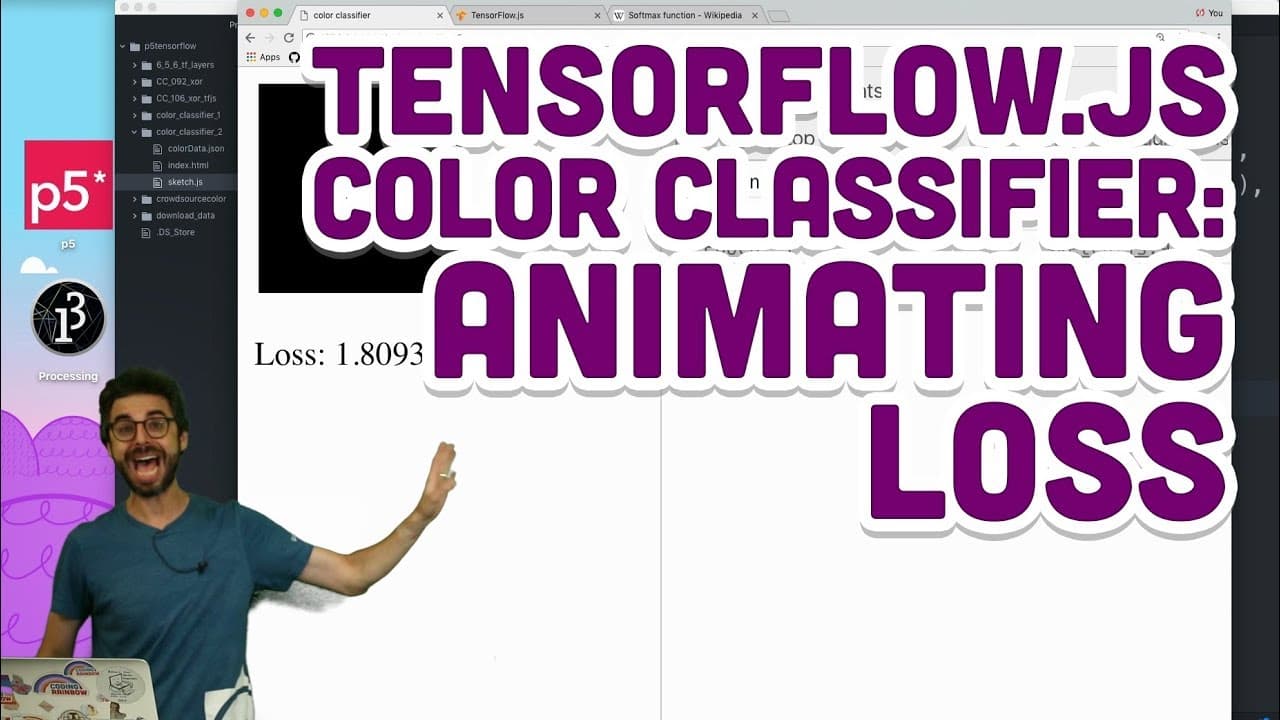
To train a color classifier with animated loss updates in TensorFlow.js, use asynchronous functions and callbacks like on train begin/end and on epoch end. By incorporating the TF next frame function, you can allow the animation to run concurrently with model training, providing real-time visual feedback on the loss function.
Transcript
all right videos 7260 three of my making your own color classifier with previous video previously on making your own color classifier intensified yes I worked in the model dot fit function so I'm fitting the model according to my training data with these options now what I want to do is I want to be able to basically see an animation graphing the l... Read More
Key Insights
- 🌸 Separating model fit into an async function enables asynchronous training with live loss function animations.
- ❤️🩹 Callbacks like on train begin/end and on epoch end can be used to trigger custom functions during specific training events.
- 🖼️ Utilizing TF next frame in async functions enhances the animation update frequency, improving visual feedback.
Install to Summarize YouTube Videos and Get Transcripts
Explore YouTube Video Summarizer or Get YouTube Transcript Extractor
Questions & Answers
Q: What is the purpose of moving the model fit function into a separate async function?
By moving the model fit function into a separate async function, it allows for animations of the loss function to be displayed while the model is training asynchronously, providing visual feedback on the training progress.
Q: How does using callbacks like on train begin/end and on epoch end contribute to the training process?
Callbacks like on train begin/end and on epoch end in TensorFlow.js allow for custom functions to be executed at specific points during the training process, enabling users to monitor and respond to training events dynamically.
Q: Why is TF next frame used in conjunction with callbacks during the training process?
TF next frame is used in conjunction with callbacks to allow the animation to update more frequently, ensuring smooth and continuous visual feedback on the loss function during training, improving the overall training experience.
Q: How can users further enhance the color classifier training process beyond what was shown in the video?
Users can experiment with querying the loss function with batches and graphing it over time, providing deeper insights into the model's training progress and potentially optimizing the training process further.
Summary & Key Takeaways
-
The video demonstrates how to train a color classifier with animated loss function updates using TensorFlow.js.
-
The process involves creating async functions, using callbacks like on train begin/end, and on epoch end, along with TF next frame to enable animations.
-
The video ends with a teaser for the next video on adding inference or prediction capabilities to the color classifier.
Read in Other Languages (beta)
Share This Summary 📚
Summarize YouTube Videos and Get Video Transcripts with 1-Click
Try YouTube Summary with ChatGPT & Claude or YouTube Transcript Generator
Explore More Summaries from The Coding Train 📚

Summarize YouTube Videos and Get Video Transcripts with 1-Click
Try YouTube Summary with ChatGPT & Claude or YouTube Transcript Generator