Astatine - Periodic Table of Videos
TL;DR
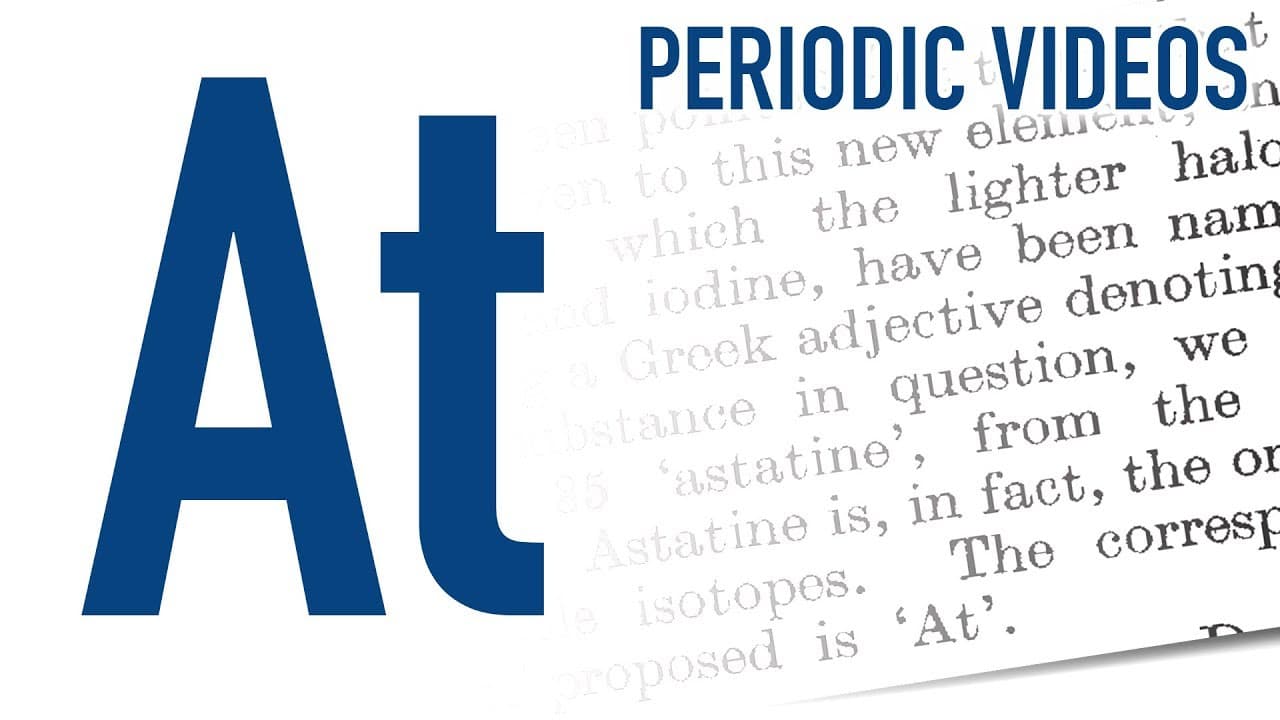
Astatine, the heaviest halogen, is a rare element with intriguing metallic characteristics and debated chemical behavior.
Transcript
Element 85 is astatine. Astatine filled in the space at the bottom of the halogens. Now, of course, it's not at the bottom of the halogens now because very recently Tennessine went below it. I'm not sure that I would drink it all the time. But at the time it was discovered it was the heaviest halogen. That is in the group that begins with fluorine,... Read More
Key Insights
- ❣️ Astatine is element 85 and the heaviest halogen, discovered synthetically through bismuth bombardment.
- 🛀 Despite its radioactivity, astatine shows potential metallic characteristics and behavior similar to polonium.
- ❓ Astatine's Greek-derived name reflects its unstable nature and ambiguity in classification.
- ❓ Detection of astatine in nature is challenging due to its minuscule presence and reliance on specific decay signatures.
- ❓ The naming debate over astatine's potential hydrogen compound highlights its unique chemical properties.
- 🤘 Astatine, although scarce and unstable, remains an intriguing element with a mix of halogen and metal traits.
- 🫵 The story of astatine's discovery showcases human ambition and competition among chemists vying for recognition.
Install to Summarize YouTube Videos and Get Transcripts
Explore YouTube Video Summarizer or Get YouTube Transcript Extractor
Questions & Answers
Q: How was astatine discovered and what synthetic method was used?
Astatine was discovered by bombarding bismuth with alpha particles, a process that created stable astatine atoms due to its minimal decay rate.
Q: What are astatine's characteristics in comparison to other halogens?
Astatine displays a mix of halogen and metal traits, potentially behaving more like polonium than iodine, with its unstable nature dictating its properties.
Q: Why is astatine so rare, and how is it detected in nature?
Astatine's scarcity is due to its minimal presence in natural sources, requiring sensitive detection methods based on its unique emission signature from decay processes.
Q: What is the significance of astatine's naming and its Greek origins?
Astatine's name, derived from the Greek word "astatos," meaning "unstable," reflects both its decaying nature and uncertain classification as a metal or halogen.
Summary & Key Takeaways
-
Astatine, element 85, filled the halogen space at the bottom of the periodic table, discovered through synthetic methods due to its radioactivity.
-
Despite being unstable and radioactive, astatine exhibits both halogen and potentially metallic properties.
-
Its scarcity, resembling polonium in chemistry, and potential for unique hydrogen compound names make astatine a captivating element.
Read in Other Languages (beta)
Share This Summary 📚
Summarize YouTube Videos and Get Video Transcripts with 1-Click
Try YouTube Summary with ChatGPT & Claude or YouTube Transcript Generator
Explore More Summaries from Periodic Videos 📚



Summarize YouTube Videos and Get Video Transcripts with 1-Click
Try YouTube Summary with ChatGPT & Claude or YouTube Transcript Generator