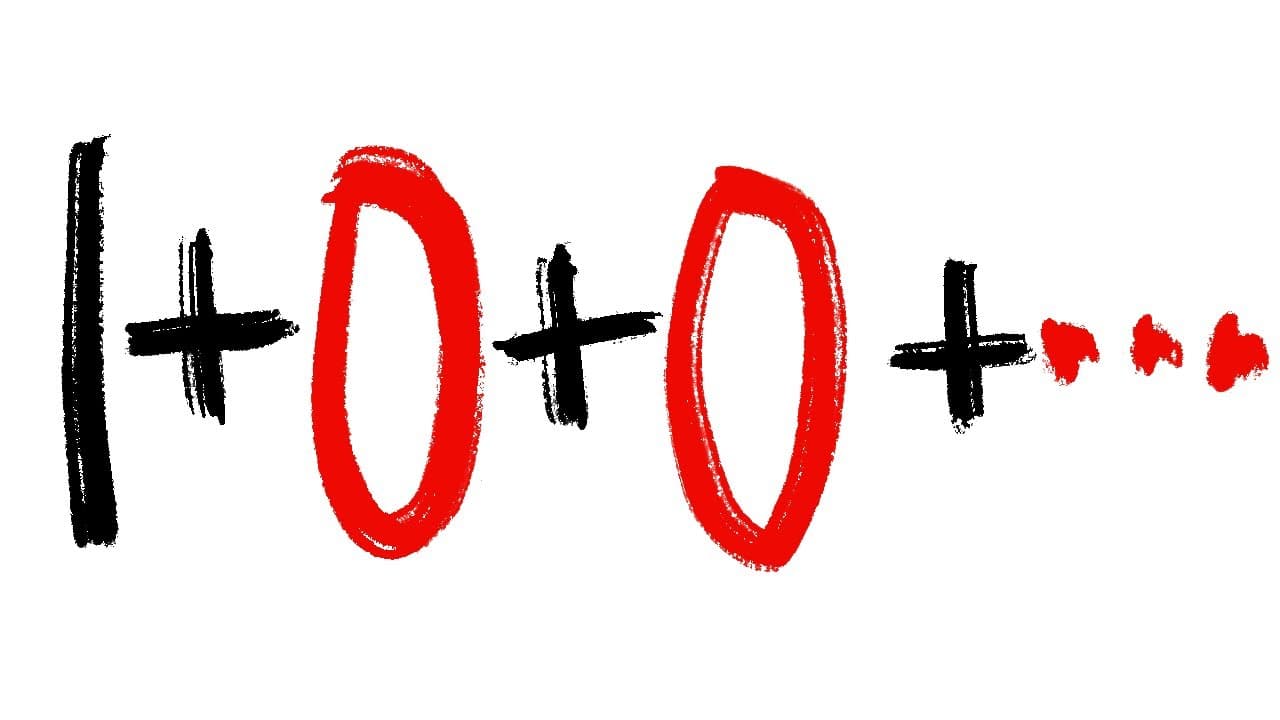
1+0+0+...=?
TL;DR
Computing the limit of the Riemann Zeta function by evaluating infinite series can lead to incorrect results.
Transcript
i want to show you a wrong way to compute the limit as s goes to infinity of the riemann zeta function and of course we'll talk about why this is wrong so check this out first we see that we have a series as n goes from one to infinity so we can just plug in the y into the end first so we get one over one and because s is going to infinity so let's... Read More
Key Insights
- ✊ The limit of 1 to the power of infinity is not always an indeterminate form; it depends on the exact value of the base.
- 🛩️ Adding a small value to the base can change the resulting limit from 1 to the mathematical constant e.
- 0️⃣ Infinitely many zeros, when not exactly zero, can lead to an indeterminate form of zero times infinity.
- 💁 Indeterminate forms require further analysis to determine the actual limit.
- 💻 The Riemann Zeta function's limit should not be computed using naive infinite series evaluation methods.
- 💁 Understanding indeterminate forms is crucial in accurately calculating limits.
- ⛔ The concept of limits is often used in calculus, specifically in the definition of integrals.
Install to Summarize YouTube Videos and Get Transcripts
Explore YouTube Video Summarizer or Get YouTube Transcript Extractor
Questions & Answers
Q: Why does 1 to the infinity power not produce an indeterminate form?
In this case, the base is exactly equal to 1, so raising it to the power of infinity results in 1. Indeterminate forms occur when the base is not exactly 1.
Q: How does adding a small value to the base affect the limit?
When a small value is added, the base becomes slightly bigger than 1. The resulting limit can no longer be determined as 1, but rather the mathematical constant e.
Q: Why does having infinitely many zeros not always result in a limit of zero?
Infinitely many zeros, when they are slightly larger than zero, can result in an indeterminate form of zero times infinity. The limit in such cases cannot be determined as zero without further analysis.
Q: What is an example of an indeterminate form that illustrates the need for additional analysis?
The example of the limit with one over n multiplied by the square root of n over n demonstrates that the sum of infinitely many zeros is no longer zero, but rather two-thirds.
Summary & Key Takeaways
-
The video discusses an incorrect method of computing the limit of the Riemann Zeta function as s approaches infinity.
-
The speaker demonstrates the method and explains why it is flawed.
-
The video also emphasizes the importance of understanding indeterminate forms and provides examples to illustrate the concept.
Read in Other Languages (beta)
Share This Summary 📚
Summarize YouTube Videos and Get Video Transcripts with 1-Click
Try YouTube Summary with ChatGPT & Claude or YouTube Transcript Generator
Explore More Summaries from blackpenredpen 📚
Summarize YouTube Videos and Get Video Transcripts with 1-Click
Try YouTube Summary with ChatGPT & Claude or YouTube Transcript Generator