L12.7 The Variance of the Sum of Random Variables
TL;DR
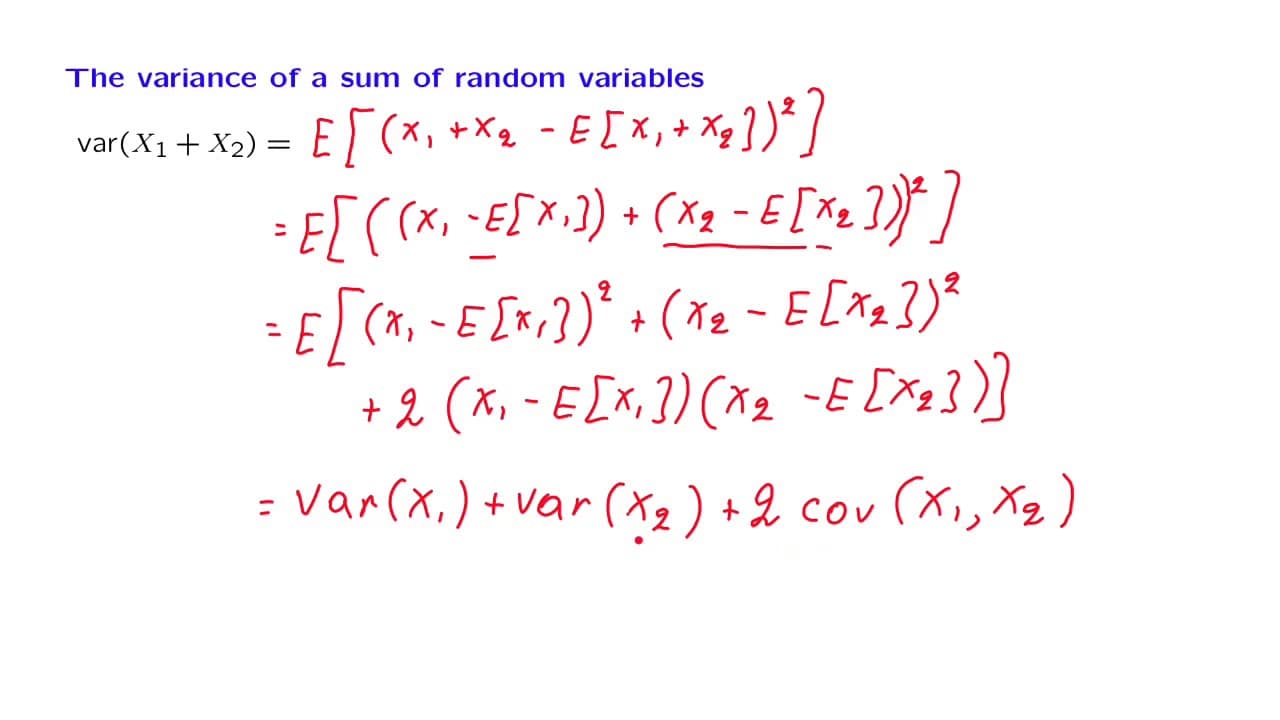
The variance of the sum of two random variables depends on their covariance and individual variances.
Transcript
One situation where covariances show up is when we try to calculate the variance of a sum of random variables. So let us look at the variance of the sum of two random variables, X1 and X2. If the two random variables are independent, then we know that the variance of the sum is the sum of the variances. Let us now look at what happens in the case w... Read More
Key Insights
- 🍹 Covariances are useful in calculating the variance of the sum of random variables, especially when the variables are dependent.
- 😵 The formula for the variance of the sum of two random variables includes the variances, covariance, and cross terms.
- 0️⃣ Independence of random variables results in zero covariance and simplifies the formula to a simple addition of variances.
- 🍹 The formula can be extended to calculate the variance of the sum of multiple random variables.
- 0️⃣ The general formula holds for both zero-mean and non-zero-mean random variables.
- 🖐️ Covariances play a crucial role in understanding the relationship between random variables and their sum.
- 🍹 The variance of the sum is influenced by both the individual variances and the covariance between random variables.
Install to Summarize YouTube Videos and Get Transcripts
Explore YouTube Video Summarizer or Get YouTube Transcript Extractor
Questions & Answers
Q: How is the variance of the sum of two random variables calculated when they are independent?
When two random variables are independent, their variances are added to calculate the variance of their sum. The covariance term is zero in this case.
Q: What happens when the random variables are dependent?
If the random variables are dependent, the variance of the sum includes an additional term involving their covariance. The formula expands to include both variances and covariances.
Q: Is the formula only applicable when the random variables have zero means?
The formula presented for calculating the variance of the sum remains valid for random variables with non-zero means. The derivation is very similar, with a few additional symbols involved.
Q: How can the formula be extended to calculate the variance of the sum of multiple random variables?
By using linearity and the properties of expectations, the formula for the variance of the sum of two random variables can be generalized to include multiple terms and cross terms involving the expected values and covariances of each random variable.
Summary & Key Takeaways
-
The variance of the sum of two independent random variables is equal to the sum of their variances.
-
When the random variables are dependent, the variance of the sum includes additional terms involving their covariance.
-
The formula can be generalized to calculate the variance of the sum of multiple random variables.
Read in Other Languages (beta)
Share This Summary 📚
Summarize YouTube Videos and Get Video Transcripts with 1-Click
Try YouTube Summary with ChatGPT & Claude or YouTube Transcript Generator
Explore More Summaries from MIT OpenCourseWare 📚



Summarize YouTube Videos and Get Video Transcripts with 1-Click
Try YouTube Summary with ChatGPT & Claude or YouTube Transcript Generator