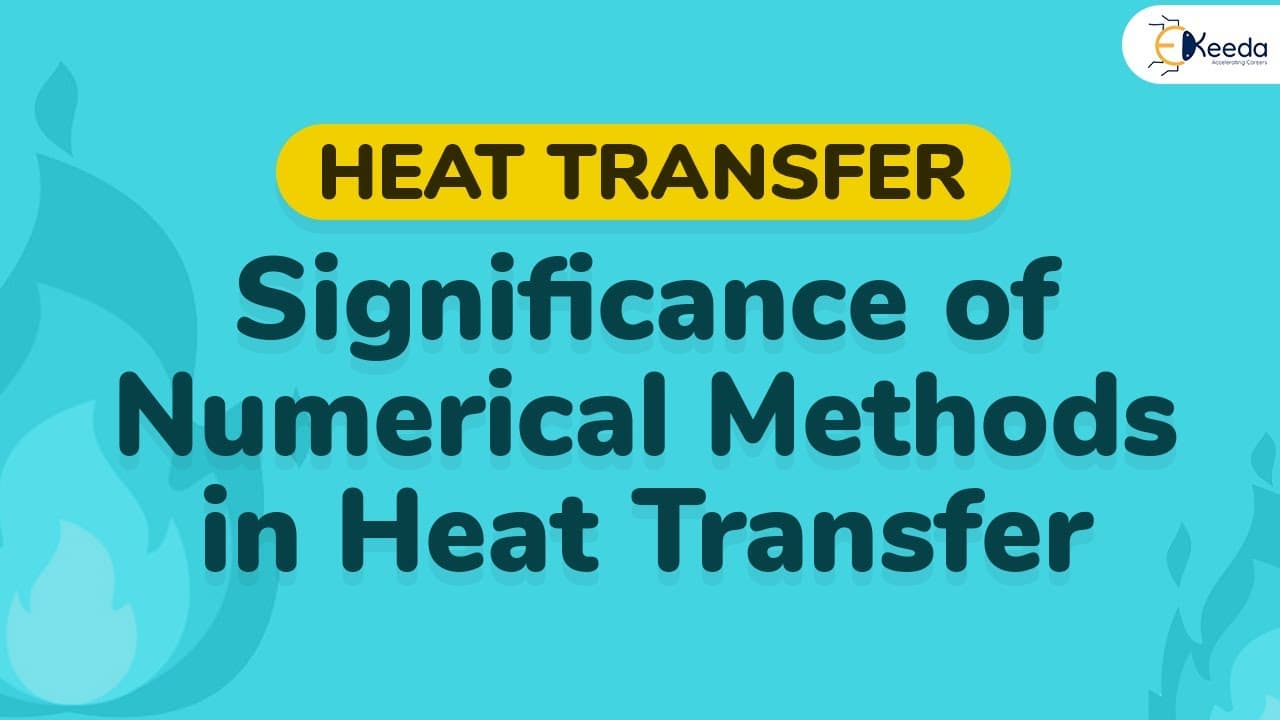
Significance of Numerical Methods in Heat Transfer - Numerical Methods In Heat Transfer
TL;DR
Numerical methods are essential in heat transfer when analytical solutions are not possible, allowing for easy and accurate solutions to complex problems.
Transcript
click the bell icon to get latest videos from equator hello friends till now we have seen the steady-state and unsteady state heat transfer in this topic let us look at the numerical method and the significance of numerical method numerical methods in heat transfer now the first question that need to be asked that what are the ways of the solution ... Read More
Key Insights
- 🥵 There are three ways to obtain solutions in heat transfer: experimental, analytical, and numerical methods.
- 🥵 Analytical solutions in heat transfer are limited to simple shapes and one-dimensional problems.
- 🥵 Numerical methods convert partial differential equations into difference equations for solving complex heat transfer problems.
- 🥵 Numerical solutions are essential for atypical shapes and three-dimensional analysis in heat transfer.
- ❓ Analytical solutions require the conversion of physical problems into mathematical equations.
- 🥵 Numerical methods have become increasingly important in industry for solving complex heat transfer problems.
- 🥵 Numerical methods allow for the calculation of intermediate parameters in heat transfer.
Install to Summarize YouTube Videos and Get Transcripts
Explore YouTube Video Summarizer or Get YouTube Transcript Extractor
Questions & Answers
Q: What are the three ways to obtain solutions in heat transfer?
The three ways to obtain solutions in heat transfer are experimental, analytical, and numerical methods. Experimental solutions involve conducting experiments and concluding results. Analytical solutions convert the physical problem into mathematical equations, while numerical solutions involve converting partial differential equations into difference equations.
Q: When are analytical solutions not possible in heat transfer?
Analytical solutions are not possible in heat transfer when the shapes of the objects or systems are atypical or when three-dimensional analysis is required. Analytical solutions are typically limited to simple shapes and one-dimensional problems.
Q: How are numerical solutions obtained in heat transfer?
Numerical solutions in heat transfer involve converting the partial differential equations into difference equations, which are algebraic equations. These difference equations can be solved using various numerical methods, allowing for accurate and efficient solutions to complex problems.
Q: Why is there an increase in the use of numerical methods in industry?
Numerical methods have become increasingly essential in industry due to their ability to provide solutions to complex heat transfer problems that cannot be solved analytically. They are easy to use and can also help find intermediate parameters, making them valuable tools in the industry.
Summary & Key Takeaways
-
There are three ways to obtain solutions in heat transfer: experimental, analytical, and numerical methods.
-
Analytical solutions are possible for simple shapes and one-dimensional problems, but for complex shapes and three-dimensional analysis, numerical methods are required.
-
Numerical methods convert partial differential equations into difference equations, allowing for the use of various numerical techniques to solve them.
Read in Other Languages (beta)
Share This Summary 📚
Summarize YouTube Videos and Get Video Transcripts with 1-Click
Try YouTube Summary with ChatGPT & Claude or YouTube Transcript Generator
Explore More Summaries from Ekeeda 📚


Summarize YouTube Videos and Get Video Transcripts with 1-Click
Try YouTube Summary with ChatGPT & Claude or YouTube Transcript Generator