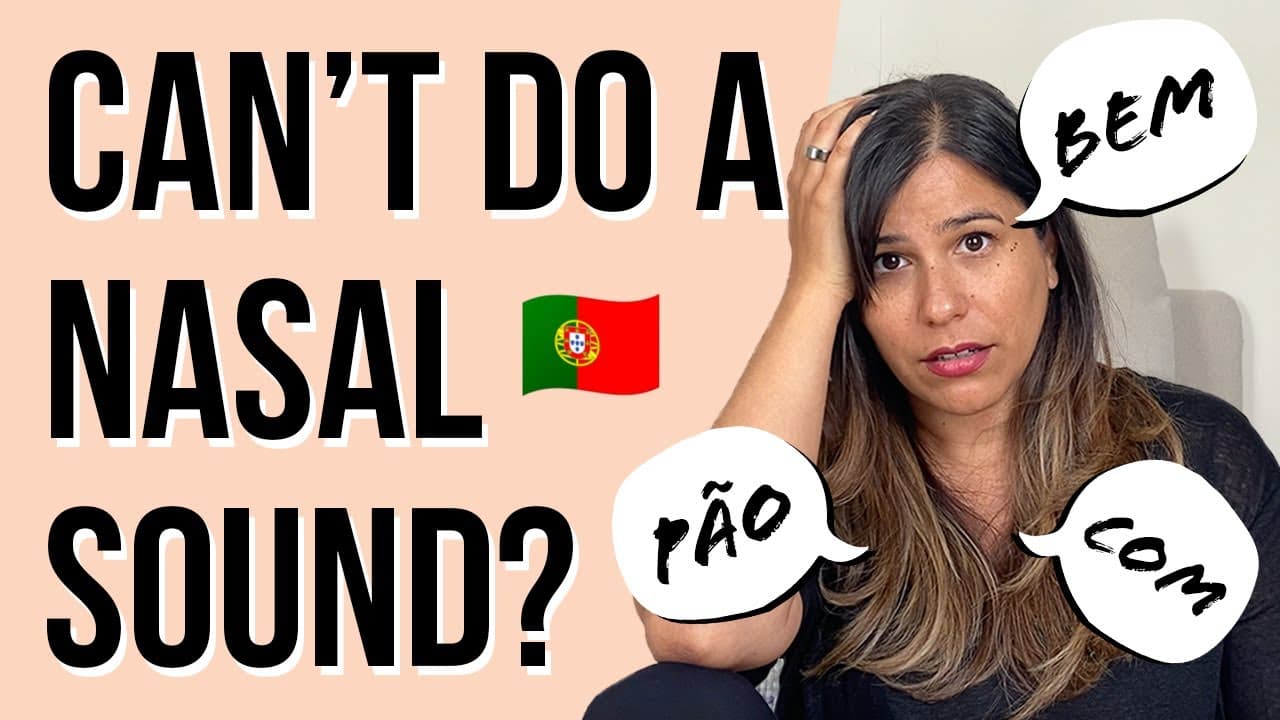
European Portuguese Nasal Sound EXPLAINED! (My Easy Hacks)
TL;DR
Learn to master Portuguese nasal sounds with easy hacks.
Transcript
if there's one sound that you need to master to speak perfect Portuguese it's the nasal sound but that can be quite difficult for us native English speakers because we don't use it in our language so it can be difficult to know how to make it and when to use it so listen up because over the next few minutes I'm going to teach you how to master ... Read More
Key Insights
- The nasal sound is crucial for speaking perfect Portuguese, especially challenging for native English speakers due to its absence in English.
- Nasal sounds in Portuguese require air to pass through both the throat and nose, unlike non-nasal vowels which use only the throat.
- Identifying nasal sounds involves looking for vowels with a tilde (~) above them, indicating nasalization.
- Words ending in 'm' or 'ns' in Portuguese often require nasalizing the preceding vowel, a common mistake for English speakers.
- A helpful tip is to think of Portuguese words ending in 'm' as ending in 'ng' in English to approximate the nasal sound.
- Screwing up the nose initially helps in producing nasal sounds, which becomes more natural with practice.
- The video offers a free one-hour lesson and a pronunciation guide to help learners master difficult Portuguese sounds.
- The content emphasizes the importance of subscribing to the channel for more free lessons and to support the creator.
Install to Summarize YouTube Videos and Get Transcripts
Explore YouTube Video Summarizer or Get YouTube Transcript Extractor
Questions & Answers
Q: Why are nasal sounds challenging for English speakers?
Nasal sounds are challenging for English speakers because they do not occur naturally in the English language. English vowels typically involve air passing only through the throat, while nasal sounds require air to pass through both the throat and nose. This unfamiliar mechanism can make it difficult for English speakers to produce and recognize nasal sounds in Portuguese.
Q: How can learners identify nasal sounds in Portuguese?
Learners can identify nasal sounds in Portuguese by looking for vowels with a tilde (~) above them. This symbol indicates that the vowel should be nasalized. Additionally, words ending in 'm' or 'ns' often require the preceding vowel to be nasalized, which is a common point of confusion for English speakers.
Q: What practical tip is offered for producing nasal sounds?
A practical tip offered for producing nasal sounds is to think of Portuguese words ending in 'm' as if they end in 'ng' in English. This mental shift helps English speakers approximate the nasal sound more accurately. The video also suggests screwing up the nose initially to help push air through the nose, making nasal sounds more natural with practice.
Q: What resources does the video offer for further learning?
The video offers several resources for further learning, including a free one-hour beginner lesson and a pronunciation guide with tips to improve European Portuguese pronunciation. These resources are designed to help learners master difficult sounds and improve their overall language skills. Links to these resources are provided in the video description.
Q: Why does the host encourage viewers to subscribe to the channel?
The host encourages viewers to subscribe to the channel because it helps her reach a wider audience with her free lessons. Subscribing is a simple and free action that supports the creator's efforts to provide valuable language learning content. Additionally, subscribers benefit from regular updates and access to new language tips and tutorials.
Q: What is the significance of nasal sounds in Portuguese pronunciation?
Nasal sounds are significant in Portuguese pronunciation because they are a defining feature of the language, essential for speaking accurately and naturally. Mastery of nasal sounds helps learners sound more like native speakers and improves their overall communication skills in Portuguese. Understanding when and how to use nasal sounds is crucial for fluency.
Q: How does the video address common mistakes English speakers make with nasal sounds?
The video addresses common mistakes by highlighting the tendency of English speakers to mispronounce words ending in 'm' or 'ns' by not nasalizing the preceding vowel. It provides clear examples and a practical tip to think of these words as ending in 'ng' to help learners adjust their pronunciation. This guidance aims to correct common errors and improve accuracy.
Q: What additional content does the host provide for language learners?
In addition to the nasal sound tutorial, the host provides various quick-fire lessons on topics like common Portuguese words, conversation tips, and verb usage. These lessons are designed to help learners sound more like locals and avoid common language pitfalls. The host also engages with learners through social media platforms, offering further support and interaction.
Summary & Key Takeaways
-
The video focuses on mastering the nasal sound in European Portuguese, crucial for accurate pronunciation. It explains that nasal sounds require air to pass through both the throat and nose, unlike non-nasal sounds. The content provides practical tips and examples for learners to practice and improve their nasal pronunciation.
-
Liz Sharma, the host, explains that nasal sounds are indicated by a tilde above vowels and often occur in words ending with 'm' or 'ns'. She offers a tip for English speakers to think of these words as ending in 'ng' to better approximate the nasal sound.
-
The video encourages viewers to subscribe for more free lessons and offers additional resources like a one-hour beginner lesson and a pronunciation guide. Liz emphasizes the importance of practice and provides links to further learning materials and social media for continued engagement.
Read in Other Languages (beta)
Share This Summary 📚
Summarize YouTube Videos and Get Video Transcripts with 1-Click
Try YouTube Summary with ChatGPT & Claude or YouTube Transcript Generator
Explore More Summaries from Talk the Streets 📚
![Learn European Portuguese Outside of Portugal! [NEW apps & TOP tips!] thumbnail](/_next/image?url=https%3A%2F%2Fi.ytimg.com%2Fvi%2F0K81C-5Z1I0%2Fhqdefault.jpg&w=750&q=75)





Summarize YouTube Videos and Get Video Transcripts with 1-Click
Try YouTube Summary with ChatGPT & Claude or YouTube Transcript Generator