What Is Jensen's Inequality and How Is It Used?
TL;DR
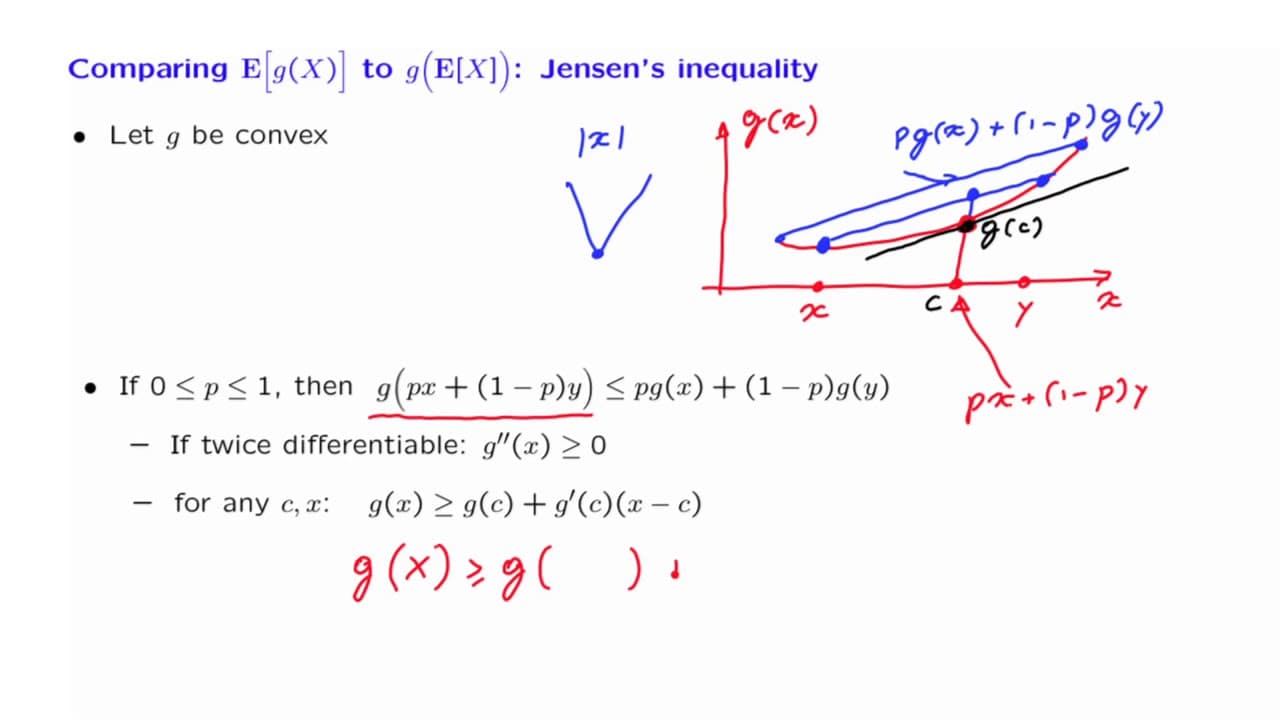
Jensen's inequality states that for a convex function, the expected value of that function is greater than or equal to the value of the function evaluated at the expected value of a random variable. Convex functions curve upwards and have non-negative second derivatives. For concave functions, the inequality reverses, providing insights on the expected value relationships.
Transcript
Let X be a random variable, and let g be a function. We know that if g is linear, then the expected value of the function is the same as that linear function of the expected value. On the other hand, we know that when g is nonlinear, in general, these two quantities will not be related. But there is a special case in which we can establish some rel... Read More
Key Insights
- 🔨 Jensen's inequality is a mathematical tool that relates the expected value of a function to the function evaluated at the expected value of a random variable.
- 📈 Convex functions tend to curve upwards and have non-negative second derivatives, while concave functions curve downwards.
- ◀️ The inequality in Jensen's inequality reverses for concave functions compared to convex functions.
- 🫥 Convexity can be defined using weighted averages, non-negative second derivatives, or the property that the function lies on top of its tangent line.
Install to Summarize YouTube Videos and Get Transcripts
Explore YouTube Video Summarizer or Get YouTube Transcript Extractor
Questions & Answers
Q: What is Jensen's inequality?
Jensen's inequality states that if a function is convex, the expected value of that function is greater than or equal to the function evaluated at the expected value of a random variable.
Q: How can we define convexity?
Convexity can be defined in multiple ways, including using weighted averages, non-negative second derivatives, or the property that the function lies on top of its tangent line.
Q: Does Jensen's inequality hold for concave functions?
Yes, Jensen's inequality holds for concave functions, but the inequality is reversed. For concave functions, the expected value of the function is less than or equal to the function evaluated at the expected value of a random variable.
Q: How can Jensen's inequality be applied to specific functions?
Jensen's inequality can be used to derive inequalities related to various functions. For example, applying it to the quadratic function confirms that the expected value of X squared is greater than or equal to the square of the expected value.
Summary & Key Takeaways
-
Jensen's inequality states that for a convex function, the expected value of the function is greater than or equal to the function evaluated at the expected value of a random variable.
-
Convexity means that a function tends to curve upwards and has non-negative second derivatives.
-
The inequality in Jensen's inequality reverses for concave functions, which have a tendency to curve downwards.
Read in Other Languages (beta)
Share This Summary 📚
Summarize YouTube Videos and Get Video Transcripts with 1-Click
Try YouTube Summary with ChatGPT & Claude or YouTube Transcript Generator
Explore More Summaries from MIT OpenCourseWare 📚



Summarize YouTube Videos and Get Video Transcripts with 1-Click
Try YouTube Summary with ChatGPT & Claude or YouTube Transcript Generator