k map Simplification | Dont care conditions | STLD | Lec-43
TL;DR
The video explains don't care conditions in K maps and their impact on logic circuit outputs.
Transcript
hi everyone in this video I'm going to tell you an interesting topic with don't care conditions in the previous video we have seen the simplification of K maps with respect to normal uh Min terms and as well as Max terms so that we have derived the P and S forms but now sometimes when you are going to operate with logical circuts in future understa... Read More
Key Insights
- 😨 Don't care conditions are essential for simplifying logic circuits, allowing flexibility in output assignments.
- 💄 Indeterminate states can significantly influence circuit behavior, making understanding these scenarios crucial for circuit effectiveness.
- 😨 The K map serves as a critical tool for visualizing and managing don't care conditions in logic design.
- 😑 Proper mapping of don't care conditions can enhance circuit efficiency while reducing the complexity of logical expressions.
- 😁 Understanding the interactions between min terms and don't care conditions is vital for optimal outcomes in circuit simplifications.
- 👥 The concept of grouping in K maps is pivotal; larger groups generally lead to cleaner and simpler circuit designs.
- 🥺 Careful consideration of don't care terms leads to practical design decisions, significantly affecting the performance of logical circuits.
Install to Summarize YouTube Videos and Get Transcripts
Explore YouTube Video Summarizer or Get YouTube Transcript Extractor
Questions & Answers
Q: What are don't care conditions in logic circuits?
Don't care conditions refer to input combinations in a logic circuit where the output can be either 0 or 1 without affecting the circuit's overall functionality. These conditions allow circuit designers to choose which value—either 0 or 1—best simplifies the design, making them important for optimizing logical expressions and K map mappings.
Q: How do don't care conditions help in simplification?
Don't care conditions provide flexibility in K map simplification by allowing certain variables to be ignored or mapped as needed. By treating these conditions strategically, designers can form larger groups on the K map, leading to simpler logical expressions and reducing the total number of gates required in a circuit.
Q: Can you provide an example of using don't care conditions?
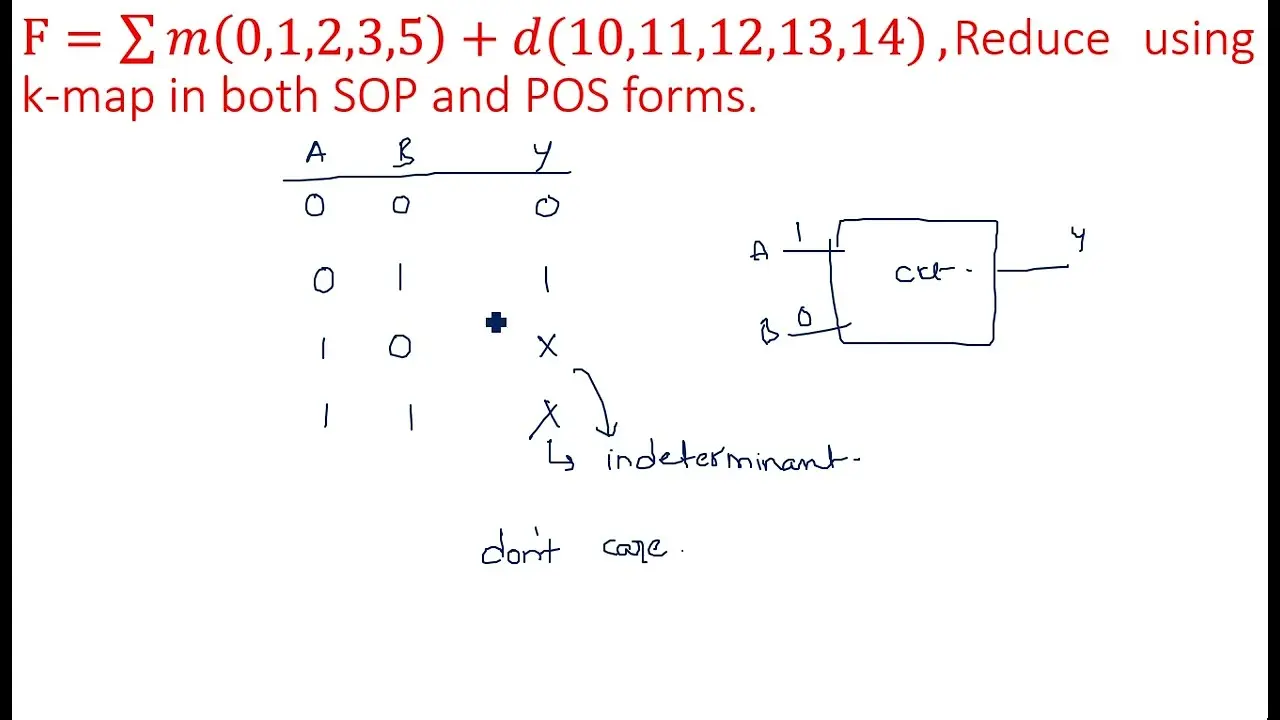
In the provided example, a circuit output derived from min terms 0, 1, 2, 3, and 5 includes don't care conditions represented by terms 10, 11, 12, 13, and 14. These terms can be mapped to the K map, providing opportunities to combine them with min terms for simpler expressions during circuit design.
Q: What are indeterminate states and how do they relate to don't care conditions?
Indeterminate states occur in logic circuits when the output isn't clearly defined as 0 or 1. These states often arise from specific input combinations and are associated with don't care conditions, allowing engineers to optimize the circuit by treating these states flexibly during K map simplification.
Q: How does the mapping of don't care conditions on a K map work?
Mapping don't care conditions on a K map involves marking them in a way that allows for effective groupings with existing min terms. While they can be crossed out when not needed, when advantageous for simplification, they can be utilized as ones or zeros, depending on the resultant benefits for the expression simplification.
Q: When should don't care conditions not be used?
Don't care conditions should not be used when they do not lead to an effective simplification or increased grouping in the K map. If mapping them does not provide an advantage, or if they stand alone without appropriate min terms to group with, it’s best to ignore them in favor of accurate representation of the logic circuit.
Summary & Key Takeaways
-
The video introduces don't care conditions in logic circuits, explaining their significance in K map simplifications for both Sum of Products (SOP) and Product of Sums (POS).
-
It discusses the concept of indeterminate states, highlighting how certain input combinations yield outputs that cannot be definitively categorized as 0 or 1.
-
Practical examples illustrate mapping don’t care conditions alongside min terms to optimize logic circuit designs, showcasing their benefits in simplifying expressions.
Read in Other Languages (beta)
Share This Summary 📚
Summarize YouTube Videos and Get Video Transcripts with 1-Click
Try YouTube Summary with ChatGPT & Claude or YouTube Transcript Generator