What Is Model Reference Adaptive Control (MRAC)? | Learning-Based Control, Part 3
TL;DR
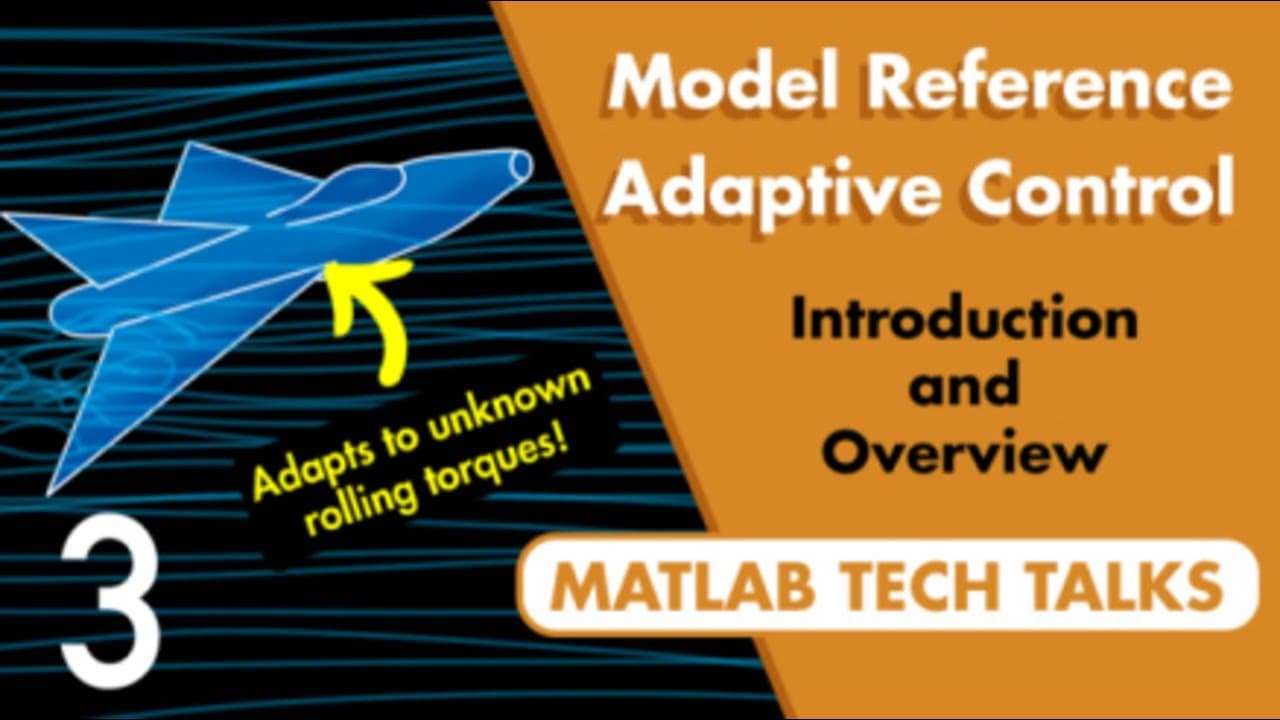
Model Reference Adaptive Control (MRAC) is an adaptive control method that adjusts the parameters of a controller in real-time to handle variations and uncertainties in the system being controlled.
Transcript
Can you design a controller that is able to handle unexpected and uncertain changes to the system that you're trying to control? In an extreme case, imagine a plane flying along happily on autopilot and then suddenly part of the wing falls off. Now, if you want autopilot to handle that, is that something you should have expected and built in some k... Read More
Key Insights
- 🛩️ Adaptive controllers can handle unexpected changes in a system, such as when part of a plane's wing falls off during autopilot.
- 🔄 Adaptive control adjusts the parameters of the controller in real time to handle variations in process dynamics, including disturbances from the environment and changes in the system itself.
- 💪 A robust controller can handle expected variations, but struggles with large and uncertain variations.
- ⚖️ Gain scheduling can be used to smoothly transition between sets of gains optimized for different system variations, but it requires prior knowledge of those variations.
- 📚 Model reference adaptive control (MRAC) is a type of adaptive controller that aims to match the behavior of a reference model, learning and adjusting parameters in real time.
- 〰️ The model matching conditions in MRAC involve solving for parameters that make the state and input matrices of the closed-loop system equal to those of the reference model.
- ❓ MRAC can learn and cancel out unmodeled dynamics (uncertainty) in the system by using a set of basis functions (features) and adaptive control weights.
- 📊 Radial basis functions, which are universal approximators, can be used as basis functions in MRAC to represent any arbitrary function, even in the absence of a nominal model.
Install to Summarize YouTube Videos and Get Transcripts
Explore YouTube Video Summarizer or Get YouTube Transcript Extractor
Questions & Answers
Q: How does Model Reference Adaptive Control (MRAC) handle uncertainties and variations in the system being controlled?
MRAC adapts the parameters of the controller in real-time to match a reference model, allowing it to handle uncertainties and variations in the system. It can learn and cancel out unmodeled dynamics, improving the performance of the closed-loop system.
Q: What is the difference between a robust controller and an adaptive controller?
A robust controller is designed to work across the entire range of expected variations, while an adaptive controller adjusts its parameters in real-time to handle unexpected changes and uncertainties in the system.
Q: How does MRAC learn and cancel out unmodeled dynamics?
MRAC uses a learning mechanism to adjust the parameters of the controller, including the weights of basis functions, to match the unknown dynamics of the system. By canceling out these unmodeled dynamics, the controller can achieve better performance.
Q: Can MRAC learn the control parameters as well as the unmodeled dynamics?
Yes, MRAC can be designed to learn both the control parameters and the unmodeled dynamics of the system. This allows the controller to optimize its performance and improve the matching between the closed-loop system and the reference model.
Q: How does the choice of basis functions affect the performance of MRAC?
The choice of basis functions determines the flexibility and accuracy of the model approximation. Using more basis functions, such as radial basis functions, can provide a better nonlinear estimate of the unmodeled dynamics and improve the overall tracking performance of the MRAC controller.
Q: What are some potential applications of MRAC?
MRAC can be applied in various fields, including aerospace, robotics, and process control, where uncertainties and variations in the system dynamics are common. It can improve the robustness and adaptability of control systems in these applications.
Q: Where can I find more information about MRAC and its mathematical foundations?
The video mentions the MIT rule and the Lyapunov rule for learning the parameters of an adaptive controller. You can find more information about these rules and other mathematical aspects of MRAC in the resources linked in the video description. Additionally, you can explore other control theory references and literature on adaptive control.
Summary & Key Takeaways
-
Adaptive controllers can handle unexpected changes and uncertainties in the system being controlled.
-
One method, called Model Reference Adaptive Control (MRAC), adapts the parameters of the controller in real-time to match a reference model.
-
MRAC can learn and cancel out unmodeled dynamics and improve the performance of the closed-loop system.
Read in Other Languages (beta)
Share This Summary 📚
Summarize YouTube Videos and Get Video Transcripts with 1-Click
Try YouTube Summary with ChatGPT & Claude or YouTube Transcript Generator
Explore More Summaries from MATLAB 📚

Summarize YouTube Videos and Get Video Transcripts with 1-Click
Try YouTube Summary with ChatGPT & Claude or YouTube Transcript Generator