L05.9 Elementary Properties of Expectation
TL;DR
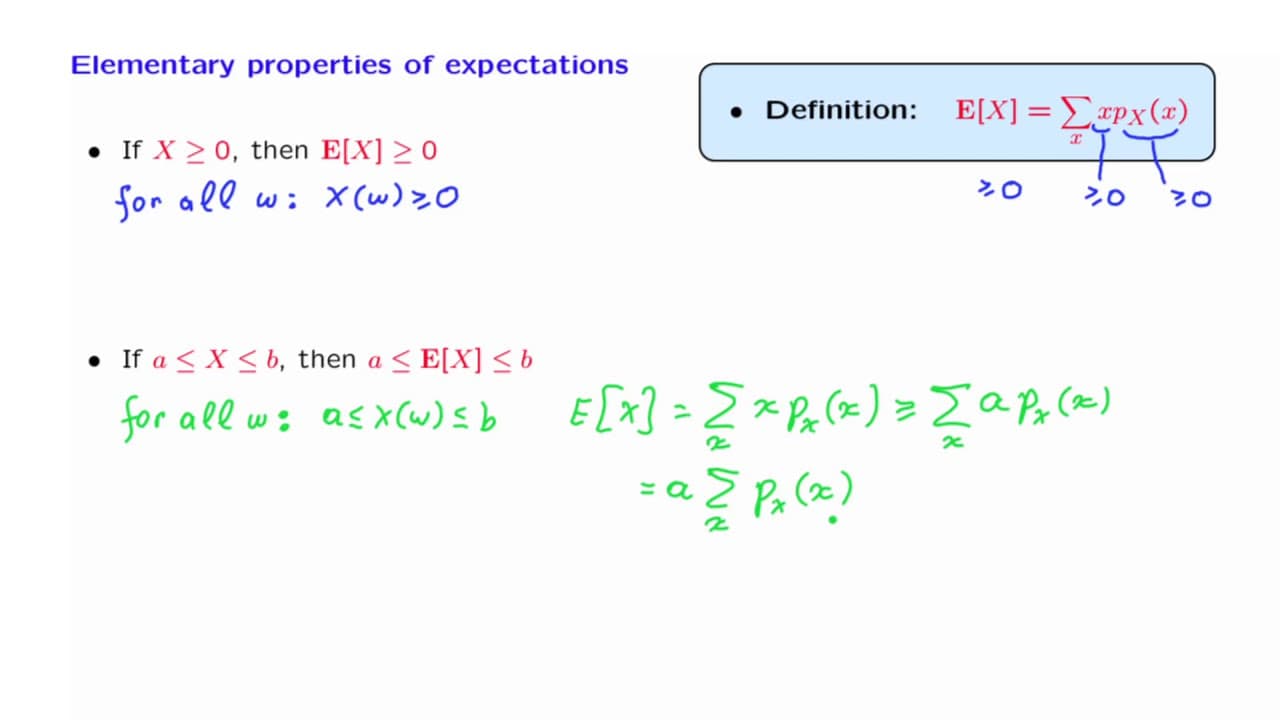
The expected value of a non-negative random variable is also non-negative, and the expected value of a random variable within a certain range is at least as large as the lower bound of the range. Additionally, the expected value of a constant is equal to the constant.
Transcript
We now note some elementary properties of expectations. These will be some properties that are extremely natural and intuitive, but even so, they are worth recording. The first property is the following. If you have a random variable which is non-negative, then its expected value is also non-negative. What does it mean that the random variable is n... Read More
Key Insights
- 🚱 Expected values of non-negative random variables and random variables within a certain range are also non-negative.
- 💐 The lower bound of a range is a lower bound for the expected value of the random variable.
- 🟰 The expected value of a constant is equal to the constant.
- 🖐️ Probability plays a crucial role in calculating expected values.
Install to Summarize YouTube Videos and Get Transcripts
Explore YouTube Video Summarizer or Get YouTube Transcript Extractor
Questions & Answers
Q: What does it mean for a random variable to be non-negative?
A random variable is non-negative when the associated numerical value of the random variable is non-negative for all possible outcomes of the experiment.
Q: How does the non-negativity of probabilities relate to the non-negativity of expected values?
Since the sum of non-negative entries (probabilities) in the calculation of an expectation, which includes all possible numerical values of the random variable, is non-negative, the expected value is also non-negative.
Q: How can we prove that the expected value of a random variable within a certain range is at least as large as the lower bound of the range?
By considering the sum over all possible values of the random variable, which are all at least as large as the lower bound, we can establish the inequality and pull out a factor of the lower bound. Additionally, the sum of the probability mass function (PMF) over all possible values of the random variable is equal to 1, allowing us to obtain the lower bound as the expected value.
Q: What does it mean to take the expected value of a constant?
A constant can be viewed as a degenerate type of random variable that can only take a single value. The expected value of a constant is obtained by multiplying the constant by the probability that the random variable takes the value of the constant, which is 1. Therefore, the expected value is equal to the constant.
Summary & Key Takeaways
-
Non-negative random variables have non-negative expected values.
-
Random variables within a certain range have expected values at least as large as the lower bound of the range.
-
The expected value of a constant is equal to the constant.
Read in Other Languages (beta)
Share This Summary 📚
Summarize YouTube Videos and Get Video Transcripts with 1-Click
Try YouTube Summary with ChatGPT & Claude or YouTube Transcript Generator
Explore More Summaries from MIT OpenCourseWare 📚



Summarize YouTube Videos and Get Video Transcripts with 1-Click
Try YouTube Summary with ChatGPT & Claude or YouTube Transcript Generator