k-map 4 variables | Examples | Part-2/2 | STLD | Lec-42
TL;DR
This video demonstrates four-variable K-map example simplifications and logic circuit design.
Transcript
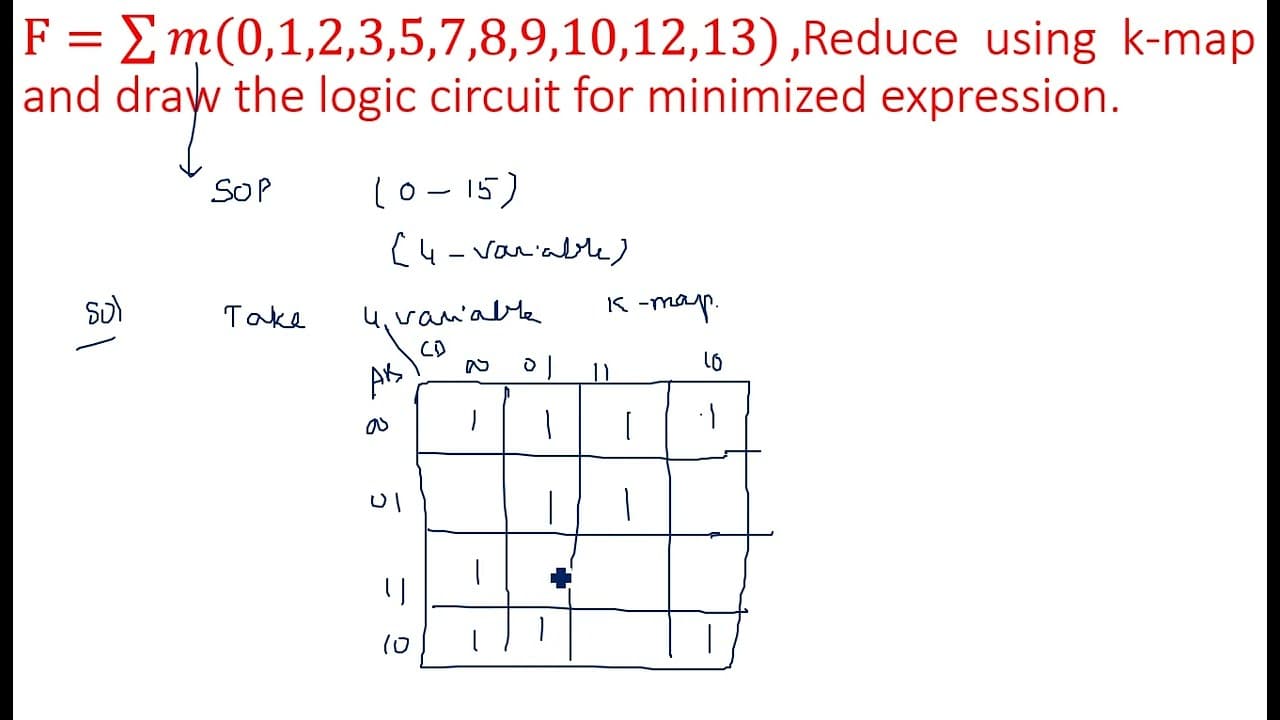
hi everyone in this video I explaining the examples of kmap four variable kmap see for example this is the expression given to you uh the expression is given in terms of minan terms 0 1 2 3 5 7 8 9 10 12 13 so now reduce this using kmap and draw the logic circuit for this minimizer expression see f is given like this and we have to see whether it i... Read More
Key Insights
- 💁 K-maps simplify Boolean expressions visually, making it easier to find minimal forms.
- 🎃 A four-variable K-map consists of 16 blocks, allowing any combination of four variables.
- ❓ Proper mapping of minterms and maxterms is crucial for identifying the correct logic configurations.
- 😉 Grouping 1's efficiently in the K-map enables minimum term reduction for circuit design.
- #️⃣ The logic expression derived from K-maps must translate into a practical circuit with the correct number of gates.
- 👌 Understanding variable representation and organization in K-maps enhances problem-solving efficiency.
- 😫 Both SOP and POS forms can be derived from the same set of minterms depending on design needs.
Install to Summarize YouTube Videos and Get Transcripts
Explore YouTube Video Summarizer or Get YouTube Transcript Extractor
Questions & Answers
Q: What is the significance of using K-maps in digital logic design?
K-maps, or Karnaugh maps, are a visual method for simplifying Boolean expressions. They allow designers to easily identify patterns and combinations of inputs that produce the output, minimizing the number of terms in the expression. This simplification directly leads to a more efficient logic circuit, reducing the number of gates required and enhancing performance.
Q: How do you determine if the expression is a sum of products or product of sums?
The type of expression is determined by its notation. If the expression is provided as a summation of minterms (like M0, M1, M2...), it indicates a sum of products (SOP). Conversely, if it lists the maxterms (like P4, P6...), it represents a product of sums (POS). It is crucial to identify this notation to apply the correct simplification approach.
Q: How do you map minterms on a K-map?
Minterms are mapped on a K-map by placing '1's in their corresponding positions. Each minterm corresponds to a unique square on the K-map. For example, if you have minterm M1, it would be mapped to the coordinates that represent that binary input in the K-map. After mapping all minterms, you look for groups of 1's to simplify the expression.
Q: How can you derive the logic circuit from a minimized Boolean expression?
To derive a logic circuit, you first need to translate the minimized Boolean expression into logic gates. Each term in the expression corresponds to a combination of AND, OR, and NOT gates. You would identify which variables are inverted (using NOT gates), then connect the outputs of these gates to an OR gate or AND gate as dictated by the expression, ultimately producing the desired output based on the logical operation.
Summary & Key Takeaways
-
The video explains how to utilize a four-variable K-map for simplifying expressions given in minterms and deriving logic circuits.
-
It details the process of identifying the necessary number of variables based on the provided minterms and determining whether to use sum of products or product of sums.
-
It illustrates the mapping of ones and zeros onto the K-map, showing how to derive minimized expressions and corresponding logic circuits consisting of basic gates.
Read in Other Languages (beta)
Share This Summary 📚
Summarize YouTube Videos and Get Video Transcripts with 1-Click
Try YouTube Summary with ChatGPT & Claude or YouTube Transcript Generator