What Is Classical Realism in International Relations?

TL;DR
Classical realism is an international relations theory that emphasizes self-interest, power, and survival in an anarchic global system. Stemming from the failures of the League of Nations and rooted in the ideas of thinkers like Thucydides, Machiavelli, and Hobbes, it posits that states operate in a self-help environment, prioritizing national interest defined primarily in terms of power.
Transcript
Hey everyone. Noah Zerbe here. This is one of a series of brief videos where we examine the mainstream theories of international relations. This video introduces classical realism. Look for other videos where we discuss classical liberalism, neorealism, and neoliberalism. So let's get started with classical realism. As an organized school of though... Read More
Key Insights
- 🚨 Realism emerged as a response to the failure of collective security mechanisms and the Cold War tensions.
- ✊ Classical realism draws from ancient philosophers like Thucydides, Machiavelli, Hobbes, and Mozi, who discussed power and self-interest in politics.
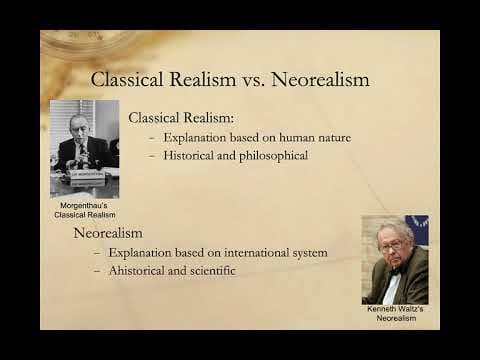
- 🌍 Hans Morgenthau's book "Politics Among Nations" laid out the six tenets of classical realism, emphasizing the state's pursuit of power and the importance of the national interest.
- 🫵 Classical realism views the international system as anarchic, making cooperation between states difficult.
- ✊ The focus on self-interest and survival highlights the importance of power in classical realism.
- 🌍 Realists believe that trust between states is limited due to the absence of a central authority in the international system.
- 👾 Power is seen as a zero-sum game in classical realism, where one state's gain implies another state's loss.
Install to Summarize YouTube Videos and Get Transcripts
Explore YouTube Video Summarizer or Get YouTube Transcript Extractor
Questions & Answers
Q: What were the historical events that led to the emergence of classical realism?
Classical realism emerged in response to the failure of the League of Nations to prevent World War II and the tensions between the US and the Soviet Union in the Cold War.
Q: Who were the influential philosophers in the development of classical realism?
Thucydides, Machiavelli, Hobbes, and Mozi are some of the influential philosophers whose works influenced classical realism.
Q: How does classical realism view human nature?
Classical realism views human nature as fundamentally self-interested, and contends that without external intervention, people will pursue their own interests, sometimes employing deception, treachery, and violence.
Q: What are the main tenets of classical realism?
The main tenets of classical realism, as outlined by Hans Morgenthau, include the view that politics is governed by objective laws rooted in human nature, the state's national interest is defined in terms of power, and abstract moral principles cannot be universally applied to politics.
Summary & Key Takeaways
-
Realism emerged as a response to the failure of the League of Nations to prevent World War II, and the tensions of the Cold War.
-
The historical roots of classical realism can be traced back to ancient Greek, Italian, and Chinese philosophers such as Thucydides, Machiavelli, Hobbes, and Mozi.
-
Hans Morgenthau's book "Politics Among Nations" is often seen as the seminal text in classical realism, outlining its six tenets and highlighting the importance of power and the state.
Read in Other Languages (beta)
Share This Summary 📚
Summarize YouTube Videos and Get Video Transcripts with 1-Click
Try YouTube Summary with ChatGPT & Claude or YouTube Transcript Generator
Explore More Summaries from Noah Zerbe 📚



Summarize YouTube Videos and Get Video Transcripts with 1-Click
Try YouTube Summary with ChatGPT & Claude or YouTube Transcript Generator