Hofstede's Model of National Cultures
TL;DR
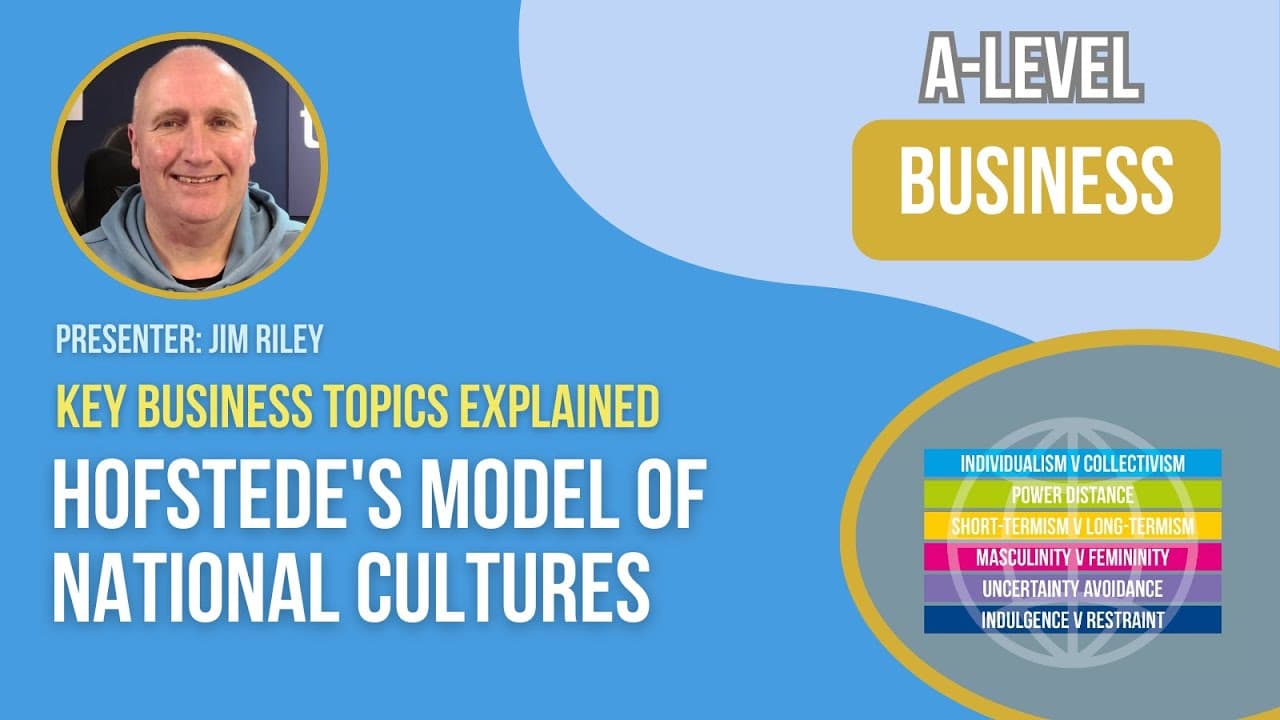
Hofstede's model categorizes national cultures into six different dimensions, including individualism versus collectivism, power distance, masculinity versus femininity, uncertainty avoidance, long-term orientation, and indulgence versus restraint.
Transcript
hi there we were looking at organizational culture it's Italy in the context of multinational businesses it's important to consider the different cultures that exist around the world and a theorist who came up with a model of this was good Hofstadter and his theory of national cultures so let's take a quick look at what his theory his model said th... Read More
Key Insights
- 🌍 Hofstede's model of national cultures: Kurt Hofstede conducted research on IBM employees worldwide and categorized national cultures into six categories.
- 💼 Individualism vs. collectivism: Some cultures value individual performance, while others prioritize teamwork, which affects how employees are rewarded.
- 🏢 Power distance: Cultures with high power distance emphasize authority and hierarchy, while those with low power distance promote flatter structures and empowerment.
- 🚹 Masculinity vs. femininity: Decision-making styles differ across cultures, with masculine styles being aggressive and data-driven, while feminine styles involve consultation and less aggression.
- 🔍 Uncertainty avoidance: Cultures vary in their attitude towards risk, with low levels of uncertainty avoidance embracing risk and change more, while high levels prefer certainty. ⏰ Long-term orientation: Some cultures focus on short-term gains, while others take a more long-term perspective, influencing reward structures and investment decisions.
- 🎉 Indulgence vs. restraint: Societies differ in their openness to gratification and self-expression, with some embracing indulgence and others being more restrained.
- 🌎 Application of the model: Understanding different cultures is crucial for multinational businesses to navigate challenges in various countries and adapt their strategies accordingly.
Install to Summarize YouTube Videos and Get Transcripts
Explore YouTube Video Summarizer or Get YouTube Transcript Extractor
Questions & Answers
Q: How did Hofstede categorize national cultures using his model?
Hofstede categorized national cultures based on six dimensions: individualism versus collectivism, power distance, masculinity versus femininity, uncertainty avoidance, long-term orientation, and indulgence versus restraint. By examining these dimensions, he aimed to understand and define the cultural differences that exist between nations.
Q: Why is it important for multinational businesses to consider cultural differences?
Multinational businesses operate in different countries with diverse cultural backgrounds. Failing to understand and consider these cultural differences can lead to miscommunication, conflicts, and inefficiencies. By recognizing and addressing cultural variations, businesses can adapt their strategies to better engage with employees and customers in different markets.
Q: How does national culture impact employee motivation and rewards in multinational businesses?
National culture influences how employees are motivated and rewarded in multinational businesses. For example, in cultures that value individualism, financial bonuses and commissions based on individual performance may be more effective. In contrast, in collectivist cultures, team-based rewards and recognition might be more appropriate to foster motivation and cooperation.
Q: How does the power distance dimension affect organizational structures in different national cultures?
The power distance dimension reflects the extent to which a culture recognizes authority and hierarchical structures. In high power distance cultures, such as those that value authority and strict hierarchies, organizations may follow a command-and-control approach. In contrast, low power distance cultures promote flatter organizational structures, delegation, and employee empowerment.
Q: How can understanding cultural differences in decision-making styles benefit multinational businesses?
Cultural differences in decision-making styles, as represented by the masculinity versus femininity dimension, can impact how decisions are made in multinational businesses. Recognizing these differences allows organizations to tailor their decision-making processes. For example, in cultures with a masculine approach, involving more consultation and hunch-based decision-making might be more effective, while feminine decision-making styles may emphasize collaboration and a less aggressive approach.
Q: How does the uncertainty avoidance dimension impact risk-taking in different national cultures?
The uncertainty avoidance dimension refers to a culture's attitude towards risk and uncertainty. Cultures with low uncertainty avoidance scores tend to embrace risk-taking and are more open to change and innovation. In contrast, high uncertainty avoidance cultures prioritize certainty and may be less inclined to take risks. Multinational businesses need to consider these cultural differences when developing strategies and managing risks in diverse markets.
Q: How can Hofstede's model be applied to investment appraisal decisions in multinational businesses?
The long-term orientation dimension in Hofstede's model relates to the perspective and time horizon of business decisions. Some cultures prioritize short-term performance and financial rewards, whereas others take a more long-term perspective. When conducting investment appraisals, multinational businesses can consider these cultural differences to align their decisions with the prevailing time horizon and expectations in each market they operate in.
Summary & Key Takeaways
-
Hofstede conducted research at IBM to identify and categorize different national cultures.
-
His model includes six dimensions, such as individualism versus collectivism, power distance, and masculinity versus femininity.
-
Understanding these cultural differences is crucial for multinational businesses to navigate and make strategic decisions.
Read in Other Languages (beta)
Share This Summary 📚
Summarize YouTube Videos and Get Video Transcripts with 1-Click
Try YouTube Summary with ChatGPT & Claude or YouTube Transcript Generator
Explore More Summaries from tutor2u 📚






Summarize YouTube Videos and Get Video Transcripts with 1-Click
Try YouTube Summary with ChatGPT & Claude or YouTube Transcript Generator