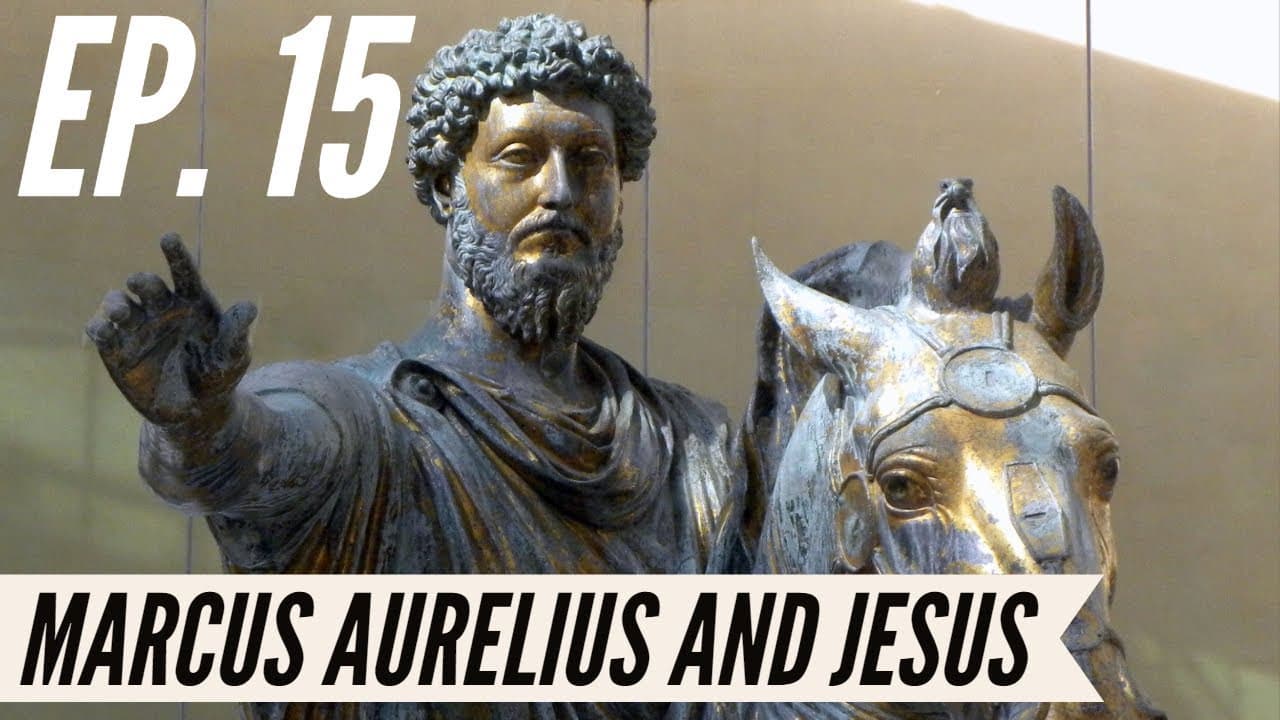
Ep. 15 - Awakening from the Meaning Crisis - Marcus Aurelius and Jesus
TL;DR
This video explores the Stoic philosophy, specifically Pro Chiron and Pro sasch, as a response to the meaning crisis, and examines the radical transformation and love offered by Jesus and Christianity.
Transcript
you welcome back to awakening from the meaning crisis so last time we finished up our look at what was going on in Buddhism and then we moved back to the west and we started to take a look at what was coming after the actual revolution and we saw that Aristotle's disciple Alexander assured in a period of turmoil and cultural anxiety a period when m... Read More
Key Insights
- ♂️ Cultivation of wisdom in the face of a meaning crisis: In times of cultural anxiety and loss, the cultivation of wisdom takes on a therapeutic dimension, with philosophers becoming the physicians of the soul. This has a direct connection to the response to the meaning crisis.
- 🏛️ Change in the notion of wisdom: Wisdom now includes a therapeutic dimension, where philosophers are tasked with hearing anxiety and providing remedies. It is about understanding oneself and learning to accept mortality instead of striving for immortality.
- 🌀 Process of identification: The Stoics emphasized the importance of recognizing and discerning the process of co-identification and how it impacts one's sense of self, identity, and agency. They advocated for bringing awareness to this process to prevent distortion and achieve self-transcendence.
- 📖 Distinguishing between the event and the meaning: The Stoics emphasized the importance of understanding that the meaning assigned to an event is not intrinsic to the event itself. By separating the event from the meaning, one can have greater control over their identity and agency.
- 🌍 Integration of ancient philosophy with cognitive science: The goal is to salvage the psycho-technologies and practices of wisdom and meaning-making from the Western tradition, integrating them with modern scientific understanding to address the meaning crisis more effectively.
- ⚡ Jesus as the ultimate Kairos: Christianity introduces the concept of Jesus as the ultimate turning point in history. He encapsulates the divine creative power of logos and represents the potential for personal transformation and metanoia.
- ❤️ Love as agape: Christianity offers a different kind of love, agape, which is not consumptive or based on reciprocity. It is a transformative love that turns non-persons into moral agent persons, bringing the possibility of belonging to the kingdom of God.
- 🏛️ Promise of Christianity: Christianity offers the potential for individuals to experience a personal Kairos through the acceptance and practice of agape love. It provides the opportunity for radical personal transformation and a new way of being in the world.
Install to Summarize YouTube Videos and Get Transcripts
Explore YouTube Video Summarizer or Get YouTube Transcript Extractor
Questions & Answers
Q: What is the core idea behind Pro Chiron and Pro sasch in Stoic philosophy?
Pro Chiron and Pro sasch in Stoic philosophy refer to the practice of paying attention to the process of meaning-making and discerning between events and their assigned meanings. This practice involves becoming aware of how meaning is created and how our identities and sense of control are shaped as a result. By honing this awareness and developing discernment, individuals can have a greater sense of agency over their own lives and ultimately achieve wisdom and self-transcendence.
Q: How does Jesus embody the principle of logos in Christianity?
In Christianity, Jesus is seen as the embodiment of the principle of logos, which refers to the creative word or intelligibility that God speaks into existence. The Gospel of John describes Jesus as the incarnation of this logos, representing the ultimate Kairos or turning point in history. Through his teachings and actions, Jesus offers a radical transformation and personal Kairos to individuals, allowing them to experience a new mind, heart, and modal way of being. This transformation is often associated with the concept of being "born again" or undergoing a metanoia, where one's salience landscape and sense of self are profoundly changed.
Q: What distinguishes agape love from eros and philia in Christianity?
In Christianity, there are three forms of love: eros, philia, and agape. Eros refers to the love that seeks to be one with something, whether it be physical, emotional, or spiritual. Philia is the love that seeks cooperation and reciprocity, often found in friendships or relationships based on shared interests or values. Agape, on the other hand, is a selfless and unconditional love that goes beyond consumption or reciprocity. It is the love that sees the value and worth in others, turning non-persons into moral agent persons. This is the love that Jesus claimed God had for all individuals and offered as a transformative force in Christianity, allowing individuals to experience a profound sense of belonging and personhood in the kingdom of God.
Summary & Key Takeaways
-
The video discusses the Stoic philosophy of Pro Chiron and Pro sasch, which involves paying attention to the process of meaning-making and distinguishing between events and their assigned meanings.
-
The Stoics focus on bringing awareness to the co-identification process and developing discernment to separate meaning from events, leading to a sense of control and the fulfillment of wisdom.
-
The video then shifts to Christianity, where Jesus is seen as a radical Kairos, embodying the principle of logos and offering a personal transformation through a love that turns non-persons into moral agent persons.
Read in Other Languages (beta)
Share This Summary 📚
Summarize YouTube Videos and Get Video Transcripts with 1-Click
Try YouTube Summary with ChatGPT & Claude or YouTube Transcript Generator
Explore More Summaries from John Vervaeke 📚




Summarize YouTube Videos and Get Video Transcripts with 1-Click
Try YouTube Summary with ChatGPT & Claude or YouTube Transcript Generator