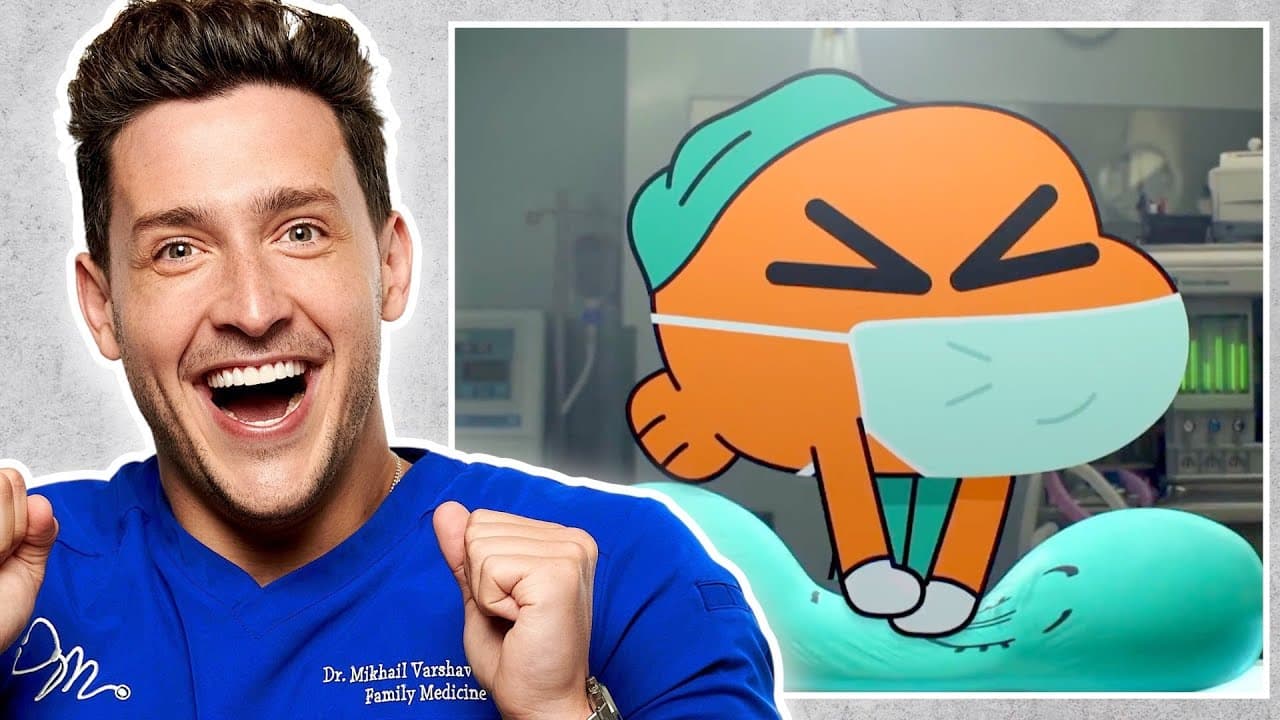
Doctor Reacts To Cartoon Network Medical Scenes
TL;DR
Doctor Mike finds that Cartoon Network medical scenes mix recognizable concepts with exaggerated or inaccurate portrayals. He explains that chickenpox is caused by varicella, radiation exposure can cause severe burns rather than make people transparent, and growing abnormalities should be investigated as possible signs of cancer. Read on for his specific explanations of infections, tumors, parasites, surgery, and cartoon medicine.
Transcript
- Nickelodeon, "South Park", "Simpsons", "Family Guy". We watched a lot of cartoons for their medical accuracy, but now we're about to watch Cartoon Network. Let's get started. Peewoop. - [Dexter] What are these strange protrusions? - Those protrusions might be chickenpox caused by the virus, varicella. Oh, and they're itchy. That looks like chicke... Read More
Key Insights
- "Those protrusions might be chickenpox caused by the virus, varicella." (0:13)
- "Because chickenpox in adulthood is much worse than it is when you're a child." (1:17)
- "They might get really bad burns, but they don't become see-through." (2:46)
- "A parasitic relationship means that the thing that attaches to the host ends up harming the host for its own benefit." (4:02)
- "Actually, family members shouldn't operate on one another." (5:21)
Install to Summarize YouTube Videos and Get Transcripts
Explore YouTube Video Summarizer or Get YouTube Transcript Extractor
Questions & Answers
Q: What causes chickenpox, and why should you avoid scratching it?
Chickenpox is caused by the varicella virus and produces itchy protrusions. Scratching can create a bacterial infection on top of the chickenpox.
Q: What were chickenpox parties?
Chickenpox parties involved gathering children in a room with a child who had chickenpox so they would all contract it at the same time. The stated reasoning was that chickenpox is much worse in adulthood than in childhood.
Q: Does radiation make people appear see-through?
No. The X-ray-like transparency shown during cartoon radiation scenes is not how radiation works. People exposed to acute radiation poisoning may suffer very bad burns, but they do not become see-through.
Q: What is a teratoma?
A teratoma is described as a tumor containing multiple different cell lines. When teratomas are opened, they may contain hair, teeth, and other unusual pieces, and some people describe one as resembling a retained twin.
Q: When should an abnormal growth be investigated?
Unusual abnormal growths on the human body should be investigated. Growth indicates cellular division, which could be a sign of cancer, although the doctor emphasizes that not every growth is cancer.
Q: What is the difference between parasitic and symbiotic relationships?
In a parasitic relationship, the attached organism harms the host for its own benefit. In a symbiotic relationship, it helps both the host and itself.
Q: How can intestinal worms be treated?
Intestinal worms can consume food inside the body and grow to massive lengths. The doctor says medications can poison them and make them fall out of the body.
Q: Should family members operate on one another?
The doctor says family members should not perform operations on one another. Emotional involvement could cause them to make bad decisions.
Summary & Key Takeaways
-
The analysis explores various Cartoon Network shows, highlighting their comedic yet flawed representations of medical conditions like chickenpox and surgery.
-
It emphasizes how certain medical concepts, such as the treatment of cancer and vaccines, are portrayed in a fun yet misleading manner, potentially confusing young audiences.
-
The discussion includes the creators' humorous takes on medical terminologies and situations, demonstrating both the entertainment value and informative potential of animated media.
Read in Other Languages (beta)
Share This Summary 📚
Summarize YouTube Videos and Get Video Transcripts with 1-Click
Try YouTube Summary with ChatGPT & Claude or YouTube Transcript Generator
Explore More Summaries from Doctor Mike 📚



Summarize YouTube Videos and Get Video Transcripts with 1-Click
Try YouTube Summary with ChatGPT & Claude or YouTube Transcript Generator