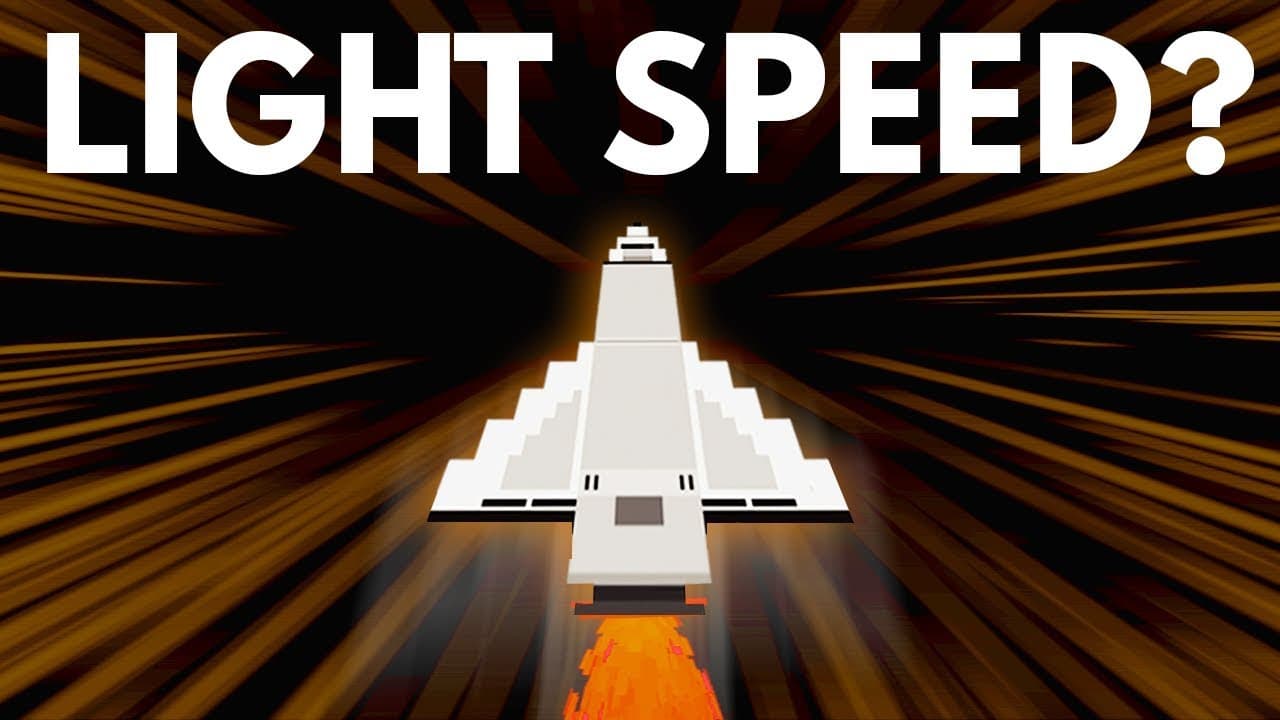
What If You Traveled Faster Than The Speed Of Light?
TL;DR
Light travels fastest in a vacuum but can be slowed in different mediums; traveling at light speed could have complex consequences.
Transcript
hey there welcome to life noggin just the other day I was having an intense debate with triangle Bob on the speed of light I was so ready to drop some knowledge on him but triangle Bob did what he does best and ran away because he knows he was wrong he didn't go faster than the speed of light but is that actually possible what would even happen, bu... Read More
Key Insights
- 🙂 Light travels at its maximum speed in a vacuum, but can be slowed in different mediums.
- 🙂 Cherenkov radiation occurs when particles exceed the speed of light in specific environments.
- 🙂 Researchers have successfully slowed down light in free space by manipulating photons' spatial structure.
- 🙂 Traveling at light speed could lead to unique challenges such as time dilation and fuel depletion.
- 🙂 Despite complications, light speed travel could offer advantages like quicker interstellar colonization.
- 🙂 Trips at light speed could redefine space exploration, potentially reaching distant planets like Trappist-1.
- ⚡ Light speed travel raises philosophical questions about aging, time perception, and human exploration.
Install to Summarize YouTube Videos and Get Transcripts
Explore YouTube Video Summarizer or Get YouTube Transcript Extractor
Questions & Answers
Q: What is light composed of, and how fast does it travel in a vacuum?
Light consists of particles called photons and travels at a speed of about 300,000 km/s in a vacuum, making it the fastest known entity in the universe.
Q: Can particles travel faster than light, and in what medium does this phenomenon occur?
In certain mediums like water and glass, particles can move faster than light, resulting in phenomena like Cherenkov radiation, seen as a bluish white glow in nuclear reactor surroundings.
Q: How did researchers in Scotland manage to slow the speed of light in free space?
Researchers in Scotland slowed light moving through free space by applying a mask to an optical beam, giving photons a spatial structure that reduced their speed, indicating the potential for groundbreaking discoveries.
Q: What are the potential complications and benefits of traveling at the speed of light?
Complications include rapid fuel consumption and potential hazards like space debris, while benefits include faster interplanetary travel, enabling possibilities like colonizing Mars or Trappist-1 within a human lifetime.
Summary & Key Takeaways
-
Light is electromagnetic radiation that travels at 300,000 km/s in a vacuum, faster than any other particle.
-
In mediums like water and glass, light can be slowed down, allowing some particles to surpass its speed.
-
Potential consequences of traveling at light speed include time dilation, fuel limitations, and space debris hazards.
Read in Other Languages (beta)
Share This Summary 📚
Summarize YouTube Videos and Get Video Transcripts with 1-Click
Try YouTube Summary with ChatGPT & Claude or YouTube Transcript Generator
Explore More Summaries from Life Noggin 📚


Summarize YouTube Videos and Get Video Transcripts with 1-Click
Try YouTube Summary with ChatGPT & Claude or YouTube Transcript Generator