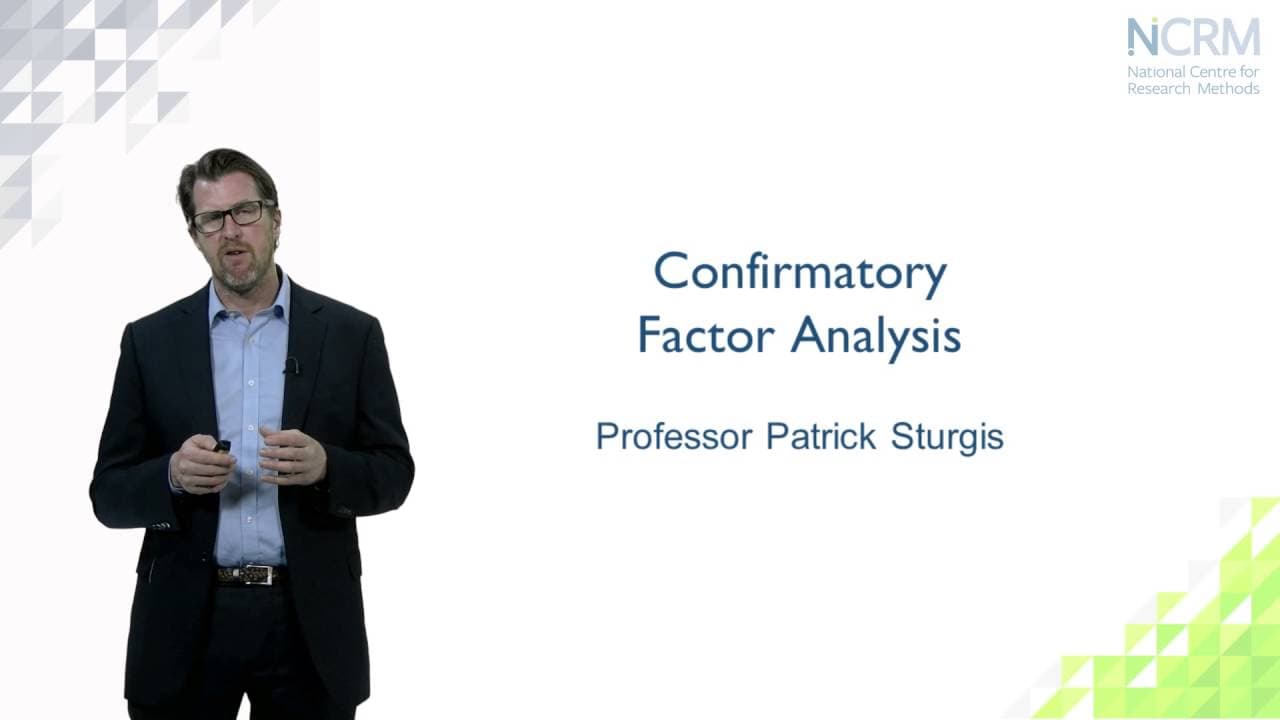
Confirmatory Factor Analysis; Patrick Sturgis (part 3 of 6)
TL;DR
Explore the use of latent variables to measure concepts in confirmatory factor analysis and the differences between exploratory and confirmatory factor analysis.
Transcript
in the first two videos on structural equation models I've covered some of the sort of conceptual background the history some of the key ideas in this video we move to understanding some of the applications some of the actual model fitting that goes on in structural equation modeling and this focuses particularly on confirmatory factor analysis so ... Read More
Key Insights
- 📙 Measurement and modeling: This video discusses the use of latent variables in measuring concepts and contrasts exploratory factor analysis with confirmatory factor analysis.
- 📔 Exploratory factor analysis: Exploratory factor analysis is a historical approach to estimating latent variables, which allows for a reordering of observed data to best account for observed correlations between variables.
- 🔁 Item rotation: Exploratory factor analysis allows for the rotation of axes to better understand the underlying structure of the factors.
- ⚖️ Constrained vs. unrestricted factor models: Confirmatory factor analysis, unlike exploratory factor analysis, places restrictions on the parameters of the model and does not allow for rotation. It specifies the measurement model before looking at the data.
- 📐 Estimating latent means: Confirmatory factor analysis can estimate latent means, which is useful for comparing groups or studying change over time.
- 🔗 Reflective vs. formative indicators: The direction of the causal relationship between latent variables and indicators determines whether the indicators are reflective (caused by the latent variable) or formative (causing the latent variable).
- 📏 Fixing metric: The metric of latent variables can be fixed by setting the variance of the latent variable to one or fixing one of the factor loadings to one, allowing the latent variable to have the same scale as the reference item.
- 📦 Item parceling: Item parceling is a technique used when there are a large number of indicators and latent variables, where subsets of indicators are combined into parcels and used as observed indicators for the latent variables.
- ⬆️ Higher-order factor models: Higher-order factor models involve a hierarchical structure, where a higher-order factor is measured by lower-level latent variables, often used to analyze dimensional structures in psychology and other fields.
Install to Summarize YouTube Videos and Get Transcripts
Explore YouTube Video Summarizer or Get YouTube Transcript Extractor
Questions & Answers
Q: What is the difference between exploratory factor analysis (EFA) and confirmatory factor analysis (CFA)?
The main difference is that in EFA, the relationships between observed variables are reordered to identify underlying factors, while in CFA, a measurement model is specified beforehand based on theoretical assumptions and constraints.
Q: How are latent variables used to measure concepts in CFA?
Latent variables in CFA are used as underlying constructs to explain the relationships between observed indicators. The latent variables cause the observed indicators and represent the unobserved aspects of the measured concepts.
Q: What are some limitations of exploratory factor analysis?
EFA relies on subjective judgment and heuristic rules to determine the number of factors to retain and the amount of variance explained. Additionally, EFA is an inductive procedure, which may not align with the preference for theory-driven analysis in quantitative social science.
Q: How does CFA handle the metric or scale of latent variables?
In CFA, the metric or scale of latent variables can be established by fixing the factor loading of one indicator to a specific value, usually 1. This allows for the interpretation of the latent variable on the same scale as the specific indicator.
Q: What is the main focus of CFA in terms of the relationships between variables?
The main focus of CFA is on the relationships between latent variables and their measured indicators. CFA is primarily concerned with assessing the fit of a theory-driven measurement model to the data and examining the associations between latent variables.
Q: When would researchers be interested in estimating latent means in CFA?
Researchers may be interested in estimating latent means in CFA when they want to compare group differences or analyze changes over time. Estimating latent means allows for the examination of mean differences or changes in the underlying constructs measured by the latent variables.
Q: What is the difference between formative indicators and reflective indicators in CFA?
In CFA, reflective indicators are indicators that are caused by the latent variable, while formative indicators are indicators that cause the latent variable. Reflective indicators align with the traditional approach, while formative indicators are used in cases where the causality flows from the observed indicators to the latent variable.
Q: How can item parceling be used to simplify analysis in CFA when there are a large number of indicators?
Item parceling is a technique used in CFA when there are a large number of indicators. It involves grouping subsets of indicators together to create parcels, which are then treated as observed indicators for the latent variables. This approach helps simplify the analysis and reduce the complexity of the model.
Summary & Key Takeaways
-
Confirmatory factor analysis (CFA) is a method in structural equation modeling (SEM) used to measure concepts using latent variables.
-
CFA contrasts with exploratory factor analysis (EFA), where the relationships between observed variables are reordered to identify underlying factors.
-
CFA involves specifying a measurement model before examining the data, allowing for testing of theoretical assumptions and constraints.
Questions:
-
What is the difference between exploratory factor analysis (EFA) and confirmatory factor analysis (CFA)?
-
How are latent variables used to measure concepts in CFA?
-
What are some limitations of exploratory factor analysis?
-
How does CFA handle the metric or scale of latent variables?
-
What is the main focus of CFA in terms of the relationships between variables?
-
When would researchers be interested in estimating latent means in CFA?
-
What is the difference between formative indicators and reflective indicators in CFA?
-
How can item parceling be used to simplify analysis in CFA when there are a large number of indicators?
Answers:
Q: What is the difference between exploratory factor analysis (EFA) and confirmatory factor analysis (CFA)?
The main difference is that in EFA, the relationships between observed variables are reordered to identify underlying factors, while in CFA, a measurement model is specified beforehand based on theoretical assumptions and constraints.
Read in Other Languages (beta)
Share This Summary 📚
Summarize YouTube Videos and Get Video Transcripts with 1-Click
Try YouTube Summary with ChatGPT & Claude or YouTube Transcript Generator
Explore More Summaries from National Centre for Research Methods (NCRM) 📚

Summarize YouTube Videos and Get Video Transcripts with 1-Click
Try YouTube Summary with ChatGPT & Claude or YouTube Transcript Generator