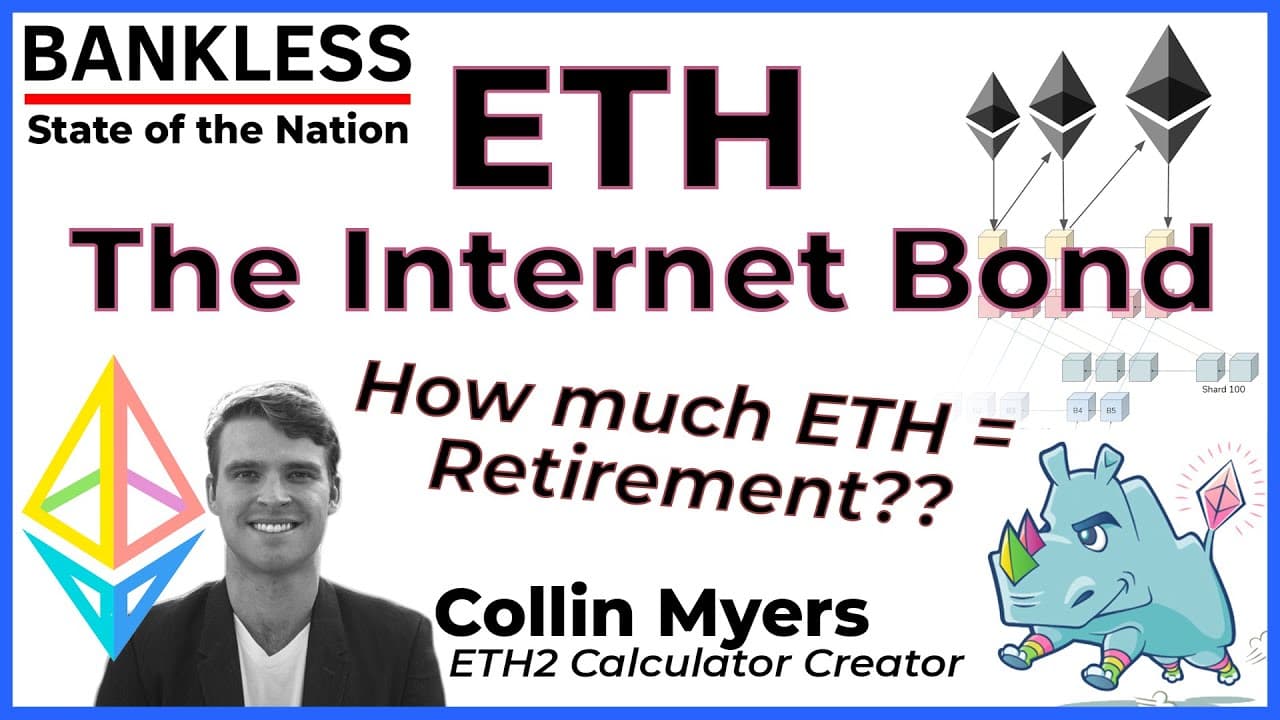
SotN#22: BONDING! w/ Collin Myers (ETH Internet Bond Market, Staking Returns, ETH Needed to Retire?)
TL;DR
Ethereum 2.0 introduces staking as a way to earn passive income with ETH, similar to traditional bond markets but with unique properties and benefits.
Transcript
if you want to live a bankless life you need to get a hardware wallet there is no alternative for storing your crypto in a self-sovereign fashion that's why i have four ledgers that i use to manage my different crypto assets using the ledger live account as well ledger live is like your home base for managing your ethereum defy and crypto accounts ... Read More
Key Insights
- 🔑 The Ledger hardware wallet is recommended for storing crypto assets in a self-sovereign manner, ensuring control and security over your funds.
- 🌐 Ledger Live is a user-friendly platform that allows you to manage your different crypto wallets, including Ethereum DeFi accounts, in one place.
- 💱 Ledger Live enables users to perform various financial activities, such as buying, selling, lending, swapping and staking crypto assets, fulfilling the money verbs of the Bankless skill cube.
- 🔄 Ledger Swap feature allows users to directly swap assets within the Ledger Live application, ensuring trustlessness in financial activities on Ethereum and Bitcoin.
- 💡 The Ledger website provides advanced knowledge about the capabilities of Ledger hardware wallets, helping users explore more possibilities for self-sovereign management of their assets.
- 🔐 Owning a Ledger hardware wallet allows users to maintain full control over their assets, ensuring self-sovereignty and eliminating reliance on third parties.
- 🌐 Wiring is a decentralized finance (DeFi) project that seeks out yield in different ways, including through vaults and the earn system, providing opportunities for users to earn yield on their stablecoins.
- 🌍 State of the Nation Episode 22 highlights the emergence of Ethereum as an internet bond and the potential for institutional investors to understand and participate in this new financial product. It also discusses the potential for staking in Ethereum 2.0 to provide a passive income source.
- 📈 The growth of the bond market, both traditional and digital, highlights the importance of debt in fueling global economic growth and provides opportunities for investors.
- 💰 Ethereum 2.0's internet bond, combined with the high level of interest from institutional investors, could enable the Ethereum network to reach new financial milestones and potentially challenge traditional bond markets.
- 🔗 The introduction of Ethereum 2.0 staking and the potential for a risk-free rate within the network creates new opportunities for investors to earn passive income and participate in a decentralized financial ecosystem.
- 📊 The ETH2 Calculator developed by Colin Myers and the ConsenSys Codify team provides insights into the potential annual profits for staking ETH, based on various variables such as the number of validators, hardware requirements, and the total amount of ETH staked.
- 🏦 The yields from ETH 2.0 staking can provide a more attractive passive income compared to traditional bonds, offering an annualized return of 12.43% in a base case scenario.
- 💡 Traditional bond investors may begin to understand and participate in the Ethereum 2.0 internet bond market as they see the potential for higher yields and a self-sovereign financial ecosystem.
- 🛠️ The ETH2 Calculator offers flexibility for users to adjust variables and explore different scenarios to understand their potential earnings from ETH 2.0 staking.
- ⚠️ It's important to consider that the ETH2 Calculator projections are based on current assumptions and may change over time due to factors such as network growth, stake rewards, and market conditions.
Install to Summarize YouTube Videos and Get Transcripts
Explore YouTube Video Summarizer or Get YouTube Transcript Extractor
Questions & Answers
Q: How does staking in Ethereum 2.0 compare to traditional bond markets?
Staking in Ethereum 2.0 is similar to traditional bond markets, as it involves earning passive income by investing capital. However, it offers unique properties such as perpetual nature and decentralized governance that traditional bonds lack. Additionally, staking eliminates counterparty risk, as funds are secured within the Ethereum network itself.
Q: How does the Ethereum 2.0 calculator estimate potential earnings from staking?
The Ethereum 2.0 calculator takes into account variables such as ETH price, total ETH at stake, uptime, and hardware costs. It provides an estimate of potential earnings based on the network's state and reward structure. However, actual earnings may vary as variables change over time.
Q: What are the benefits of staking in Ethereum 2.0 compared to other investment options?
Staking in Ethereum 2.0 offers several advantages over traditional investments. It provides a source of passive income denominated in a self-sovereign currency (ETH). It also eliminates intermediaries, ensuring that users have full control over their assets. Moreover, staking in Ethereum 2.0 allows you to participate in the growth of the network and contribute to its security.
Q: Can staking in Ethereum 2.0 be a reliable source of income for retirement?
Staking in Ethereum 2.0 has the potential to generate a reliable passive income, but it is dependent on various factors. These include the amount of ETH staked, network state, and reward structure. While it can be a promising source of retirement income, it is essential to consider the risks and uncertainties associated with cryptocurrency investments.
Q: How does staking in Ethereum 2.0 compare to other DeFi opportunities for earning yield?
Staking in Ethereum 2.0 offers a unique opportunity for earning yield by securing the network. Unlike some DeFi opportunities, there is no counterparty risk involved, as funds are locked within the protocol itself. However, it is important to consider other DeFi options as well, such as lending or liquidity pools, which may offer higher yield potential but come with their own risk profiles.
Q: How does Ethereum staking compare to traditional bond markets in terms of liquidity?
Initially, during the earlier phases of Ethereum 2.0, staking liquidity may be limited. However, as the network matures, it is expected to become more liquid. Traditional bond markets generally offer higher liquidity, but Ethereum staking provides the advantage of self-sovereignty, as users have direct control over their assets without relying on intermediaries.
Q: Can Ethereum staking be considered a risk-free investment?
While staking in Ethereum 2.0 offers inherent security as it is based on the protocol itself, it is important to note that no investment is entirely risk-free. Ethereum staking carries risks such as market volatility, technical vulnerabilities, and regulatory changes. However, compared to traditional investment options, it eliminates counterparty risk and adds a layer of decentralization to the investment process.
Summary & Key Takeaways
-
Ethereum 2.0 introduces staking as a way to earn passive income with ETH.
-
Staking can be seen as similar to traditional bond markets, but with unique properties and benefits.
-
The internet bond model explores the perpetual nature of participating in ETH 2.0 and how it differs from traditional bonds.
-
The calculator helps estimate the potential earnings from staking based on various factors and variables.
Read in Other Languages (beta)
Share This Summary 📚
Summarize YouTube Videos and Get Video Transcripts with 1-Click
Try YouTube Summary with ChatGPT & Claude or YouTube Transcript Generator
Explore More Summaries from Bankless 📚






Summarize YouTube Videos and Get Video Transcripts with 1-Click
Try YouTube Summary with ChatGPT & Claude or YouTube Transcript Generator