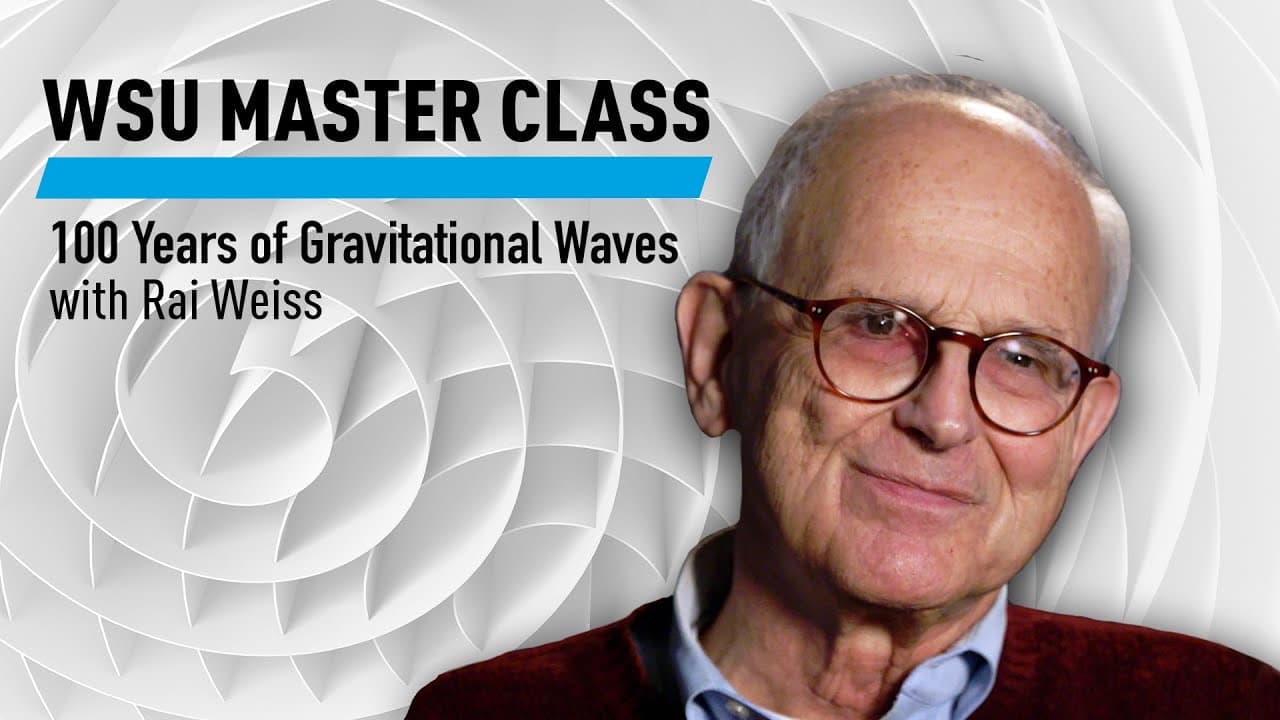
WSU: 100 Years of Gravitational Waves with Rai Weiss
TL;DR
Gravitational waves, first predicted by Albert Einstein, are deformations in space caused by the movement of massive objects. This comprehensive analysis explores the history, technology, and future of gravitational wave detection.
Transcript
hi i'm ray weiss and thank you for having me let me start by saying the following uh the i'm going to give you the outline of my talk is fundamentally that i'm going to say a little bit about the history of this field because it's not known that well i mean gravitational waves themselves have had a very complex history and i'll describe some of tha... Read More
Key Insights
- 👾 Gravitational waves were first predicted by Einstein in 1916 and involve the deformation of space caused by accelerated masses.
- 👋 The detection of gravitational waves requires highly sensitive technology, such as interferometers, to measure extremely small changes in distance.
Install to Summarize YouTube Videos and Get Transcripts
Explore YouTube Video Summarizer or Get YouTube Transcript Extractor
Questions & Answers
Q: What is the difference between Newtonian gravity and Einstein's theory of gravity?
Newtonian gravity is based on the idea of a force between masses, whereas Einstein's theory states that mass deforms space, causing objects to move. Einstein's theory also incorporates the finite speed of light and the idea of gravitational waves.
Q: How do scientists detect gravitational waves?
Scientists use interferometers, such as the ones in LIGO and VIRGO, to measure small changes in distance caused by gravitational waves. By comparing the signals from multiple detectors, they can confirm the detection of gravitational waves.
Q: What are the implications of detecting gravitational waves?
The detection of gravitational waves confirms a major prediction of Einstein's theory of relativity and opens up a new field of study in astronomy. Gravitational waves can provide insight into the behavior of massive objects in the universe, such as black holes and neutron stars.
Q: Are there any limitations to detecting gravitational waves?
One limitation is the sensitivity of the detectors, as gravitational waves can be very faint and difficult to distinguish from background noise. Additionally, the current network of detectors is limited to specific regions of the sky, and finding the exact location of a gravitational wave source can be challenging.
Summary & Key Takeaways
-
Gravitational waves were first theorized by Albert Einstein in 1916 and involve the deformation of space caused by the movement of accelerated masses.
-
The detection of gravitational waves requires highly sensitive technology, such as interferometers, to measure extremely small changes in distance caused by the waves.
-
The recent detection of gravitational waves from the collision of two black holes has provided confirmation of Einstein's theory and opened up new possibilities for studying the universe.
Read in Other Languages (beta)
Share This Summary 📚
Summarize YouTube Videos and Get Video Transcripts with 1-Click
Try YouTube Summary with ChatGPT & Claude or YouTube Transcript Generator
Explore More Summaries from World Science Festival 📚



Summarize YouTube Videos and Get Video Transcripts with 1-Click
Try YouTube Summary with ChatGPT & Claude or YouTube Transcript Generator