How to Train a Pose Recognition Model with PoseNet and ML5.js
TL;DR
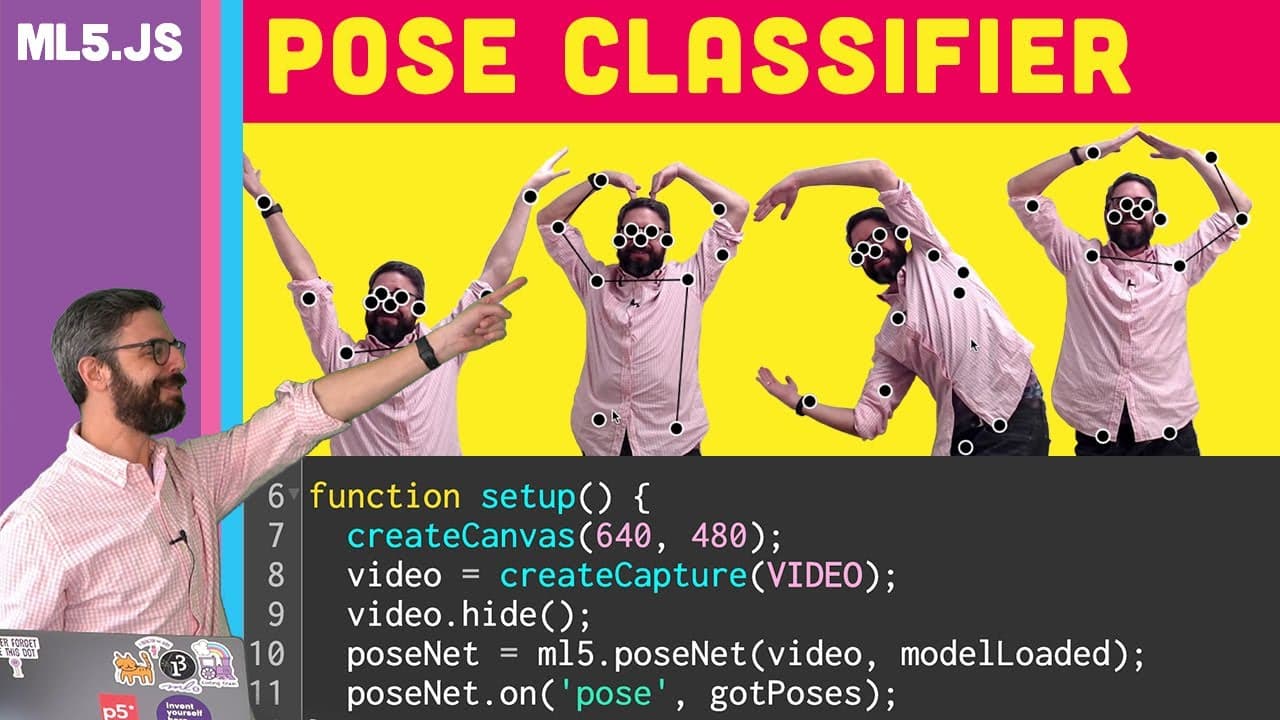
To train a pose recognition model using PoseNet and ML5.js, first collect pose data by capturing keypoint coordinates from user movements. Normalize this data for effective training, then use an ML5 neural network to classify poses. Finally, implement a deployment routine that continuously classifies poses in real-time, improving accuracy by applying confidence thresholds.
Transcript
[WHISTLE] Hello. And welcome to another video using Posenet and ML5.js. But in this video, what I'm going to do is take the output of the Posenet pre-trained model, and feed that into an ML5 neural network to train, oppose classifier, to recognize when I'm making certain motions like a y, and m, a c, and an a. Before I begin coding, let me quickly ... Read More
Key Insights
- ⌛ Utilizing PoseNet with ML5.js enables real-time pose classification through a personalized neural network.
- ❓ Effective data collection, normalization, training, and deployment are essential steps in creating a functional pose recognition system.
- 👤 Mirroring images enhances interaction by providing users with a more intuitive visual feedback mechanism.
- 😫 Setting confidence thresholds can improve model accuracy by filtering out uncertain predictions.
Install to Summarize YouTube Videos and Get Transcripts
Explore YouTube Video Summarizer or Get YouTube Transcript Extractor
Questions & Answers
Q: How does mirroring the image enhance interactivity in the pose classification process?
Mirroring the image makes it more intuitive and natural for the user to see themselves reflected on screen, aiding in better interaction with the pose classification model.
Q: What is the significance of normalization in the data during the classification process?
Normalization ensures that the data inputted for classification falls within a standard range, allowing consistent and accurate predictions from the neural network model.
Q: How can the classification process be improved by setting a confidence threshold?
Setting a confidence threshold filters out noisy or uncertain predictions, improving the accuracy of pose classification by only updating the label when the model is highly confident.
Q: What future possibilities are suggested for expanding on this pose classification tutorial?
Future possibilities include exploring regression models for color output based on poses, enhancing and refining the pose classification accuracy, and experimenting with different pose labels and movements for diverse applications.
Summary & Key Takeaways
-
Tutorial showcasing using PoseNet with ML5.js to train a neural network for pose recognition.
-
Demonstrates mirroring images for intuitive interaction.
-
Discusses normalization, data collection, model training, and deployment for real-time classification.
Read in Other Languages (beta)
Share This Summary 📚
Summarize YouTube Videos and Get Video Transcripts with 1-Click
Try YouTube Summary with ChatGPT & Claude or YouTube Transcript Generator
Explore More Summaries from The Coding Train 📚



Summarize YouTube Videos and Get Video Transcripts with 1-Click
Try YouTube Summary with ChatGPT & Claude or YouTube Transcript Generator