Improving Tesla Autopilot with Neuroevolution | Risto Miikkulainen and Lex Fridman
TL;DR
Evolutionary computation and neural evolution can improve the performance of multi-task networks by combining the wisdom gained from multiple tasks into the internal representations.
Transcript
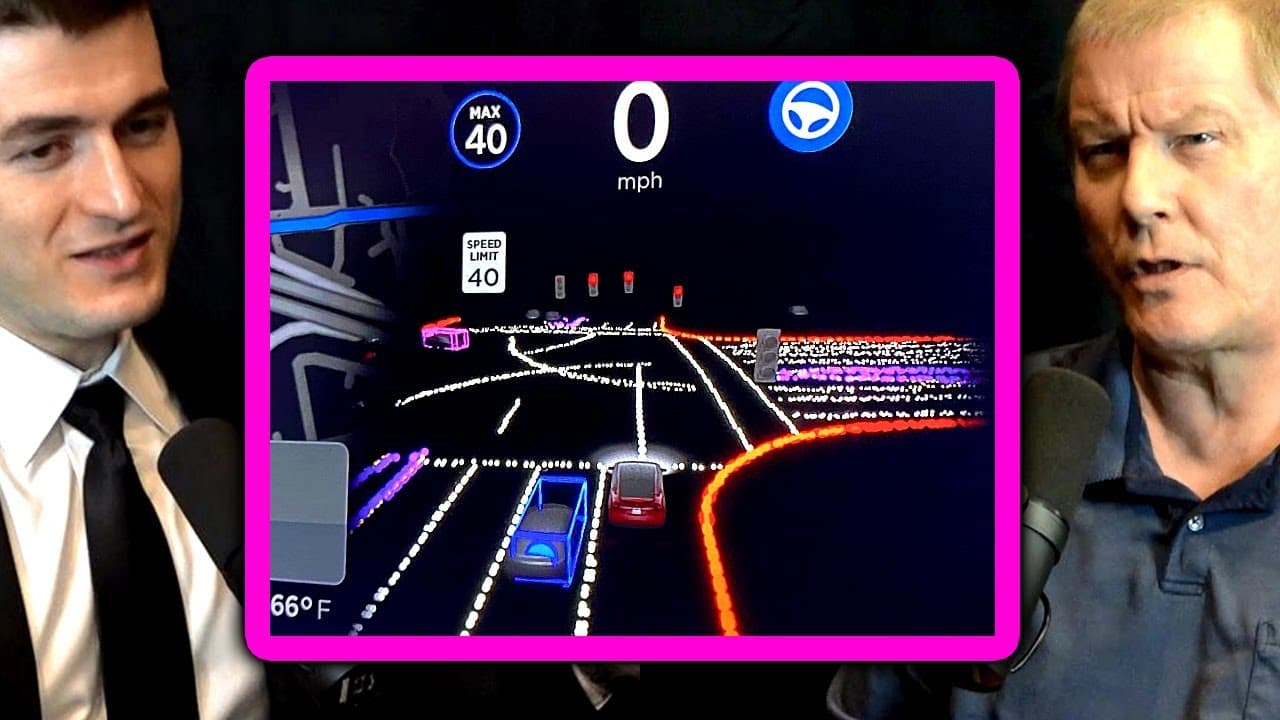
first of all it's fascinating to think about this context uh in terms of uh evolving architectures so i've studied tesla autopilot for a long time it's one particular implementation of an ai system that's operating in the real world i find it fascinating because of the scale at which it's used out in the real world and uh i'm not sure if you're fam... Read More
Key Insights
- 🤕 Tesla's autopilot system utilizes a multi-task network with a core and multiple heads trained on different tasks.
- 🌍 Evolutionary computation and neural evolution are effective in improving the performance of multi-task networks operating in real-world contexts.
- ❓ Combining tasks in learning can enhance performance beyond what can be achieved by learning each task individually.
- 🎨 Architectural design is essential for determining how internal representations are combined in multi-task networks.
- 😫 General representations are crucial for supporting an arbitrary set of tasks and future challenges.
- ✖️ Tasks within multi-task networks do not have to be closely related to benefit from learning and improvement.
- 💦 Evolutionary computation and neural evolution draw inspiration from how biological intelligence works.
Install to Summarize YouTube Videos and Get Transcripts
Explore YouTube Video Summarizer or Get YouTube Transcript Extractor
Questions & Answers
Q: How does the multi-task network in Tesla's autopilot system work?
Tesla's autopilot system incorporates a multi-task network with a core trained on specific tasks and multiple heads trained on different tasks. This allows the system to handle various tasks simultaneously.
Q: What are the benefits of using evolutionary computation and neural evolution in multi-task networks?
Evolutionary computation and neural evolution help in combining the wisdom gained from multiple tasks into internal representations. This improves the performance of the network by leveraging the support provided by different tasks.
Q: How can architectural design contribute to combining tasks in multi-task networks?
Architectural design plays a crucial role in deciding how and where the internal representations are combined in a multi-task network. Researchers are studying the optimal strategies for combining tasks to maximize the network's performance.
Q: How does building a general representation benefit biological intelligence and multi-task networks?
Building a general representation supports not only multiple tasks but also future tasks and challenges. It helps in learning the structure of the world, enabling better adaptation and performance in various problem domains.
Summary & Key Takeaways
-
Tesla's autopilot system, led by Andre Kapati, uses a multi-task network with a core trained on specific tasks and multiple heads trained on different tasks.
-
Evolutionary computation and neural evolution can be applied to improve the performance of these multi-task networks operating in the real world.
-
The combination of tasks in learning can result in better performance compared to learning each task individually, and a good internal representation is essential for supporting multiple tasks.
Read in Other Languages (beta)
Share This Summary 📚
Summarize YouTube Videos and Get Video Transcripts with 1-Click
Try YouTube Summary with ChatGPT & Claude or YouTube Transcript Generator
Explore More Summaries from Lex Clips 📚




Summarize YouTube Videos and Get Video Transcripts with 1-Click
Try YouTube Summary with ChatGPT & Claude or YouTube Transcript Generator