Products
Features
YouTube Video Summarizer
Summarize YouTube videos
Web & PDF Highlighter
Highlight web pages & PDFs
Chat with PDF
Ask any PDF questions with AI
Ask AI Clone
Chat with your highlights & memories
Audio Transcriber
Transcribe audio files to text
Glasp Reader
Read and highlight articles
Kindle Highlight Export
Export your Kindle highlights
Idea Hatch
Hatch ideas from your highlights
Integrations
Obsidian Plugin
Notion Integration
Pocket Integration
Instapaper Integration
Medium Integration
Readwise Integration
Snipd Integration
Hypothesis Integration
Apps & Extensions
Chrome Extension
Safari Extension
Edge Add-ons
Firefox Add-ons
iOS App
Android App
Discover
Discover
Ideas
Discover new ideas and insights
Articles
Curated articles and insights
Books
Book recommendations by great minds
Posts
Essays and notes from readers
Quotes
Inspiring quotes collection
Videos
Curated videos and summaries
Explore Glasp
Glasp Story
How we grew from 0 to 3 million users
Glasp Newsletter
Weekly insights and updates
Glasp Talk
Interview series with great minds
Glasp Blog
Latest news and articles
Glasp Use Cases
Learn how others use Glasp
Build & Support
Glasp API
Access Glasp's API for developers
MCP Connector
Connect Glasp to Claude & ChatGPT
Community
Glasp Reddit Community
Students
Student discount and benefits
FAQs
Frequently Asked Questions
AboutPricing
DashboardLog inSign up

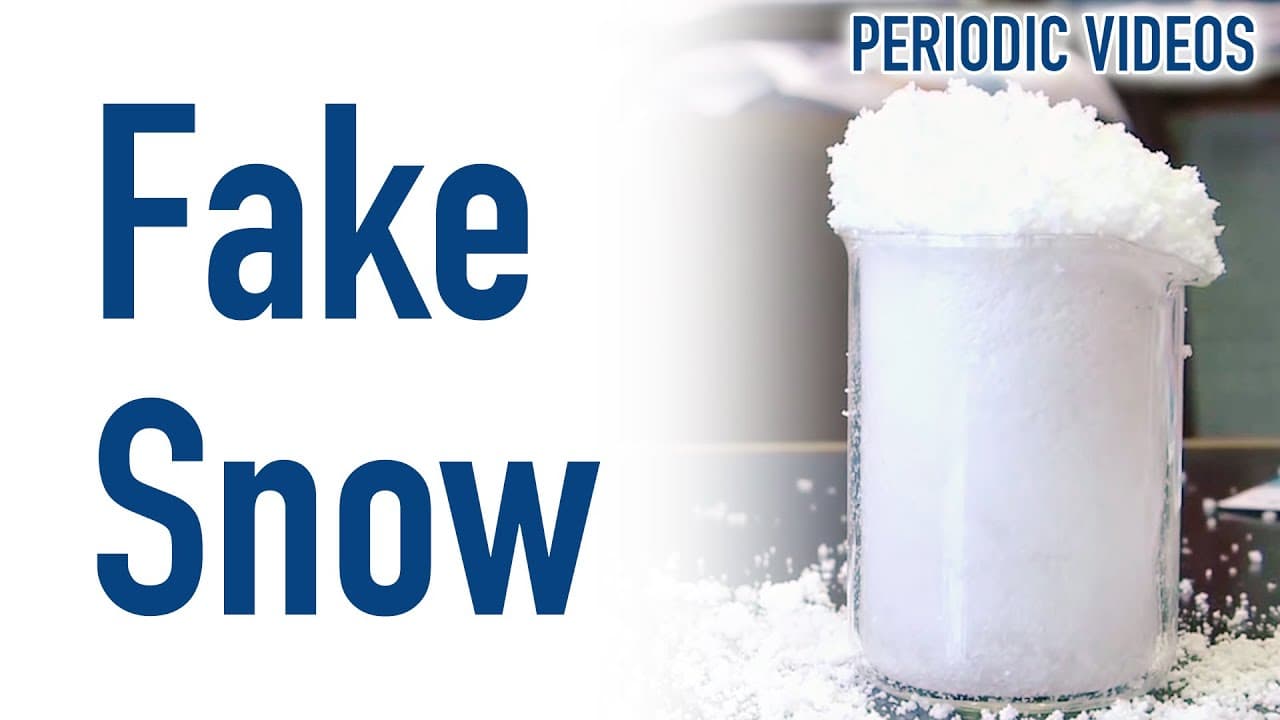
Fake Snow - Periodic Table of Videos

243.7K views
•
December 23, 2014
by
Periodic Videos
YouTube video player
Fake Snow - Periodic Table of Videos

TL;DR

Sodium polyacrylate, a white powder, absorbs water to create artificial snow for practical uses like in diapers.

Category Tag: Chemistry

Summary:

  • Sodium polyacrylate, a white powder, absorbs water easily, swelling up to create an artificial snow-like substance.
  • This material is made of polymerized acrylic acid molecules linked together, forming a chain that retains water without dissolving.
  • Sodium polyacrylate is commonly used in diapers to keep babies dry by absorbing liquid effectively.

Questions and Answers: Question: How does sodium polyacrylate create artificial snow? Answer: Sodium polyacrylate, composed of polymerized acrylic acid molecules linked together, absorbs water to swell up and mimic the texture and feel of snow. The sodium ions within the material interact with water molecules, retaining water and giving off energy.

Question: What are practical applications of sodium polyacrylate? Answer: Sodium polyacrylate is widely used in diapers to keep babies dry by absorbing and retaining liquid effectively. It can be utilized in absorbent materials to maintain dryness in various products.

Question: Why does sodium polyacrylate not dissolve in water like sodium chloride? Answer: Sodium polyacrylate does not dissolve in water like sodium chloride due to the interlinked polymer chains that prevent the material from breaking down. The structure of the polymerized chains allows for water absorption without dissolution.

Question: How does sodium polyacrylate benefit from its organic chain structure? Answer: The organic chain structure of sodium polyacrylate prevents dissolution in water, enabling the material to absorb and retain water effectively. The interlinked chains create a swellable texture, ideal for applications requiring moisture absorption.

Key Insights:

  • Sodium polyacrylate, a polymerized material, absorbs water to create artificial snow-like textures.
  • The organic chain structure of sodium polyacrylate prevents dissolution in water, allowing for efficient moisture absorption.
  • This material is commonly used in diapers to keep babies dry by absorbing liquid effectively.
  • The interlinked polymer chains of sodium polyacrylate contribute to its water-retaining properties and swellable texture.
  • Sodium polyacrylate's ability to mimic snow makes it a fun and practical material for various applications.
  • It absorbs water through its sodium salt composition, leading to a swelling effect reminiscent of snow.
  • The unique properties of sodium polyacrylate make it suitable for absorbent materials and moisture retention in products.
  • The science behind sodium polyacrylate showcases its practicality and fun applications for creating artificial snow.

Transcript

Brady's given me a Christmas present This is so-called 'artificial snow', or sodium polyacrylate It's a white powder. If I put a little bit on the desk... And what happens with this and why people like it: is that it absorbs water very easily. I've got some water here. And since it's just water, I can do the experiments in my office. So, are you re... Read More

Key Insights

  • 💦 Sodium polyacrylate, a polymerized material, absorbs water to create artificial snow-like textures.
  • 👻 The organic chain structure of sodium polyacrylate prevents dissolution in water, allowing for efficient moisture absorption.
  • 👶 This material is commonly used in diapers to keep babies dry by absorbing liquid effectively.
  • 💦 The interlinked polymer chains of sodium polyacrylate contribute to its water-retaining properties and swellable texture.
  • 🏂 Sodium polyacrylate's ability to mimic snow makes it a fun and practical material for various applications.
  • 🥺 It absorbs water through its sodium salt composition, leading to a swelling effect reminiscent of snow.
  • ❓ The unique properties of sodium polyacrylate make it suitable for absorbent materials and moisture retention in products.

Install to Summarize YouTube Videos and Get Transcripts

Explore YouTube Video Summarizer or Get YouTube Transcript Extractor

Questions & Answers

Q: How does sodium polyacrylate create artificial snow?

Sodium polyacrylate, composed of polymerized acrylic acid molecules linked together, absorbs water to swell up and mimic the texture and feel of snow. The sodium ions within the material interact with water molecules, retaining water and giving off energy.

Q: What are practical applications of sodium polyacrylate?

Sodium polyacrylate is widely used in diapers to keep babies dry by absorbing and retaining liquid effectively. It can be utilized in absorbent materials to maintain dryness in various products.

Q: Why does sodium polyacrylate not dissolve in water like sodium chloride?

Sodium polyacrylate does not dissolve in water like sodium chloride due to the interlinked polymer chains that prevent the material from breaking down. The structure of the polymerized chains allows for water absorption without dissolution.

Q: How does sodium polyacrylate benefit from its organic chain structure?

The organic chain structure of sodium polyacrylate prevents dissolution in water, enabling the material to absorb and retain water effectively. The interlinked chains create a swellable texture, ideal for applications requiring moisture absorption.

Summary & Key Takeaways

  • Sodium polyacrylate, a white powder, absorbs water easily, swelling up to create an artificial snow-like substance.

  • This material is made of polymerized acrylic acid molecules linked together, forming a chain that retains water without dissolving.

  • Sodium polyacrylate is commonly used in diapers to keep babies dry by absorbing liquid effectively.


Read in Other Languages (beta)

English

Share This Summary 📚

Summarize YouTube Videos and Get Video Transcripts with 1-Click

Download browser extensions on:

Try YouTube Summary with ChatGPT & Claude or YouTube Transcript Generator

Explore More Summaries from Periodic Videos 📚
Melting Silver - Periodic Table of Videos thumbnail
Melting Silver - Periodic Table of Videos
Periodic Videos
Vodka - Periodic Table of Videos thumbnail
Vodka - Periodic Table of Videos
Periodic Videos
Questions for The Professor - Periodic Table of Videos thumbnail
Questions for The Professor - Periodic Table of Videos
Periodic Videos
Silver Halides - Periodic Table of Videos thumbnail
Silver Halides - Periodic Table of Videos
Periodic Videos
Seaborgium Chemistry - Periodic Table of Videos thumbnail
Seaborgium Chemistry - Periodic Table of Videos
Periodic Videos
Rubidium - Periodic Table of Videos thumbnail
Rubidium - Periodic Table of Videos
Periodic Videos

Summarize YouTube Videos and Get Video Transcripts with 1-Click

Download browser extensions on:

Try YouTube Summary with ChatGPT & Claude or YouTube Transcript Generator

Apps & Extensions

  • Chrome Extension
  • Safari Extension
  • Edge Add-ons
  • Firefox Add-ons
  • iOS App
  • Android App

Key Features

  • YouTube Video Summarizer
  • Web & PDF Summarizer
  • Web & PDF Highlighter
  • Chat with PDF
  • Ask AI Clone
  • Audio Transcriber
  • Glasp Reader
  • Kindle Highlight Export
  • Idea Hatch

Integrations

  • Obsidian Plugin
  • Notion Integration
  • Pocket Integration
  • Instapaper Integration
  • Medium Integration
  • Readwise Integration
  • Snipd Integration
  • Hypothesis Integration

More Features

  • APIs
  • MCP Connector
  • Blog & Post
  • Embed Links
  • Image Highlight
  • Personality Test
  • Quote Shots
  • Open Graph Checker

Company

  • About us
  • Our Story
  • Brand Assets
  • Blog
  • Community
  • FAQs
  • Job Board
  • Newsletter
  • Pricing
Terms

•

Privacy

•

Guidelines

© 2026 Glasp Inc. All rights reserved.