Computing With Art - Computerphile
TL;DR
Can paintings be used for computation? This video explores the connections between art, physics, chemistry, biology, and computing to solve computational problems using patterns.
Transcript
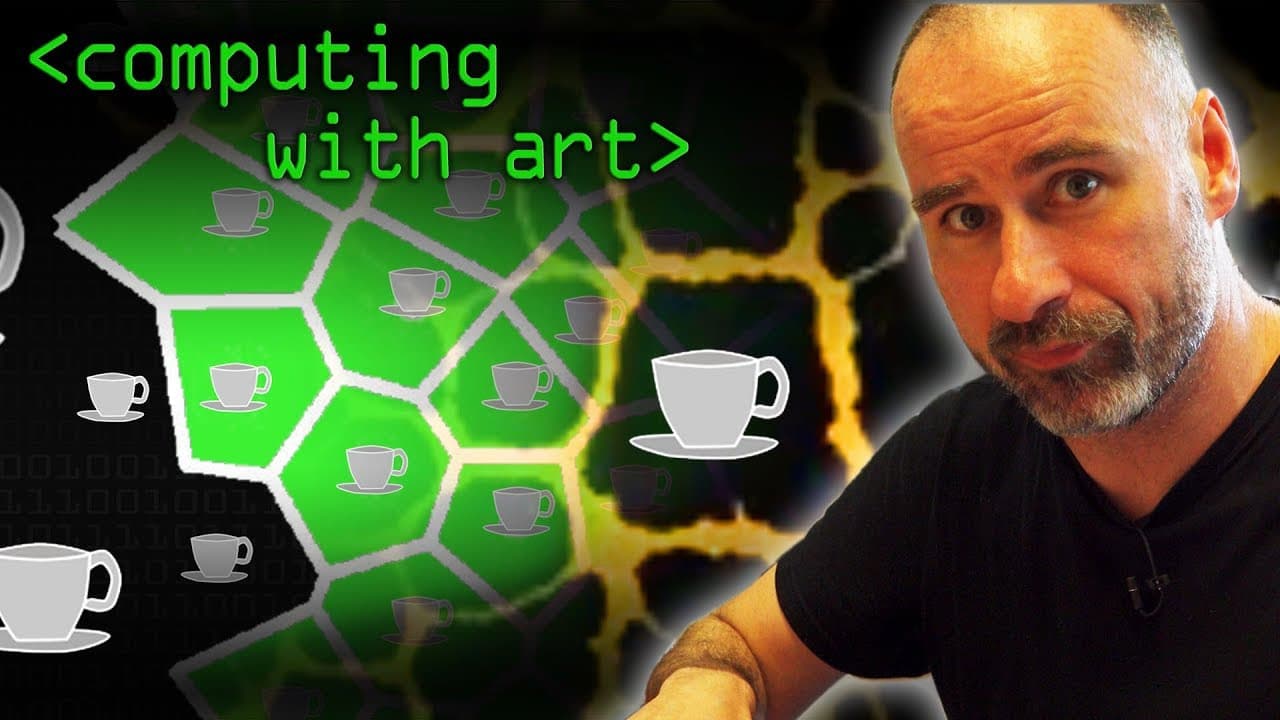
We're going to talk about Can we compute with art? can paintings compute and it's it's a broader theme in terms of What are the links between physics and chemistry and biology and computing and indeed art? So I worked with somebody called Linda Jackson who's a local nottingham artist She'd started to play with something called acrylic pouring where... Read More
Key Insights
- 🥰 Cellular patterns observed in art and nature highlight the interconnectedness of physics, chemistry, biology, and computing.
- 🫗 Artistic processes like acrylic pouring can produce patterns that can be harnessed for computational purposes.
- 🧚 The Verona tessellation, a computational geometry approach, is effective for solving problems related to catchment areas and fair division.
- 🫵 Physical systems can be viewed as "physical computers" that can perform computations by leveraging the inherent properties and behaviors of materials.
- 💁 Programming the evaporation of solvents on a surface can be used to control the formation of patterns and perform computations.
- 🥰 Art can serve as a medium to explore alternative methods of computation, challenging traditional algorithm-based approaches.
- 🥰 The combination of art and science opens up new possibilities for understanding information processing and computation in unconventional ways.
Install to Summarize YouTube Videos and Get Transcripts
Explore YouTube Video Summarizer or Get YouTube Transcript Extractor
Questions & Answers
Q: How are art and nature interconnected in terms of cellular patterns?
Cellular patterns created through acrylic pouring and observed in nature demonstrate the universality of these patterns across different length scales, from the universe to the nanoscale.
Q: Can art be used for computation?
By considering patterns rather than colors, artworks created through processes like acrylic pouring can be used for computing, solving problems such as determining fair catchment areas for schools.
Q: What is the Verona tessellation and how is it used in computing catchment areas?
The Verona tessellation is an approach from computational geometry that divides a plane based on the proximity of points. It can be used to compute fair catchment areas for schools based on their locations.
Q: How are physics and chemistry involved in computational art?
The physical and chemical processes underlying art, such as the drying of particles in a solvent, can be exploited to perform computations. The formation of cellular patterns in art can be seen as a form of computation.
Summary & Key Takeaways
-
Acrylic pouring, a technique used by artists, creates cellular network patterns similar to those found in nature, from the universe to nanoscience.
-
Using a droplet of gold nanoparticles, scientists observed how the particles dried and formed cellular patterns, demonstrating the connection between physics, chemistry, and art.
-
Computational geometry, specifically the Verona tessellation, can be used to compute fair catchment areas for schools based on their locations.
Read in Other Languages (beta)
Share This Summary 📚
Summarize YouTube Videos and Get Video Transcripts with 1-Click
Try YouTube Summary with ChatGPT & Claude or YouTube Transcript Generator
Explore More Summaries from Computerphile 📚

Summarize YouTube Videos and Get Video Transcripts with 1-Click
Try YouTube Summary with ChatGPT & Claude or YouTube Transcript Generator