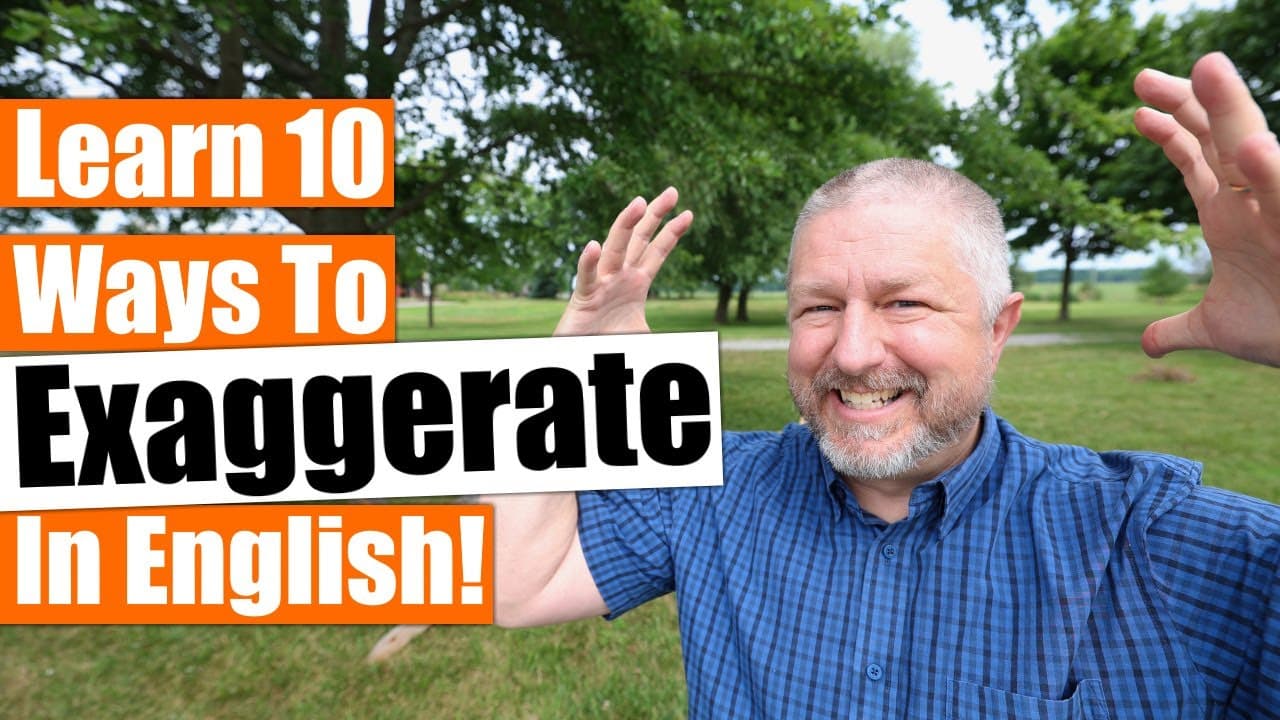
10 Different Ways To Exaggerate When Speaking English
TL;DR
English speakers often exaggerate when they talk, using phrases to describe extreme weather, emotions, and situations.
Transcript
Hi, Bob the Canadian here, as I continue to teach English online, I like to listen to all the English speakers around me to identify what makes English kind of strange sometimes. One of the things I've noticed is that English speakers like to exaggerate. When you exaggerate, it means you kind of don't tell the truth or you add to something to make ... Read More
Key Insights
- 😯 Exaggeration is a common linguistic feature in English speech, used to add emphasis and expressiveness.
- 😅 Exaggerated phrases are often used to describe extreme weather conditions, such as being "melting hot" or "freezing one's butt off."
- 😨 Exaggeration can also be used to describe emotions, such as being "scared stiff" or "dying of thirst."
- 🔇 By using exaggeration, English speakers create vivid and memorable descriptions of situations.
- 😑 Exaggeration is a cultural phenomenon that varies across languages and cultures, with each having its own unique expressions and phrases.
- 😯 English learners can benefit from understanding and using exaggeration in their language practice to add flair and creativity to their speech.
- 😒 While exaggeration is a common feature in English, it is important to recognize when to use it appropriately and to understand that it is not meant to be taken literally.
Install to Summarize YouTube Videos and Get Transcripts
Explore YouTube Video Summarizer or Get YouTube Transcript Extractor
Questions & Answers
Q: Why do English speakers exaggerate when they talk?
English speakers use exaggeration to add emphasis and color to their language, making their speech more interesting and expressive.
Q: Do English speakers really believe the exaggerated statements they make?
No, the exaggerations are used for emphasis and are not meant to be taken literally. English speakers are aware that they are exaggerating.
Q: Are there any negative consequences to using exaggeration in English speech?
Exaggeration in English speech is generally harmless and used for rhetorical effect. However, in some cases, it could lead to misunderstandings if taken literally.
Q: Are there cultural differences in the use of exaggeration in language?
Exaggeration is found in many languages, but the specific phrases and expressions used may vary across cultures. Different cultures may have their own unique ways of exaggerating certain situations.
Q: How can non-native English speakers learn to use exaggeration effectively?
Non-native English speakers can learn to use exaggeration by listening to native English speakers and practicing using exaggerated phrases in context. It is important to understand the appropriate situations in which to use exaggeration.
Summary & Key Takeaways
-
English speakers often use exaggeration to describe hot weather, saying things like "I'm melting."
-
For cold weather, an exaggerated phrase is "I'm freezing my butt off," although the speaker's butt is not actually freezing.
-
When something is very heavy, English speakers say it weighs a ton, even if it doesn't actually weigh that much.
-
To describe someone who is scared, one might say they are scared stiff, even though they are not actually stiff.
-
Instead of simply saying they are hungry, English speakers may say they are starving, and when thirsty, they might say they are dying of thirst.
-
When expressing impatience, English speakers might say they waited forever, even if it was only a long time.
-
To describe a strong desire, the phrase "I'm dying to" is used, even though the person is not actually dying.
-
When describing something or someone as very old, the phrase "as old as the hills" is used.
-
Instead of giving an exact number, English speakers may exaggerate and say they have "a million things to do."
Read in Other Languages (beta)
Share This Summary 📚
Summarize YouTube Videos and Get Video Transcripts with 1-Click
Try YouTube Summary with ChatGPT & Claude or YouTube Transcript Generator
Explore More Summaries from Learn English with Bob the Canadian 📚





Summarize YouTube Videos and Get Video Transcripts with 1-Click
Try YouTube Summary with ChatGPT & Claude or YouTube Transcript Generator