These Rare Giraffes Were Killed Just for Their Tails (Exclusive Video) | National Geographic
TL;DR
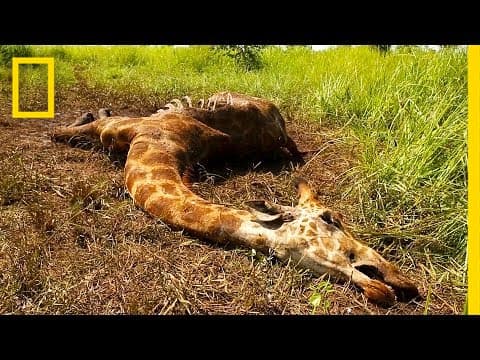
Giraffes in Garamba National Park are being poached at an alarming rate, threatening the survival of the Crodofan giraffe subspecies.
Transcript
seeing these giraffes from the air was really exciting seeing them anywhere is exciting because there's so few of them left but this was my first shot and there's a giraffe standing in this small clearing by a small tree and then the next thing I know there's three the next morning I was informed that about 12 hours after we had seen these giraffes... Read More
Key Insights
- 🦒 Giraffes are being poached at an alarming rate in Garamba National Park, jeopardizing the survival of the Crodofan giraffe subspecies.
- 💖 Anti-poaching efforts in the park are hindered by its challenging environment and highly militarized poaching networks.
- 🦒 The poaching of giraffes for their meat and tails contributes to the declining population and threat to their overall survival.
- 🕵️♀️ The loss of breeding females intensifies the risk of a shrinking giraffe population.
- 😚 Garamba National Park's history of losing species highlights the urgent need to combat poaching and protect the remaining wildlife.
- 🤨 Increased resources and awareness from organizations like National Geographic are crucial in raising awareness and galvanizing conservation efforts.
- 💖 Collaboration between local authorities, park management, and conservation organizations is essential to combat poaching effectively.
Install to Summarize YouTube Videos and Get Transcripts
Explore YouTube Video Summarizer or Get YouTube Transcript Extractor
Questions & Answers
Q: How does poaching affect the survival of giraffe subspecies?
Poaching reduces the population of giraffe subspecies, such as the Crodofan giraffe, and threatens their overall survival. Each giraffe lost represents a breeding female that could have produced more offspring.
Q: What challenges do anti-poaching teams face in Garamba National Park?
Anti-poaching teams in Garamba National Park face real risks, including ambushes and highly militarized poaching networks. The park's remote location and dense grass make it difficult to patrol and detect poachers.
Q: Why are giraffes being targeted specifically in Garamba National Park?
Giraffes are poached for various reasons, including the sale of their meat and the value of their tails. In some local beliefs, giraffe meat is believed to cause leprosy, while their tails are used as dowries or sold as flyswatters.
Q: How does the poaching of giraffes in Garamba National Park compare to other poaching incidents?
The poaching of giraffes in Garamba National Park is particularly distressing due to the rarity of the Crodofan giraffe subspecies and the fact that they are the last remaining ones in the region. The loss of each giraffe is a significant blow to their survival.
Summary & Key Takeaways
-
Poaching of giraffes has reached a devastating level in Garamba National Park, with three giraffes killed shortly after being spotted by a patrol team.
-
Garamba National Park is located in a challenging environment on the Congolese-Sudanese border, making anti-poaching efforts difficult.
-
The poached giraffes are not only killed for their meat and resources, but their tails are also used as dowries or sold for a high price.
Read in Other Languages (beta)
Share This Summary 📚
Summarize YouTube Videos and Get Video Transcripts with 1-Click
Try YouTube Summary with ChatGPT & Claude or YouTube Transcript Generator
Explore More Summaries from National Geographic 📚



Summarize YouTube Videos and Get Video Transcripts with 1-Click
Try YouTube Summary with ChatGPT & Claude or YouTube Transcript Generator