Machine Learning Tutorial Python - 10 Support Vector Machine (SVM)
TL;DR
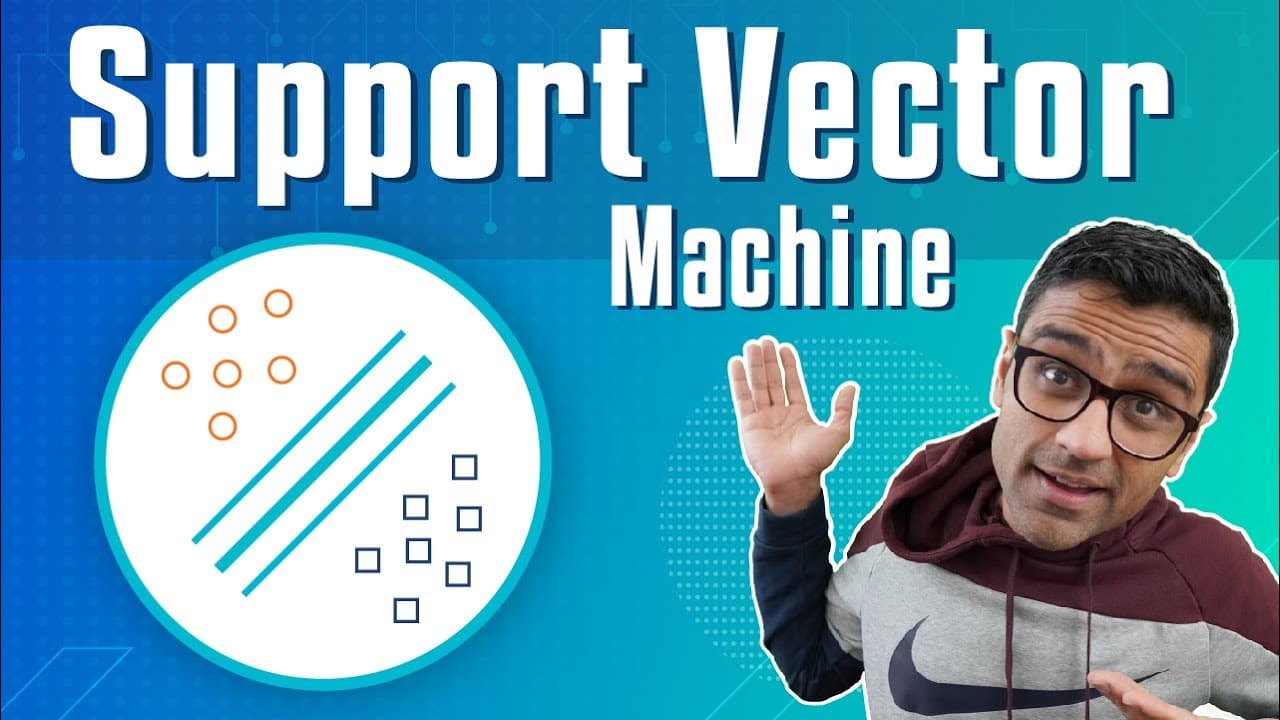
This video provides an overview of SVM, its application in classifying iris flowers, and an exercise using the SVM algorithm on a handwritten digits dataset.
Transcript
support vector machine is a very popular classification algorithm and that's what we are going to cover today we'll start with some theory first and then we will solve a classification problem for iris flowers using svm in the end we'll have an interesting exercise for you to solve so it's going to be a lot of fun today so please stay till the end ... Read More
Key Insights
- 📊 The SVM (Support Vector Machine) algorithm is a popular classification algorithm that can be used to determine the species of an iris flower based on its four features.
- 🌺 There are three different species of iris flowers.
- 🔍 When drawing a classification boundary between two groups, there are multiple valid options. The best boundary is the one with a higher margin, as it classifies the groups more accurately.
- 🔢 The classification boundary in a n-dimensional space is called a hyperplane. It separates different classification groups.
- 🧪 The SVM algorithm relies on support vectors, which are nearby data points used to determine the classification boundary.
- 🧮 Parameters such as gamma and regularization impact the decision boundary. High gamma values consider only nearby data points, while low gamma values consider data points far away.
- 📉 Higher regularization values can result in overfitting, while lower regularization values may lead to some errors but can be computationally more efficient.
- 📊 The SVM algorithm can handle complex datasets by transforming features and creating a new dimension to simplify the decision boundary. This is called using a kernel, such as the polynomial kernel.
Install to Summarize YouTube Videos and Get Transcripts
Explore YouTube Video Summarizer or Get YouTube Transcript Extractor
Questions & Answers
Q: Why is maximizing the margin between the classification boundary and nearby data points important in SVM?
Maximizing the margin ensures better classification of data points, reducing the chance of misclassification and improving the overall accuracy of the model. By having a larger margin, SVM creates a more robust decision boundary.
Q: How does SVM handle classification problems in higher-dimensional spaces?
In higher-dimensional spaces, SVM uses a hyperplane as the decision boundary. The hyperplane is defined by n features, where n is the number of dimensions in the dataset. This boundary separates different classification groups in the dataset.
Q: What is the role of regularization and how does it affect the SVM model?
Regularization, represented by the parameter C in the SVM model, controls the trade-off between achieving a low training error and having a simpler decision boundary. Higher values of C indicate lower regularization, which can lead to overfitting, while lower values of C increase regularization, potentially resulting in underfitting.
Q: How does the choice of kernel affect the SVM model's performance?
The kernel in SVM helps transform the features to a higher-dimensional space where it is easier to draw the decision boundary. Different kernels (e.g., linear, RBF) have different effects on the SVM model's performance. The choice of kernel depends on the data and problem at hand, and tuning it can improve the accuracy of the model.
Summary & Key Takeaways
-
SVM is a popular classification algorithm that aims to maximize the margin between the classification boundary and nearby data points.
-
SVM can handle classification problems in 2D, 3D, or higher-dimensional spaces using hyperplanes as decision boundaries.
-
Parameters like regularization (C), gamma, and kernel can be tuned to optimize the performance of the SVM algorithm.
Read in Other Languages (beta)
Share This Summary 📚
Summarize YouTube Videos and Get Video Transcripts with 1-Click
Try YouTube Summary with ChatGPT & Claude or YouTube Transcript Generator
Explore More Summaries from codebasics 📚





Summarize YouTube Videos and Get Video Transcripts with 1-Click
Try YouTube Summary with ChatGPT & Claude or YouTube Transcript Generator