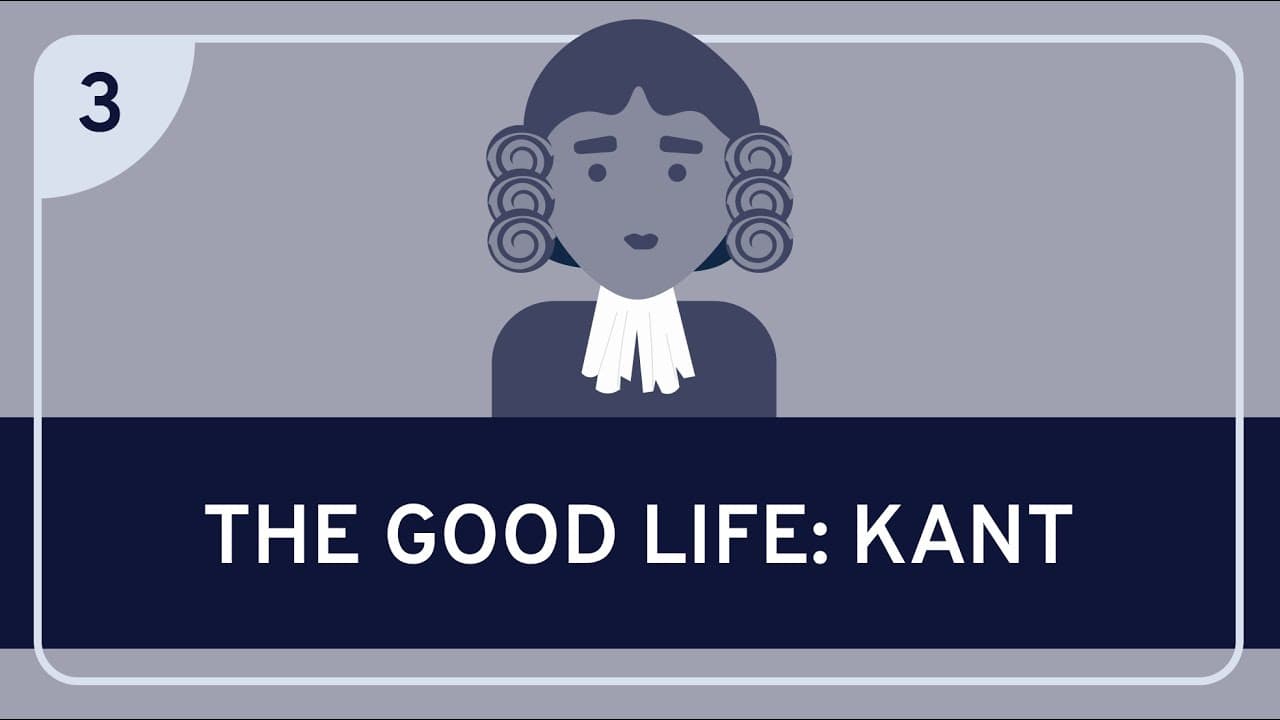
PHILOSOPHY - The Good Life: Kant [HD]
TL;DR
Kant's highest good combines virtue and happiness through reason and faith.
Transcript
(intro music) I'm Chris Surprenant, and I teach in the department of philosophy at the University of New Orleans. This video is part of my series on human well-being and the good life, and it examines Immanuel Kant's account of well-being in his moral, political, and religious writings. For Kant, the highest good for human beings is attaining both ... Read More
Key Insights
- Kant's highest good for humans is the combination of complete virtue and happiness, although these often conflict.
- Virtue, according to Kant, is the ability to resist bodily desires and do what is right for its own sake.
- Kant emphasizes that true freedom involves actions motivated by reason, not bodily desires or external influences.
- Kant's Categorical Imperative requires actions to be based on principles that can be universally applied.
- Education and civil society play crucial roles in developing the reason necessary to identify and act on moral principles.
- Kant suggests that self-respect is essential for acting virtuously, as it motivates individuals to adhere to moral principles.
- Happiness and virtue coexist only if a supreme creator ensures their alignment, highlighting the role of faith in Kant's philosophy.
- Kant believes that the development of reason through societal living is essential for understanding and acting upon moral laws.
Install to Summarize YouTube Videos and Get Transcripts
Explore YouTube Video Summarizer or Get YouTube Transcript Extractor
Questions & Answers
Q: What is Kant's view on the highest good for humans?
Kant views the highest good for humans as the conjunction of complete virtue and happiness. He believes that while these two components often seem to be in conflict, they represent the ultimate goal for human beings. Virtue involves the strength to act rightly, resisting bodily desires, while happiness is an essential part of the good life.
Q: How does Kant define virtue?
Kant defines virtue as the strength to resist bodily inclinations and do what is right simply because it is the right thing to do. This capacity for virtue is unique to humans, whose wills are influenced, but not determined, by bodily desires. Virtue involves acting in accordance with moral principles derived from reason.
Q: What role does reason play in Kant's moral philosophy?
In Kant's moral philosophy, reason is central to determining moral actions. Reason allows individuals to generate the moral law and identify principles consistent with it. It is through reason that individuals can act freely, not swayed by bodily desires or external influences, which is essential for moral praiseworthiness.
Q: What is the Categorical Imperative according to Kant?
Kant's Categorical Imperative is a principle that dictates individuals should act only according to maxims that can be universally applied as a law. It serves as a test for determining the morality of actions, ensuring they are consistent with the demands of morality and can be universally adopted without contradiction.
Q: Why is education important in Kant's philosophy?
Education is crucial in Kant's philosophy as it helps develop the reason necessary to identify and act on moral principles. Through education, individuals learn to cultivate their rational capacities, enabling them to understand and apply the moral law, which is essential for achieving virtue and the highest good.
Q: How does Kant connect morality with freedom?
Kant connects morality with freedom by asserting that morally praiseworthy actions must be performed freely, guided by reason rather than bodily desires or external coercion. True freedom involves generating principles of action from one's own reason, aligning with the moral law, and acting on these principles voluntarily.
Q: What role does self-respect play in Kant's concept of virtue?
Self-respect plays a crucial role in Kant's concept of virtue, as it motivates individuals to act according to moral principles. Kant argues that the greatest punishment for immoral behavior is feeling worthless in one's own eyes. Thus, self-respect encourages adherence to virtuous actions and principles, reinforcing moral behavior.
Q: How does Kant reconcile the tension between virtue and happiness?
Kant reconciles the tension between virtue and happiness by proposing that their coexistence is possible if a supreme creator ensures their alignment. He suggests that faith in such a creator allows individuals to hope for the realization of the highest good, where virtue and happiness are united, reflecting the rational and sensible nature of humans.
Summary & Key Takeaways
-
Immanuel Kant's philosophy posits that the highest good for humans is achieving both virtue and happiness, though they often oppose each other. Virtue involves resisting bodily desires and acting rightly, motivated by reason. Kant's Categorical Imperative tests actions against universal moral principles.
-
Kant emphasizes that true freedom and moral praiseworthiness arise when actions are motivated by reason rather than bodily desires or coercion. Education and civil society are vital in developing the reason necessary to identify and act on moral principles, fostering a virtuous character.
-
Kant argues that happiness and virtue can coexist only if a supreme creator ensures their alignment, suggesting faith's role in attaining the highest good. Self-respect is crucial for acting virtuously, motivating adherence to moral principles. Reason, developed through societal living, guides moral actions.
Read in Other Languages (beta)
Share This Summary 📚
Summarize YouTube Videos and Get Video Transcripts with 1-Click
Try YouTube Summary with ChatGPT & Claude or YouTube Transcript Generator
Explore More Summaries from Wireless Philosophy 📚
Summarize YouTube Videos and Get Video Transcripts with 1-Click
Try YouTube Summary with ChatGPT & Claude or YouTube Transcript Generator