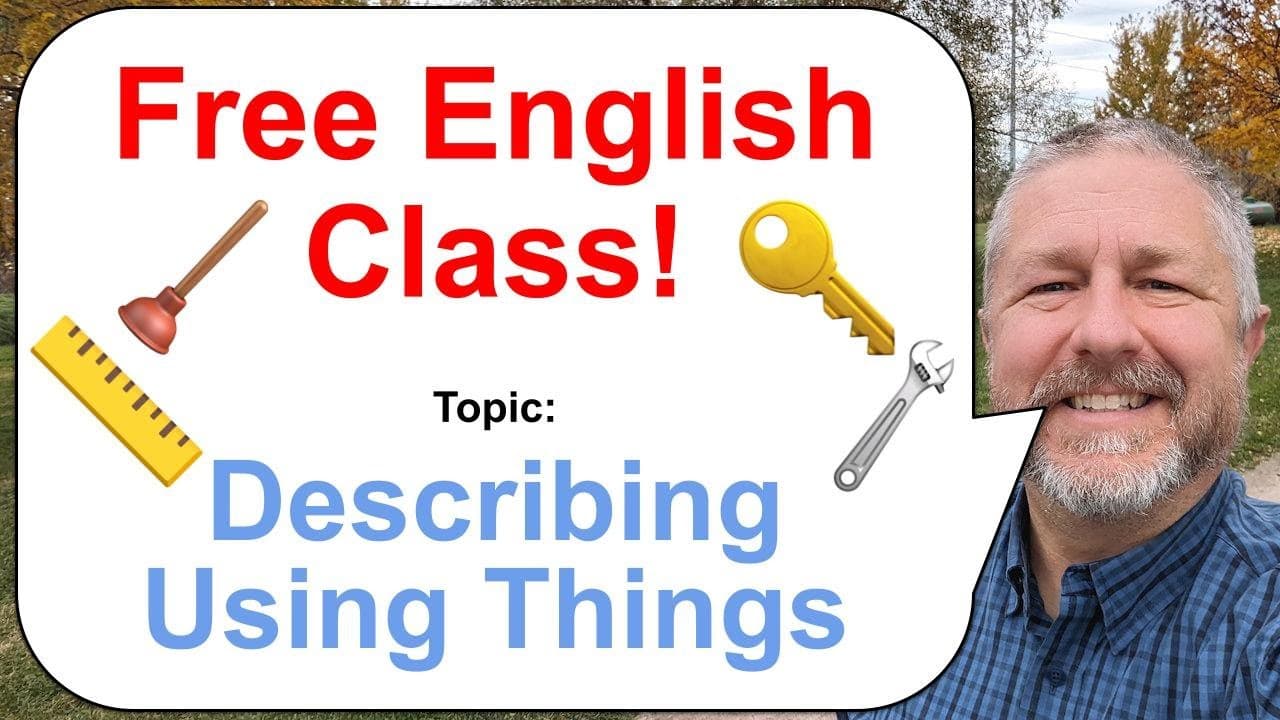
Free English Class! Topic: Describing Using Things! 🔑🔧📏
TL;DR
Learn common verbs for describing actions related to using various objects in English.
Transcript
hello hello are you ready to learn some English I hope so you might have been wondering where I was I wasn't in the chat before this lesson but I was talking to Jen I lost track of time we'll start in about 27 seconds once I confirm that everything is working properly it's nice to see some familiar names in the chat looks like everything is working... Read More
Key Insights
- ❓ Using descriptive verbs is essential for effectively communicating actions related to using different objects.
- 🙏 Common verbs discussed in this lesson include extend, retract, stack, insert, crumple, eject, rearrange, clamp, fold up, hook up, wrap, and more.
- 🥶 Practicing English in the chat during lessons provides a great opportunity for learners to improve their language skills in a stress-free environment.
- ❓ Everyday activities and objects can provide inspiration for language learning, as demonstrated by the lesson's focus on actions related to using things.
- 💄 Making a conscious effort to avoid impulse purchases of unnecessary items can be helpful in avoiding unnecessary spending.
- 🤐 Verbs such as tighten, loosen, spin, and zip are also useful for describing actions related to using various objects.
- 🫵 The instructor's engaging and personable teaching style creates an enjoyable learning experience for viewers.
Install to Summarize YouTube Videos and Get Transcripts
Explore YouTube Video Summarizer or Get YouTube Transcript Extractor
Questions & Answers
Q: When should I use the verbs "extend" and "retract"?
"Extend" means to move something from a folded or packed state to an outstretched or usable state, such as extending an awning. "Retract" is the opposite and means to move something back into its storage or original position.
Q: Can I use the verb "stack" for organizing things other than chairs?
Yes, you can stack various objects such as plates, cups, bowls, and spoons to save space or organize them neatly.
Q: How is "insert" used in English?
"Insert" is used when putting something into another thing, such as inserting a key into a lock or coins into a vending machine.
Q: What does "crumple" mean?
"Crumple" is the action of crushing or folding something haphazardly, like crumpling a piece of paper before throwing it away.
Q: Can I use "eject" to describe removing something from a computer?
No, it is more appropriate to say "eject" when removing a physical object, such as ejecting a DVD from a DVD player or removing a cassette tape from a tape deck.
Q: How is the verb "rearrange" used in English?
"Rearrange" means to change the position or order of things, such as rearranging the furniture in a room or rearranging items on a shelf.
Q: How can I use the verb "clamp" in everyday situations?
You can use "clamp" to describe attaching or securing something using a clamp, such as clamping a light onto a desk or clamping a microphone to a tripod.
Q: When should I use the verb "wrap"?
"Wrap" is used when putting something around an object, such as wrapping a gift or wrapping plastic wrap around food.
Summary & Key Takeaways
-
This English lesson focuses on verbs for describing actions related to using things, such as extend, retract, stack, insert, crumple, eject, rearrange, clamp, fold up, hook up, wrap, and more.
-
The lesson also includes tips for practicing English in the chat and highlights the importance of conversations with fellow learners.
-
The instructor shares personal anecdotes and engages with the viewers, creating a relaxed and enjoyable learning environment.
Read in Other Languages (beta)
Share This Summary 📚
Summarize YouTube Videos and Get Video Transcripts with 1-Click
Try YouTube Summary with ChatGPT & Claude or YouTube Transcript Generator
Explore More Summaries from Learn English with Bob the Canadian 📚

Summarize YouTube Videos and Get Video Transcripts with 1-Click
Try YouTube Summary with ChatGPT & Claude or YouTube Transcript Generator