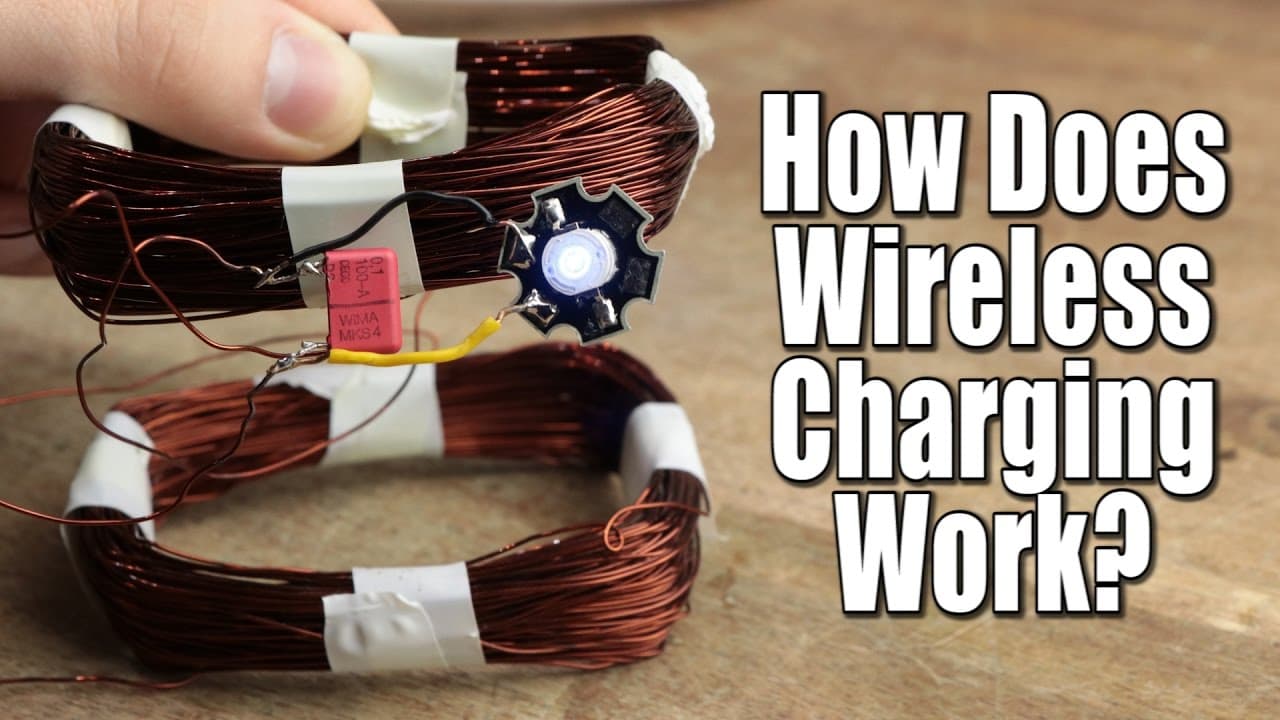
How Does Wireless Charging Work? || Crude Wireless Energy Transfer Circuit
TL;DR
Learn how to transmit energy wirelessly using resonance frequency and capacitors, but be aware of the efficiency limitations.
Transcript
Nowadays when it is time to charge your phone using a microUSB cable is not the only available option anymore There also exist wireless charging stations that can transfer sufficient energy literally through the Air a Close relative to such wireless chargers is the well-known Transformer Which can also transmit energy without the need of a wired co... Read More
Key Insights
- 🔋 Wireless charging stations have become an alternative to traditional microUSB cables for charging devices, utilizing the transmission of energy through the air.
- 🔄 Transformers can also transmit energy wirelessly by using primary and secondary coils within a closed iron core, creating a magnetic flux that induces a voltage in the secondary coil.
- 🔄 The magnetic flux created by the primary coil flows mostly through the iron core, but a small portion creates leakage flux, resulting in wireless energy transfer.
- 🔌 Without the iron core, the dream of wireless charging falls apart quickly because the leakage inductance and resistance of air coupling greatly reduce the voltage output.
- ➰ The traditional transformer setup faces challenges due to copper losses, leakage inductance, and losses in the iron core through eddy currents and hysteresis.
- 🔌 Adding a capacitor in series to the transformer can cancel out the effect of leakage inductance and maintain resonance frequency for better wireless energy transfer.
- 💡 By properly tuning the resonator circuit and adding additional capacitors, wireless energy transfer can power devices at decent distances.
- ⚡ Wireless charging stations using the Qi standard are not as efficient as traditional wired charging, requiring more energy for the charging process.
Install to Summarize YouTube Videos and Get Transcripts
Explore YouTube Video Summarizer or Get YouTube Transcript Extractor
Questions & Answers
Q: How does a traditional transformer transfer energy wirelessly?
A traditional transformer consists of primary and secondary coils that create a magnetic flux through an iron core, enabling wireless energy transfer. However, the leakage flux limits the efficiency of this wireless charging method.
Q: How can adding capacitors improve wireless energy transfer?
Adding a capacitor in series to the primary coil and another capacitor in parallel to the secondary coil can cancel out the effect of leakage inductance, improving the efficiency of wireless energy transfer.
Q: What is the efficiency of wireless charging stations compared to wired charging?
Wireless charging stations, like the ones using the Qi standard, may have lower efficiency than wired charging. The video showed that wireless energy transfer required 1.6 times as much energy as wired charging, indicating lower efficiency.
Q: Can individuals create their own transmitter and receiver circuit for wireless charging?
Yes, it is possible to create a transmitter and receiver circuit for wireless charging from scratch. However, building a Qi charging station from scratch is difficult due to the communication protocol involved in the Qi standard.
Summary & Key Takeaways
-
Traditional transformers consist of primary and secondary coils placed inside a closed iron core, which creates a magnetic flux that transfers energy.
-
The leakage flux in traditional transformers prevents efficient wireless charging through the air, but adding capacitors in series and parallel can cancel out this effect.
-
Wireless charging stations, like the ones using the Qi standard, use resonance frequency and communication protocols, but may have lower efficiency compared to wired charging.
Read in Other Languages (beta)
Share This Summary 📚
Summarize YouTube Videos and Get Video Transcripts with 1-Click
Try YouTube Summary with ChatGPT & Claude or YouTube Transcript Generator
Explore More Summaries from GreatScott! 📚

Summarize YouTube Videos and Get Video Transcripts with 1-Click
Try YouTube Summary with ChatGPT & Claude or YouTube Transcript Generator