Bistable multi-vibrators | Commutating capacitors | Pulse Digital Circuits ( PDC ) | Lec-46
TL;DR
Commutating capacitors enhance speed and stability in bi-stable multivibrators.
Transcript
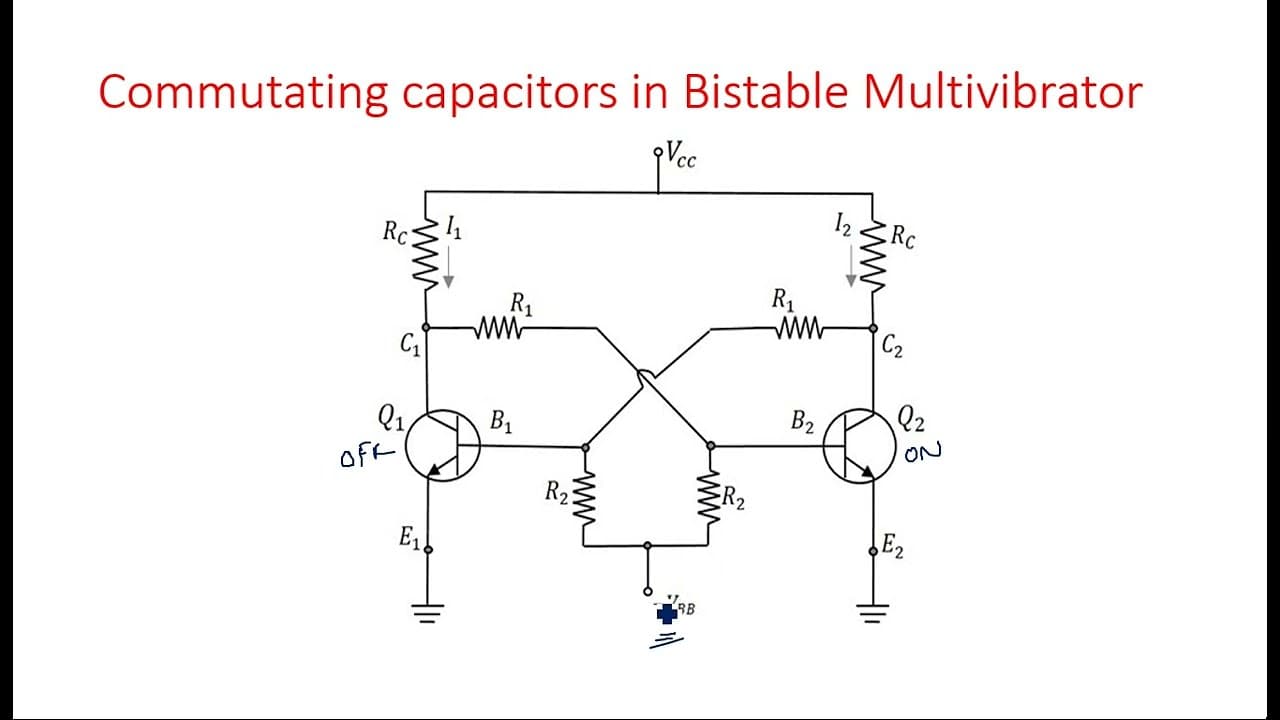
hi everyone in this video I am going to explain about the computating capacitors and its purpose in the bi-stable multivibrator most commonly these type of computating capacitors are preferred in the fixed biasing by stable multivibrator see here this is the fixer bias by stable multivibrator where no capacitor is involved here okay physically no c... Read More
Key Insights
- 😃 Commutating capacitors are crucial in speeding up response times in bi-stable multivibrators, improving circuit efficiency.
- ⚡ The behavior of transistors in different states influences the overall circuit functionality and voltage distribution.
- ❓ Virtual capacitance exists in fixed bias configurations due to the properties of the diode junction, even in the absence of physical capacitors.
- ⌛ Resistor-capacitor arrangements define the transient response and stability of multivibrator outputs, impacting time delays.
- ❓ Compensating capacitors are essential for mitigating issues associated with uncompensated networks, ensuring quicker circuit responses.
- 🤩 Understanding voltage division in resistor networks is key to grasping how current flows in transistor circuits.
- 🥺 The connection of speed-up capacitors can help avoid under-damped oscillations in circuit responses, leading to more stable operations.
Install to Summarize YouTube Videos and Get Transcripts
Explore YouTube Video Summarizer or Get YouTube Transcript Extractor
Questions & Answers
Q: What are commutating capacitors and their purpose in a multivibrator?
Commutating capacitors, also known as speed-up capacitors or transpose capacitors, are used in multivibrators to enhance the circuit's response speed. Their main purpose is to minimize transient responses that could slow down the circuit's operation, allowing for more immediate stabilization when the circuit switches states.
Q: How does the arrangement of resistors and capacitors affect a bi-stable multivibrator's operation?
In a bi-stable multivibrator, the arrangement of resistors and capacitors dictates how voltage is distributed and how quickly the circuit responds during switching. An uncompensated arrangement could lead to slow stabilization due to delays from transient responses, while a compensated arrangement with additional capacitors can provide quicker transitions and more stable operation.
Q: Why are capacitors referred to as virtually existing in fixed bias multivibrator configurations?
In fixed bias multivibrator configurations, while no physical capacitors are present, the properties of semiconductor junctions create a dielectric region that behaves like a capacitor. This virtual capacitance influences the circuit's performance even without actual capacitance components, playing a crucial role in determining voltage levels at different points.
Q: What challenges arise when dealing with uncompensated networks in multivibrators?
Uncompensated networks in multivibrators may lead to prolonged transient responses, causing instability in output voltages. This can result in slower stabilization times and undesired oscillations. By adding compensatory capacitors, these challenges can be mitigated, resulting in faster and more reliable performance.
Summary & Key Takeaways
-
This content explains the role of commutating capacitors in bi-stable multivibrators, specifically in fixed bias configurations, highlighting their virtual existence despite physical absence.
-
The discussion outlines how transistors behave in different states (on and off) and how voltage divides through resistors to affect circuit operation.
-
It emphasizes the importance of speed-up capacitors to compensate transient responses and their effect on the circuit's stability and performance.
Read in Other Languages (beta)
Share This Summary 📚
Summarize YouTube Videos and Get Video Transcripts with 1-Click
Try YouTube Summary with ChatGPT & Claude or YouTube Transcript Generator