Energy below the barrier and phase shift
TL;DR
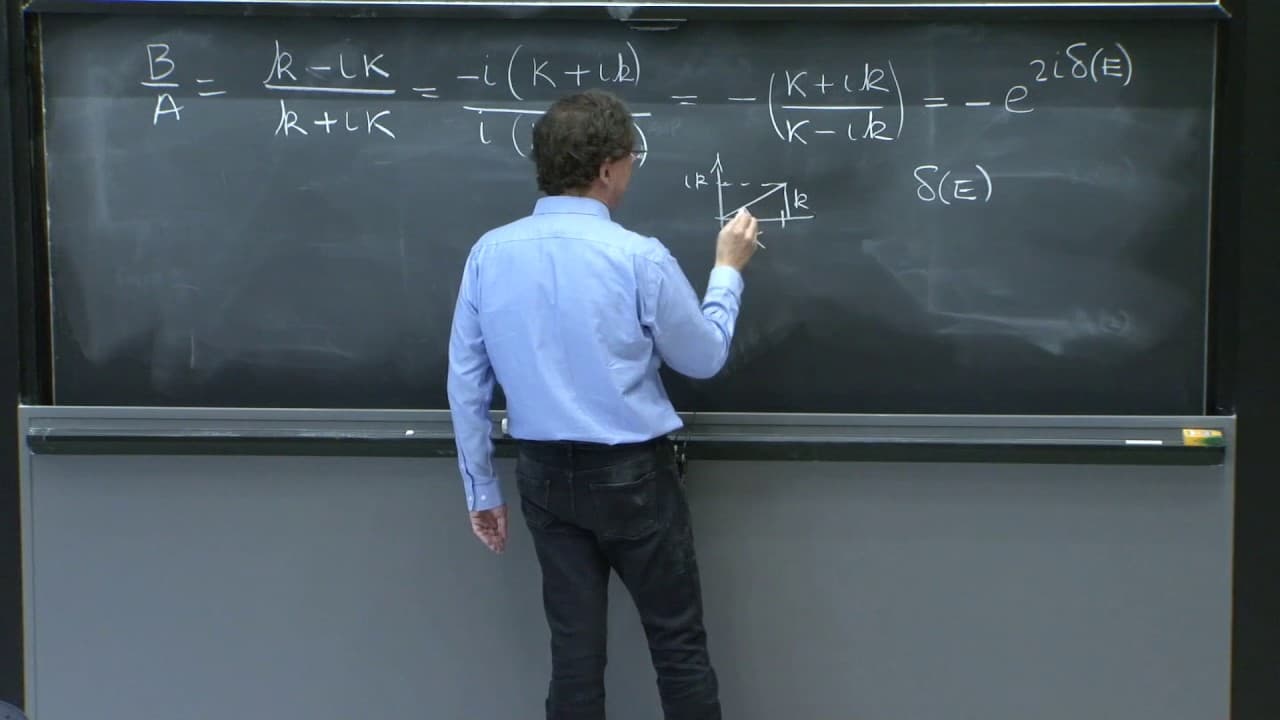
Analytic continuation allows for an easier solution to the Schrodinger equation, resulting in a phase shift that affects the probability density in quantum mechanics.
Transcript
PROFESSOR: Let's do E less than V not. So we're back here. And now of the energy e here is v not is x equal 0. X-axis. And that's the situation. Now you could solve this again. And do your calculations once more. But we can do this in an easier way by trusting the principle of analytic continuation. In this case, it's very clear and very unambiguou... Read More
Key Insights
- ☺️ Analytic continuation simplifies solving the Schrodinger equation by assuming the solution is the same for x less than 0.
- #️⃣ The substitution of a complex number for a real number in the solution introduces a phase shift that is necessary for the correct result.
- 👉 Current conservation is maintained in the solution due to the absence of probability current on the right side of the region where x is greater than 0.
- ❎ The probability density of the solution can be expressed as 4a squared times the square of the sine of kx minus delta of e.
- 🥰 The phase shift, represented by delta of e, depends on the energy and varies from 0 to pi/2 as the energy increases from 0 to the value of v not.
Install to Summarize YouTube Videos and Get Transcripts
Explore YouTube Video Summarizer or Get YouTube Transcript Extractor
Questions & Answers
Q: How does analytic continuation simplify solving the Schrodinger equation?
Analytic continuation allows for an easier solution by assuming that the solution is the same for x less than 0 and using a different exponential term for x greater than 0.
Q: What is the significance of the phase shift in the solution?
The phase shift, represented by delta of e, affects the ratio of the coefficients a and b in the solution and is necessary to obtain the correct result.
Q: How is current conservation maintained in the solution?
On the region where x is greater than 0, the solution is real, resulting in no probability current. This ensures that current conservation is maintained.
Q: How is the probability density expressed in the solution equation?
The probability density is proportional to 4a squared times the square of the sine of kx minus delta of e.
Summary & Key Takeaways
-
Analytic continuation simplifies solving the Schrodinger equation by using the principle that the solution is the same for x less than 0, with a different exponential term for x greater than 0.
-
The substitution of a complex number, i kappa, for k bar in the solution equation results in a phase shift. This phase shift affects the ratio of the coefficients a and b in the solution.
-
Current conservation is maintained in the solution, as there is no probability current on the right side of the region where x is greater than 0.
-
The probability density of the solution can be expressed as 4a squared times the square of the sine of kx minus delta of e.
Read in Other Languages (beta)
Share This Summary 📚
Summarize YouTube Videos and Get Video Transcripts with 1-Click
Try YouTube Summary with ChatGPT & Claude or YouTube Transcript Generator
Explore More Summaries from MIT OpenCourseWare 📚



Summarize YouTube Videos and Get Video Transcripts with 1-Click
Try YouTube Summary with ChatGPT & Claude or YouTube Transcript Generator