The history of the barometer (and how it works) - Asaf Bar-Yosef
TL;DR
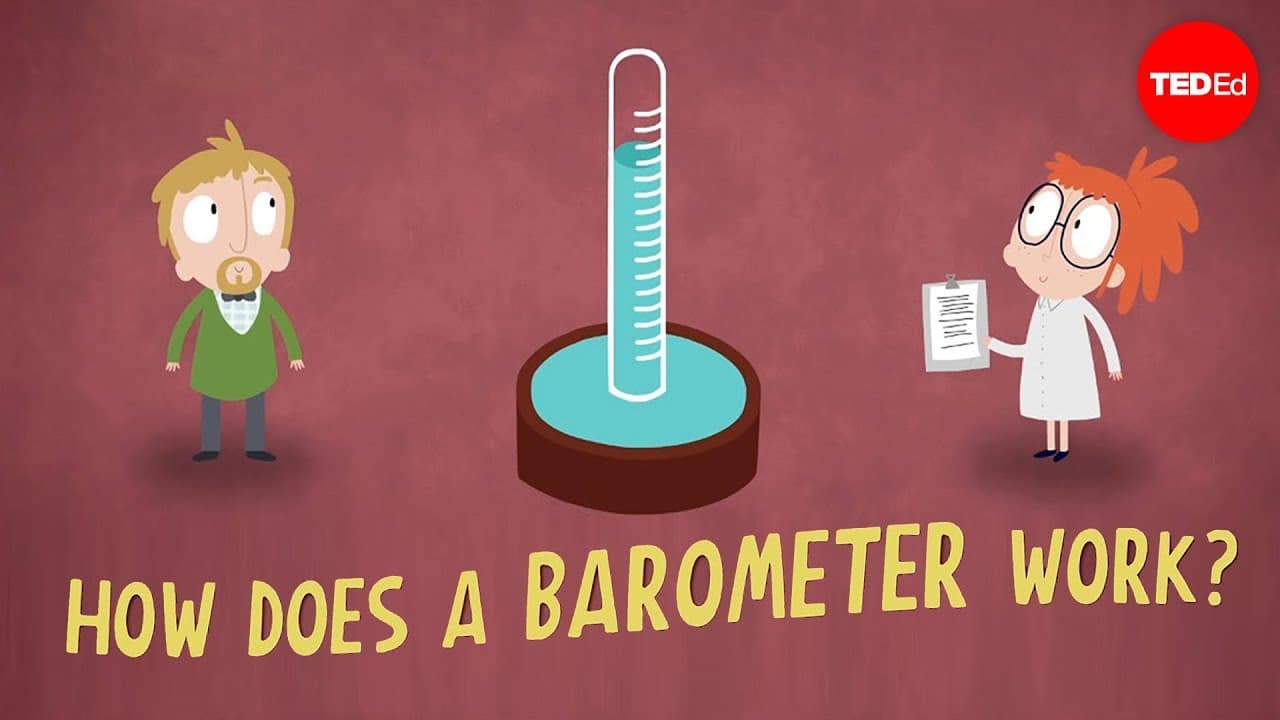
Barometers measure air pressure, which is crucial for understanding and predicting extreme weather events. The invention of the barometer challenged Aristotle's belief that a vacuum could not exist.
Transcript
Aristotle famously said, "Nature fears of empty space" when he claimed that a true vacuum, a space devoid of matter, could not exist because the surrounding matter would immediately fill it. Fortunately, he turned out to be wrong. A vacuum is a key component of the barometer, an instrument for measuring air pressure. And because air pressure corr... Read More
Key Insights
- ❓ Aristotle's belief that a vacuum could not exist was challenged by the invention of the barometer.
- ❓ Galileo Galilei and Gasparo Berti conducted experiments to demonstrate the possibility of a vacuum.
- 💦 Evangelista Torricelli refined the understanding of barometers by considering the balance of atmospheric pressure and the water column.
- ⚾ Mercury barometers based on Torricelli's model were widely used until 2007.
Install to Summarize YouTube Videos and Get Transcripts
Explore YouTube Video Summarizer or Get YouTube Transcript Extractor
Questions & Answers
Q: What is the purpose of a barometer?
Barometers are used to measure air pressure, which is essential for weather forecasting and understanding extreme weather events. By tracking changes in air pressure, meteorologists can predict weather changes.
Q: How did Galileo Galilei contribute to the development of barometers?
Galileo proposed that sucking air out of a pipe made water rise to replace the void, limiting its force to lift water to only 10.3 meters. This challenged the belief that a vacuum could not exist.
Q: How did Gasparo Berti demonstrate the possibility of a vacuum?
Berti conducted an experiment with a long tube filled with water, where both ends were plugged. By opening the bottom end and allowing water to pour out until it reached 10.3 meters, he created a stable vacuum.
Q: How did Evangelista Torricelli refine the understanding of barometers?
Torricelli focused on the influence of atmospheric pressure on the water column inside the tube. He concluded that the water level decreases until the pressures from the atmosphere and the water outside the tube are equal.
Summary & Key Takeaways
-
Barometers are essential tools for weather forecasters and scientists to measure air pressure, which correlates to temperature and can contribute to extreme weather events.
-
The invention of the barometer challenged Aristotle's belief that a vacuum could not exist, leading to experiments by Galileo Galilei and Gasparo Berti to demonstrate its possibility.
-
Evangelista Torricelli refined the understanding of barometers by realizing that air pressure balances the water column inside the tube, leading to the development of mercury barometers.
Read in Other Languages (beta)
Share This Summary 📚
Summarize YouTube Videos and Get Video Transcripts with 1-Click
Try YouTube Summary with ChatGPT & Claude or YouTube Transcript Generator
Explore More Summaries from TED-Ed 📚



Summarize YouTube Videos and Get Video Transcripts with 1-Click
Try YouTube Summary with ChatGPT & Claude or YouTube Transcript Generator