Bar graph | Students Passed | Data Interpretation | Reasoning | Part - 12 | Bharath Kumar
TL;DR
Analyzing candidates' test performance across institutions using data interpretation techniques.
Transcript
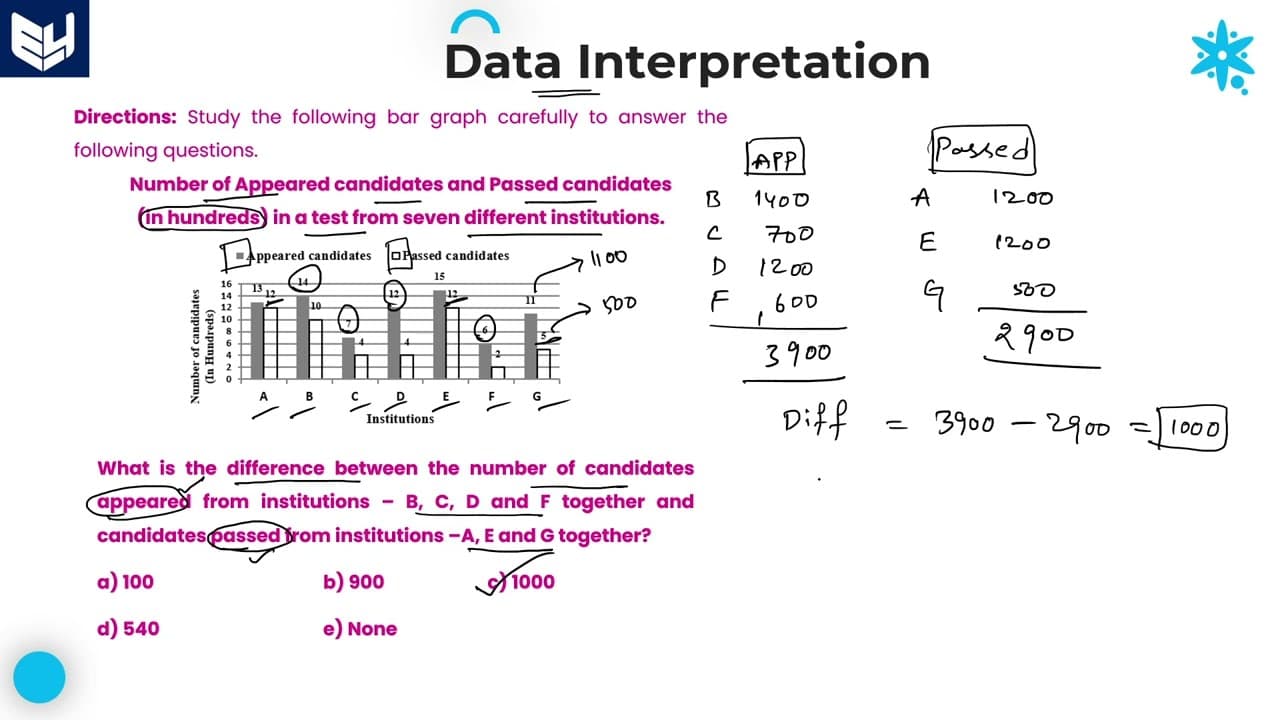
hi everyone welcome to the session in this session I am continuing data interpretation that is paragraph written predation here first of all we need to read the information carefully and then we need to solve the questions according to the given information here the information is about a number of appeared candidates and past candidates in a test ... Read More
Key Insights
- ☠️ Understanding data interpretation is essential for analyzing performance metrics in educational contexts, as it informs on student success rates.
- ⁉️ Careful reading of data-related questions is crucial to ensure accurate calculations and interpretations in competitive exams.
- 🧭 The average number of candidates who passed can indicate the overall effectiveness of education systems across institutions, offering insights for improvements.
- 💯 The concept of conversion from hundreds to actual figures plays a vital role in maintaining accuracy throughout data calculations.
- 😥 Observational skills are important in competitive exams to quickly identify significant differences while dealing with numerous data points.
- 🥳 Calculating percentages and ratios provides valuable insights into performance trends, aiding in comparisons between different institutions.
- ☠️ Institutions must focus on enhancing their passing rates as they directly impact perceptions and decisions by prospective students.
Install to Summarize YouTube Videos and Get Transcripts
Explore YouTube Video Summarizer or Get YouTube Transcript Extractor
Questions & Answers
Q: What is the significance of understanding the difference between appeared and passed candidates?
Understanding the difference between appeared and passed candidates is crucial for accurately interpreting the performance of institutions. It allows for a clear assessment of each institution's effectiveness in helping students succeed. In competitive exams, being able to distinguish these values aids in formulating strategies for improvement and setting realistic benchmarks.
Q: How was the average number of candidates who passed calculated?
To calculate the average number of candidates who passed, the total number of passed candidates from all institutions is summed up, followed by dividing this sum by the number of institutions. The total value is obtained by first converting the hundreds to the actual figures. This method provides a clear overview of the average success rate across institutions.
Q: Why is it important to note that values are given in hundreds during calculations?
Noting that values are given in hundreds is essential because it impacts the calculations and results significantly. If this is overlooked, the final figures—such as total candidates or calculations involving averages and percentages—would be far from accurate. Awareness of this detail ensures reliable data interpretation and effective problem-solving.
Q: What approach can be taken to quickly identify the institution with the maximum difference between appeared and passed candidates?
A quick approach to find the institution with the maximum difference is to simply compare the differences in a tabulated format without calculating for all institutions rigorously. By observing the appeared and passed numbers, one can immediately pinpoint the institution with the largest gap. This method saves time during exams where speed is crucial.
Summary & Key Takeaways
-
The session focuses on data interpretation involving candidate performance from seven institutions, emphasizing the distinction between appeared and passed candidates for accurate analysis.
-
Calculations are done to determine differences, averages, and percentages, particularly showcasing the importance of careful reading of problem statements.
-
Key problem-solving strategies are presented, including how to derive failed candidates from appeared and passed candidates for precise ratio calculations.
Read in Other Languages (beta)
Share This Summary 📚
Summarize YouTube Videos and Get Video Transcripts with 1-Click
Try YouTube Summary with ChatGPT & Claude or YouTube Transcript Generator