Newton's Second Law of Motion - Force, Mass, & Acceleration
TL;DR
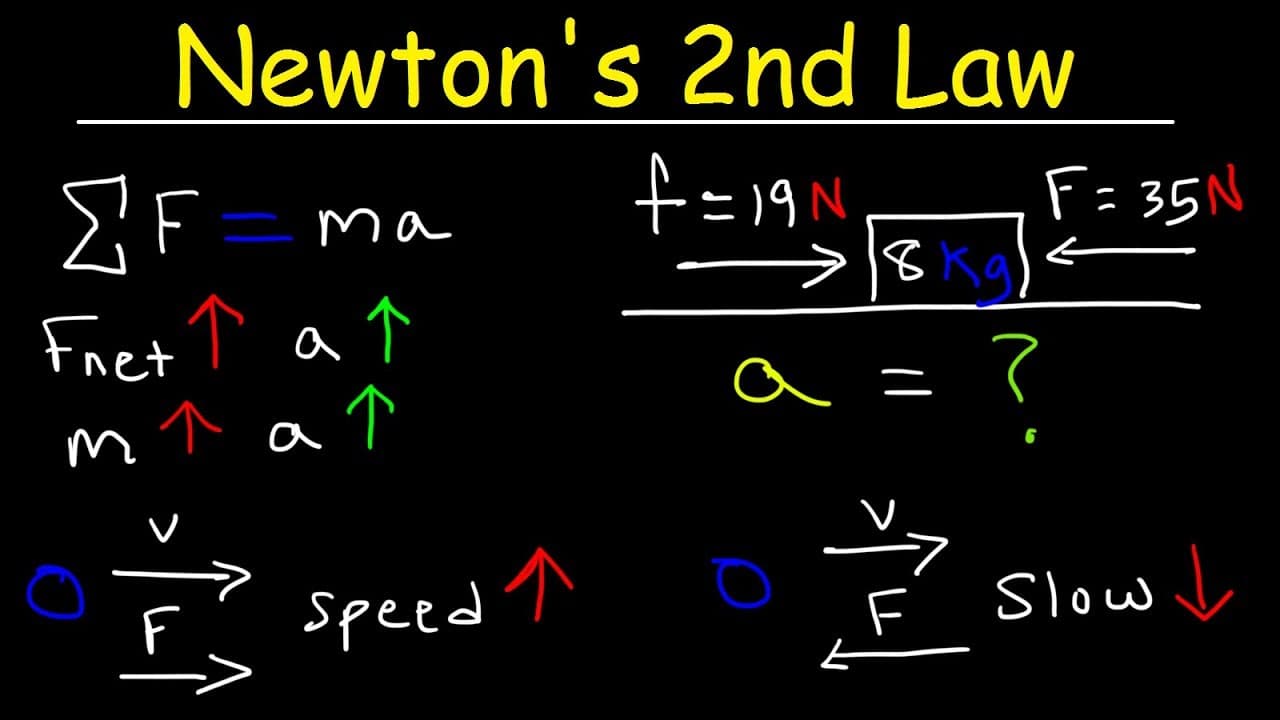
Newton's second law states that the acceleration of an object is directly proportional to the net force and inversely proportional to the mass.
Transcript
so what's the main idea behind newton's second law of motion the basic idea behind it is that the acceleration of an object is directly proportional to the net force and it's inversely proportional to the mass of the object perhaps you've seen this equation the net force is the product of the mass and the acceleration so the acceleration is equal t... Read More
Key Insights
- 👮 Newton's second law states that the acceleration of an object is determined by the net force and mass.
- 💆 Increasing the net force increases the acceleration, while increasing the mass decreases the acceleration.
- 🧑🏭 The acceleration vector and the net force vector always act in the same direction.
- 🪐 When friction is present, the net force can be calculated by subtracting the frictional force from the applied force.
Install to Summarize YouTube Videos and Get Transcripts
Explore YouTube Video Summarizer or Get YouTube Transcript Extractor
Questions & Answers
Q: What is the basic idea behind Newton's second law?
Newton's second law states that the acceleration of an object is directly proportional to the net force and inversely proportional to its mass.
Q: How does the acceleration change when the net force is doubled?
If the net force is doubled, the acceleration will also double.
Q: How does the acceleration change when the mass is tripled?
If the mass is tripled, the acceleration will decrease by a factor of three.
Q: What is the direction of the acceleration vector when a force is applied to an object?
The acceleration vector and the net force vector always act in the same direction.
Q: How do you calculate the net force when friction is involved?
The net force is the sum of all forces acting in a particular direction. In the presence of friction, the net force can be calculated by subtracting the frictional force from the applied force.
Q: What happens to the acceleration when the mass is decreased?
If the net force is constant, decreasing the mass will increase the acceleration.
Q: What happens to the acceleration when the force and velocity vectors are in opposite directions?
When the force and velocity vectors are in opposite directions, the object will slow down and decelerate.
Q: How can you calculate the average force required to accelerate an object?
To calculate the average force, you need to know the mass, the acceleration, and use the equation F = ma.
Summary & Key Takeaways
-
Newton's second law states that the acceleration of an object is determined by the net force acting on it and its mass.
-
The equation for Newton's second law is F = ma, where F is the net force, m is the mass, and a is the acceleration.
-
Increasing the net force increases the acceleration, while increasing the mass decreases the acceleration.
Read in Other Languages (beta)
Share This Summary 📚
Summarize YouTube Videos and Get Video Transcripts with 1-Click
Try YouTube Summary with ChatGPT & Claude or YouTube Transcript Generator
Explore More Summaries from The Organic Chemistry Tutor 📚


Summarize YouTube Videos and Get Video Transcripts with 1-Click
Try YouTube Summary with ChatGPT & Claude or YouTube Transcript Generator