When Should You Use Logarithmic Differentiation in Calculus?
TL;DR
Logarithmic differentiation simplifies the differentiation process for functions with multiple factors by taking the natural log of both sides. This technique converts products into sums and powers into coefficients, making it easier to differentiate complex equations. It's especially useful when dealing with functions that have complex products or exponents.
Transcript
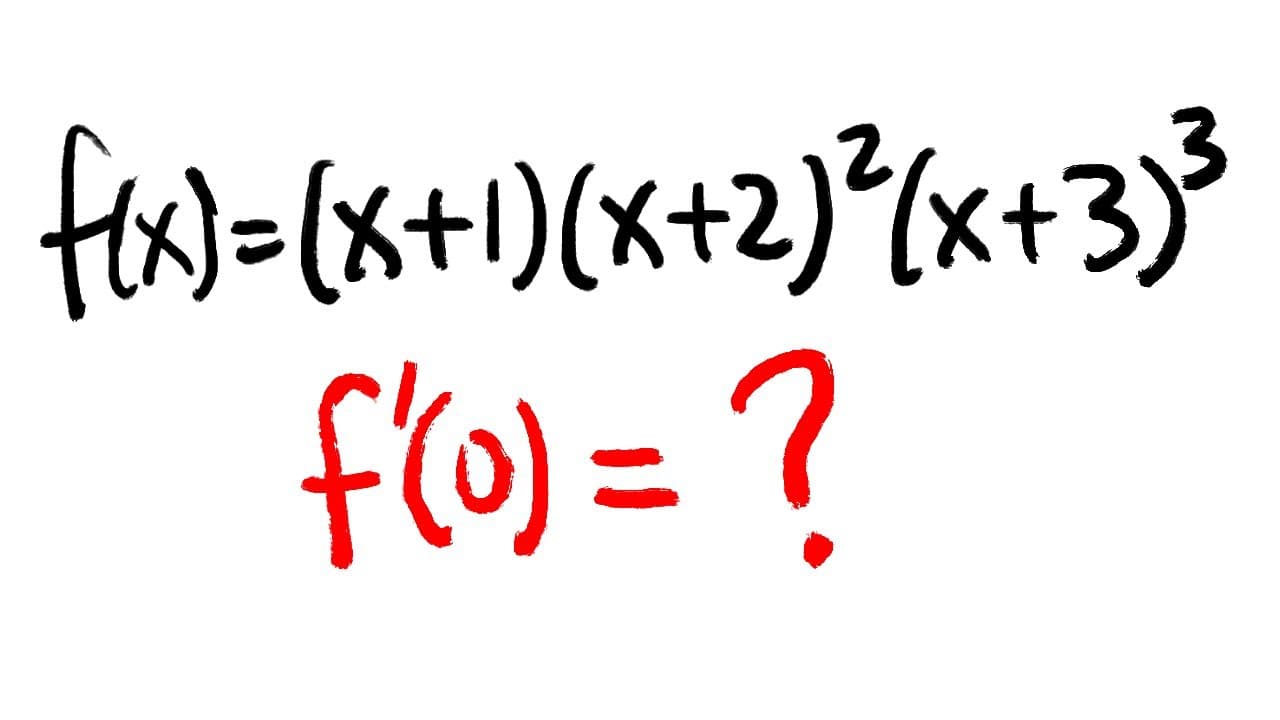
we have invited the relative of this function when X is equal to zero you know that the oh please pause the video and try this first okay the answer to this right here is 224 and if you guys got the answer correct and comment down below and there's not a hey you did right now let me show you guys how I will recommend you guys to do this you might j... Read More
Key Insights
- 🧑🏭 Logarithmic differentiation is a useful technique in calculus for solving problems with multiple factors or products.
- 🧑💻 By taking the natural log of both sides of an equation and using logarithmic properties, factors become the sum of logs and powers become coefficients.
- 😑 Differentiation is then applied to simplify the expression and make evaluation easier.
- ⌛ Logarithmic differentiation saves time and effort compared to other methods such as multiplying and differentiating or using the product rule.
- 🧑🏭 The method works regardless of the number of factors or products in the equation.
- 🧑🎓 Logarithmic differentiation is a valuable tool for students learning calculus or anyone needing to solve complex equations efficiently.
- 🧡 The technique can be used to solve a wide range of calculus problems involving multiple factors and powers.
Install to Summarize YouTube Videos and Get Transcripts
Explore YouTube Video Summarizer or Get YouTube Transcript Extractor
Questions & Answers
Q: What is logarithmic differentiation and when is it useful in calculus?
Logarithmic differentiation is a technique used to simplify calculus problems involving multiple factors or products. It is useful when the algebraic method or product rule would be too complex or time-consuming.
Q: How do you apply logarithmic differentiation to solve a problem?
To apply logarithmic differentiation, take the natural log of both sides of an equation. Rewrite the equation using the properties of logarithms to convert factors into the sum of logs and powers into coefficients. Differentiate the expression and simplify to solve the problem.
Q: What are the advantages of using logarithmic differentiation in calculus?
Logarithmic differentiation allows for a quick and efficient solution to calculus problems involving multiple factors. It eliminates the need for laborious algebraic work or the product rule, making it a valuable tool in simplifying complex equations.
Q: How do you evaluate the expression after applying logarithmic differentiation?
After applying logarithmic differentiation and obtaining a simplified expression, you can evaluate the value of the expression for a specific variable by substituting the corresponding values. In the example provided, plugging in x=0 results in the final answer of 224.
Summary & Key Takeaways
-
The content explains a method called logarithmic differentiation used to solve calculus problems involving multiple factors or products.
-
By taking the natural log of both sides of an equation, the factors become the sum of logs, and the powers become coefficients.
-
Differentiation is then applied, resulting in a simplified expression that allows for easy evaluation of the original equation.
Read in Other Languages (beta)
Share This Summary 📚
Summarize YouTube Videos and Get Video Transcripts with 1-Click
Try YouTube Summary with ChatGPT & Claude or YouTube Transcript Generator
Explore More Summaries from blackpenredpen 📚
Summarize YouTube Videos and Get Video Transcripts with 1-Click
Try YouTube Summary with ChatGPT & Claude or YouTube Transcript Generator