How to Implement the A* Pathfinding Algorithm with Obstacles
TL;DR
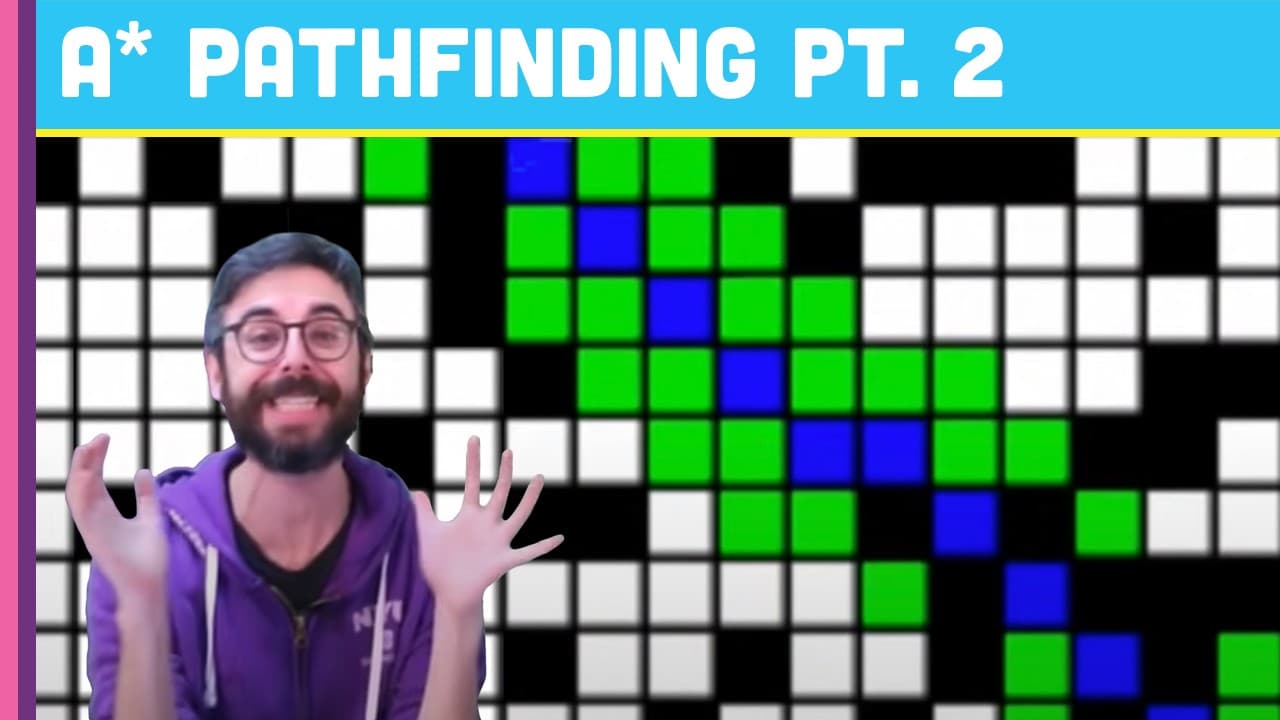
To implement the A* pathfinding algorithm with the ability to navigate around obstacles and move diagonally, start by defining the grid with obstacles and using an open and closed set to track nodes. The algorithm employs a heuristic to estimate costs and find the most efficient path from the start to the goal, effectively showcasing its adaptability.
Transcript
OK. Welcome to part two of the A star pathfinding coding challenge. Now this is looking kind of odd. And this is where all we've got so far is that we have figured out how to get from the top left to the bottom right most efficiently only if you could go right or left. So I think the magic and, sort of, beauty of the A star algorithm will be much m... Read More
Key Insights
- 🤩 The A star algorithm is more effective when diagonals and obstacles are taken into account, showcasing its versatility.
- ❓ The addition of obstacles challenges the algorithm to find alternative paths, enhancing its problem-solving capabilities.
- 💨 The algorithm's efficiency can be improved by implementing data structures like binary heaps for faster search operations.
Install to Summarize YouTube Videos and Get Transcripts
Explore YouTube Video Summarizer or Get YouTube Transcript Extractor
Questions & Answers
Q: How does the algorithm handle obstacles in the grid?
The algorithm ignores nodes marked as walls when determining valid neighbors during the pathfinding process. It avoids considering these nodes as part of the optimal path.
Q: What happens when there is no possible path to the goal?
The algorithm checks if the open set is empty before finding the next node to explore. If the open set is empty and no solution has been found, it outputs a "no solution" message.
Q: Can the algorithm be optimized for larger grids with many nodes?
Yes, the current implementation uses a linear search to check if a node is in the open or closed sets. A binary heap or other data structures can be implemented to speed up this search.
Q: Are there any limitations to the current implementation?
The heuristic used in the algorithm treats diagonal movement the same as horizontal or vertical movement. This may not accurately reflect the true cost in some scenarios.
Summary & Key Takeaways
-
The A star algorithm allows for efficient navigation from the top left corner to the bottom right corner, including diagonal movement.
-
Obstacles can be added to the grid, requiring the algorithm to find a path around them.
-
The algorithm uses an open set and a closed set to keep track of visited and unvisited nodes.
-
A heuristic is used to estimate the cost from each node to the goal, guiding the algorithm towards the most promising nodes.
Read in Other Languages (beta)
Share This Summary 📚
Summarize YouTube Videos and Get Video Transcripts with 1-Click
Try YouTube Summary with ChatGPT & Claude or YouTube Transcript Generator
Explore More Summaries from The Coding Train 📚




Summarize YouTube Videos and Get Video Transcripts with 1-Click
Try YouTube Summary with ChatGPT & Claude or YouTube Transcript Generator