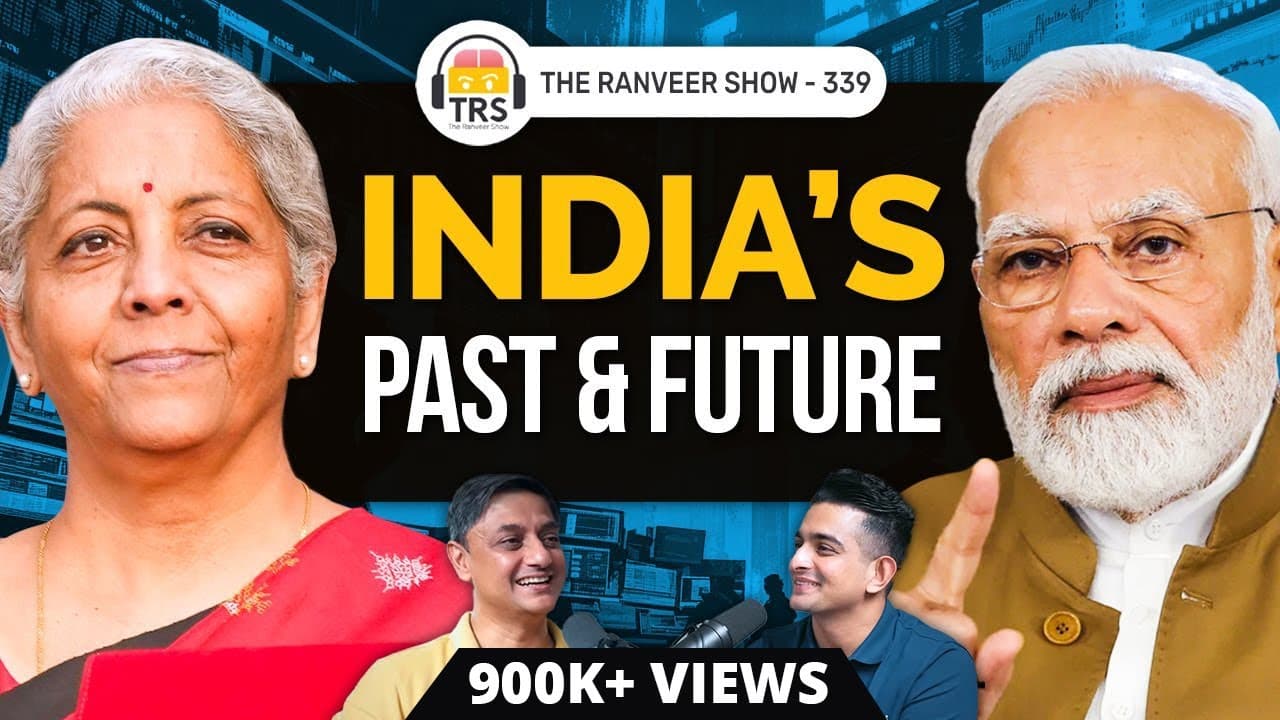
Sanjeev Sanyal On Building New Bharat | Indian Economy: Past, Present & Future Of India | TRS 339
TL;DR
India's economy is growing rapidly, yet challenges remain in equity and judicial efficiency.
Transcript
and that is important and I think I made this point last time as well when you said education is the most important thing that you need to look at and I corrected you and said no education is one thing that you need to look at health is another thing infrastructure is another thing defense is another thing after all India built one of the greatest ... Read More
Key Insights
- 🥶 The liberalization of the Indian economy in the 1990s marked a significant transition from government control to an emphasis on private enterprise and free market principles, fostering growth but also exposing underlying inequities.
- 🌥️ As India aims to become the third-largest economy, wealth distribution remains uneven, necessitating targeted interventions to uplift the poor while promoting overall economic growth.
- 👨⚖️ Bureaucratic inefficiencies and a burdensome judicial system hinder economic activity; reform in these areas is crucial for maintaining growth momentum and ensuring equitable justice.
- 🌥️ Rapid population growth can present both challenges and opportunities for economic expansion, as the government seeks to provide resources and jobs for its large citizen base.
- 🚨 Future economic planning must consider the unpredictable nature of entrepreneurial ventures, highlighting the need for a flexible approach that adapts to emerging opportunities and challenges.
- 🌍 Investment in infrastructure is vital to support ongoing growth, with projects underway across the nation to enhance connectivity and facilitate economic activities.
- 🌐 Interaction with global economies impacts domestic economic strategies, necessitating awareness of international market trends and dynamics to drive further growth.
Install to Summarize YouTube Videos and Get Transcripts
Explore YouTube Video Summarizer or Get YouTube Transcript Extractor
Questions & Answers
Q: How has India's economy changed since the liberalization in the 1990s?
India's economy transitioned from a government-controlled model to one that emphasizes free enterprise post-liberalization. This shift encouraged competition, attracted foreign investment, and led to significant growth opportunities. However, challenges like regulatory complexities and unequal wealth distribution persist, indicating the need for further reforms to maximize growth potential.
Q: What role do billionaires play in India's economic landscape?
Billionaires like Mukesh Ambani significantly influence the economy through their ventures, creating jobs and innovation. However, their impact is not unidirectional; the unpredictability of entrepreneurial decisions means that while they can drive growth, the broader economic context shapes their success and contributions to society.
Q: Why is judicial efficiency critical for India's economic growth?
The judicial system's backlog afflicts businesses' ability to enforce contracts and seek justice, creating a significant barrier to economic activity. With over 50 million cases pending, modernizing and streamlining judicial processes is essential to foster a stable business environment, attracting investment and enabling economic resilience.
Q: How does India aim to tackle poverty amidst economic growth?
The Indian government focuses on lifting the poorest citizens by directly targeting absolute poverty through various welfare schemes, such as providing financial aid for housing, healthcare, and sanitation. Growth will ideally reduce poverty levels, but targeted support ensures that the most vulnerable do not get left behind.
Q: What are the current economic growth rates for India, and how do they compare globally?
India's economy is currently experiencing a growth rate of around 6.5 to 7 percent, positioning it as one of the fastest-growing major economies worldwide. This growth, albeit positive, faces constraints due to global economic conditions, emphasizing the importance of sustainable, long-term reforms.
Q: How does the Indian government plan to approach technological advancements like AI in economic strategy?
The government acknowledges the need for strategic regulation of emerging technologies like AI to maximize benefits while mitigating risks. This involves balancing innovation with oversight, ensuring that advances contribute positively to society and the economy without infringing on individual rights or safety.
Summary & Key Takeaways
-
The discussion highlights India's economic progress since the early 90s, emphasizing the shift from a heavily government-controlled economy to one enabling private sector growth and investment, particularly through liberalization.
-
Despite becoming one of the world's largest economies, the distribution of wealth remains a critical issue, with many citizens still experiencing poverty; strategic investments and reforms are necessary to elevate living standards.
-
A deep dive into the current economic landscape reveals ongoing challenges like bureaucratic inefficiencies and the need for judicial reform, essential for fostering continued growth and prosperity.
Read in Other Languages (beta)
Share This Summary 📚
Summarize YouTube Videos and Get Video Transcripts with 1-Click
Try YouTube Summary with ChatGPT & Claude or YouTube Transcript Generator
Explore More Summaries from The Ranveer Show - All Episodes 📚

Summarize YouTube Videos and Get Video Transcripts with 1-Click
Try YouTube Summary with ChatGPT & Claude or YouTube Transcript Generator