Using specific values to test for inverses | Precalculus | Khan Academy
TL;DR
We can determine if two functions are inverses by comparing specific inputs and outputs, but this method is not foolproof.
Transcript
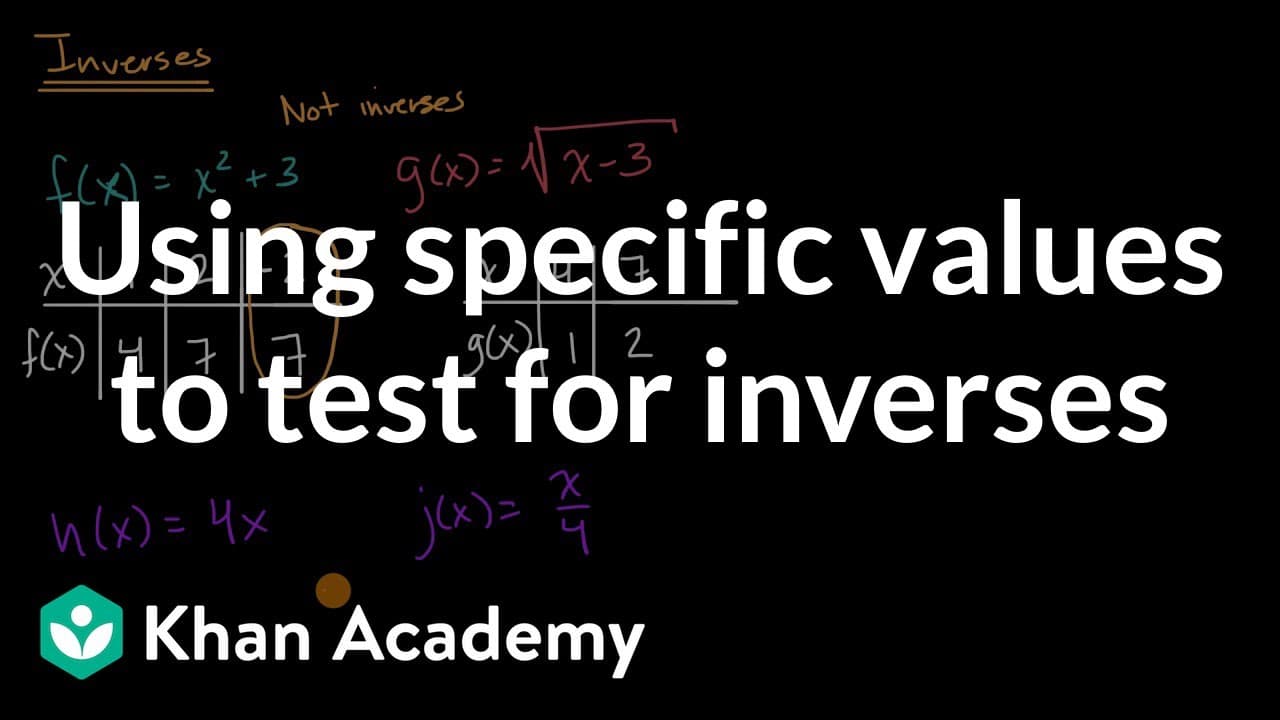
- [Instructor] In this video, we're gonna think about function inverses a little bit more, or whether functions are inverses of each other, and specifically we're gonna think about can we tell that by essentially looking at a few inputs for the functions and a few outputs? So for example, let's say we have f of x is equal to x squared plus three, a... Read More
Key Insights
- 🔠 Comparing specific input-output pairs can suggest that two functions might be inverses, but it is not a definite proof.
- ❓ Using specific values, we can find examples where two functions are not inverses, indicating that they are not inverses overall.
- 👍 It is impossible to test every possible input-output combination to prove that two functions are inverses, especially for functions with infinite values.
- 👍 Algebraic methods and graphical analysis provide other techniques to prove function inverses.
- 🪘 The formulas of two inverse functions can be different, as long as the input-output relationship is reversed.
- 🔠 Function inverses are important when solving equations or finding the original input given the output.
- ↩️ Inverse functions "undo" each other's actions, returning to the original value.
Install to Summarize YouTube Videos and Get Transcripts
Explore YouTube Video Summarizer or Get YouTube Transcript Extractor
Questions & Answers
Q: How can we determine if two functions are inverses based on inputs and outputs?
By comparing specific values, such as inputting x=1 into f(x) and getting 4, then inputting 4 into g(x) and getting 1, we can suggest that they might be inverses. However, this method is not foolproof, as shown with the negative input example where f(-2) = 7, but g(7) = 2 instead of -2.
Q: Why can't we use specific values to prove that two functions are inverses?
While specific values can give us examples of functions that are not inverses, there is an infinite number of values for which we would need to test the functions. We can't test every possible input and output combination, so specific values alone are insufficient.
Q: Are there other techniques to prove that two functions are inverses?
Yes, there are other techniques to prove function inverses, such as algebraically showing that the composition of the two functions results in the identity function, or proving that the graphs of the functions are reflections of each other across the line y=x.
Q: Can two functions be inverses of each other even if they have different formulas?
Yes, two functions can be inverses even if their formulas are different. The important factor is that the input-output relationship of one function is reversed in the other function. The formulas may look different, but they can still produce the same inverse relationship.
Summary & Key Takeaways
-
The video explores whether two functions, f(x) = x^2 + 3 and g(x) = √(x-3), are inverses of each other.
-
By comparing specific inputs and outputs, such as f(1) = 4 and g(4) = 1, it seems that they could be inverses.
-
However, when trying a negative input, such as f(-2) = 7, and finding that g(7) = 2 instead of -2, it becomes clear that they are not inverses.
Read in Other Languages (beta)
Share This Summary 📚
Summarize YouTube Videos and Get Video Transcripts with 1-Click
Try YouTube Summary with ChatGPT & Claude or YouTube Transcript Generator
Explore More Summaries from Khan Academy 📚



Summarize YouTube Videos and Get Video Transcripts with 1-Click
Try YouTube Summary with ChatGPT & Claude or YouTube Transcript Generator