Group Relative Policy Optimization(GRPO) Visualized
TL;DR
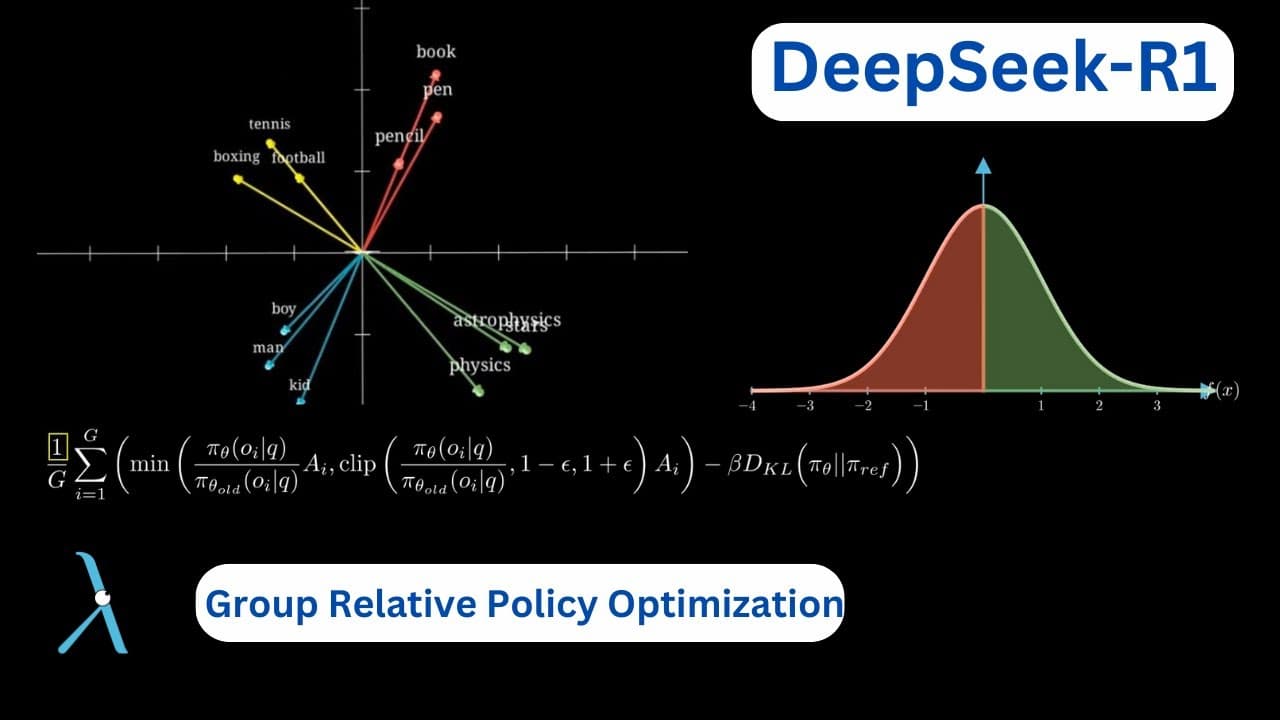
Explains Group Relative Policy Optimization for improving language model policies.
Transcript
let's begin our main proximal policy optimization algorithm this is the equation we will study consider this simple state of two words at time step T where our goal is to predict the next words probability distribution using a language model for Simplicity let's say we have three words for the next token prediction the next word pol... Read More
Key Insights
- Group Relative Policy Optimization (GRPO) updates a language model's policy by comparing actions' rewards to their expected value, encouraging beneficial actions and discouraging detrimental ones.
- The algorithm uses a softmax distribution to predict the next word in a sequence, updating policies based on advantage values derived from reward and value models.
- Advantage values determine if actions are beneficial; positive values encourage actions, while negative values discourage them.
- Policy updates are constrained by a clip function to prevent drastic changes, ensuring stability in the learning process.
- A reference policy with frozen weights is used to guide updates, preventing excessive divergence from the original policy.
- GRPO incorporates KL Divergence penalties to maintain closeness between the new and reference policies, controlled by a hyperparameter beta.
- The algorithm normalizes rewards within a group, encouraging responses better than the average and discouraging worse ones.
- The process balances policy improvements while maintaining alignment with human preferences, addressing issues like reward hacking.
Install to Summarize YouTube Videos and Get Transcripts
Explore YouTube Video Summarizer or Get YouTube Transcript Extractor
Questions & Answers
Q: What is the main goal of Group Relative Policy Optimization?
The main goal of Group Relative Policy Optimization (GRPO) is to update a language model's policy by comparing the rewards of actions to their expected values. This process encourages actions that yield higher rewards than expected and discourages those with lower rewards, thereby improving the model's performance over time.
Q: How does GRPO determine if an action is beneficial?
GRPO determines the benefit of an action using advantage values, which are calculated from the reward and value models. If the advantage value is positive, it indicates that the action provides more reward than expected, making it beneficial. Conversely, a negative advantage value suggests the action is less rewarding than expected, thus not beneficial.
Q: What role does the clip function play in GRPO?
The clip function in GRPO plays a crucial role in ensuring stability during policy updates. It constrains the changes to the policy by limiting the ratio of the new policy to the old policy within a specific range. This prevents drastic updates that could destabilize the learning process, maintaining a smooth transition between policies.
Q: Why is a reference policy used in GRPO?
A reference policy is used in GRPO to guide policy updates and prevent excessive divergence from the original policy. By using a base model with frozen weights as a reference, the algorithm ensures that the new policy remains close to the original, maintaining consistency and preventing the model from forgetting previously learned information.
Q: How does GRPO handle policy divergence?
GRPO handles policy divergence by incorporating a KL Divergence penalty in the optimization process. This penalty ensures that the new policy remains close to the reference policy, controlled by a hyperparameter beta. The penalty prevents the new policy from diverging too much from the reference, maintaining alignment and consistency.
Q: What is the significance of normalizing rewards in GRPO?
Normalizing rewards in GRPO is significant as it allows the algorithm to compare the rewards of different responses within a group. By subtracting the mean reward value, GRPO identifies which responses are better or worse than average, encouraging the generation of better-than-average responses and discouraging worse ones, thus improving overall model performance.
Q: How does GRPO address issues like reward hacking?
GRPO addresses issues like reward hacking by directly optimizing the policy based on human preferences rather than relying solely on a reward model. This approach reduces the risk of the model exploiting the reward system, as it focuses on generating responses that align with human feedback, ensuring more reliable and accurate policy updates.
Q: What is the relationship between GRPO and human preferences?
GRPO is closely aligned with human preferences as it optimizes the language model's policy based on human feedback. By categorizing responses and prioritizing those preferred by humans, GRPO ensures that the model generates responses that are not only accurate but also align with human expectations, enhancing the model's usability and effectiveness.
Summary & Key Takeaways
-
Group Relative Policy Optimization (GRPO) is a method for updating language model policies by comparing actions' rewards to expected values, encouraging beneficial actions and discouraging detrimental ones. It uses a softmax distribution to predict next words, updating policies based on advantage values derived from reward and value models.
-
Advantage values determine if actions are beneficial; positive values encourage actions, while negative values discourage them. Policy updates are constrained by a clip function to prevent drastic changes, ensuring stability in the learning process. A reference policy with frozen weights guides updates, preventing excessive divergence.
-
GRPO incorporates KL Divergence penalties to maintain closeness between the new and reference policies, controlled by a hyperparameter beta. The algorithm normalizes rewards within a group, encouraging responses better than the average and discouraging worse ones, balancing policy improvements while maintaining alignment with human preferences.
Read in Other Languages (beta)
Share This Summary 📚
Summarize YouTube Videos and Get Video Transcripts with 1-Click
Try YouTube Summary with ChatGPT & Claude or YouTube Transcript Generator