Why AI Isn't Real and Its Misconceptions Explained
TL;DR
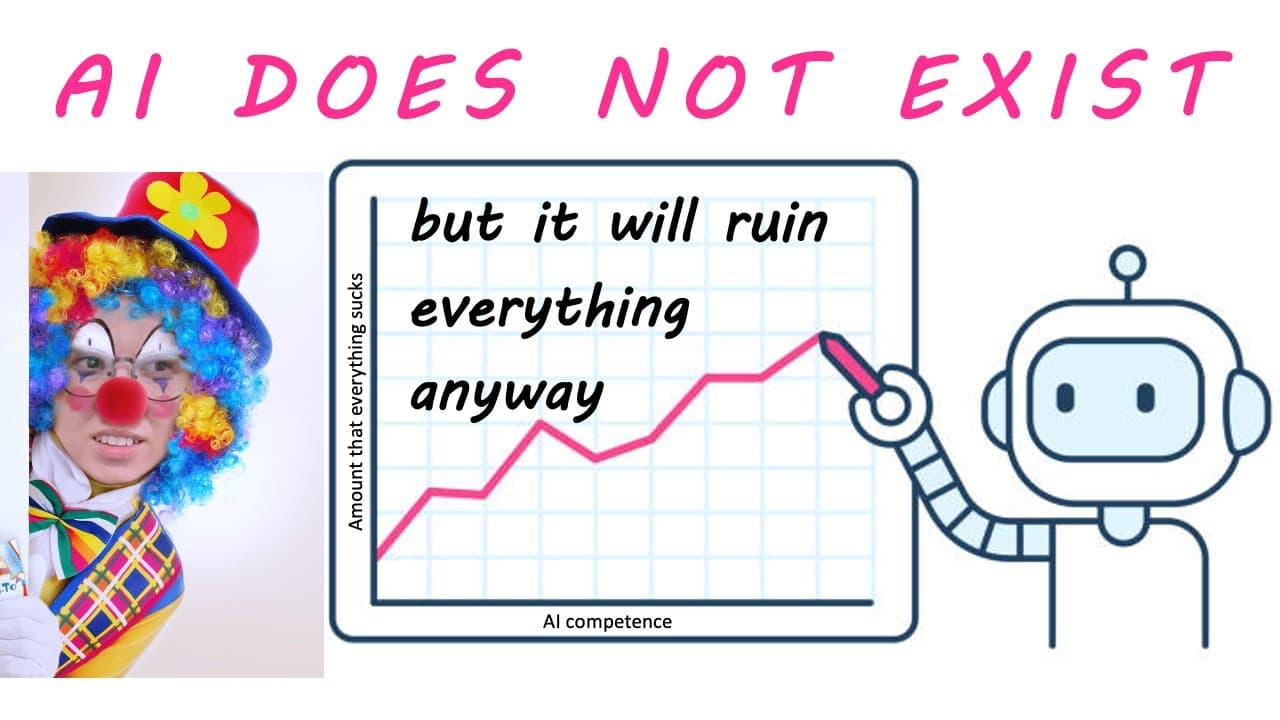
AI, in its current form, is not actual intelligence but a machine learning tool that lacks true understanding. It identifies patterns in data but has limitations and biases, making it essential to involve human experts in decision-making. Relying solely on AI for important tasks can lead to ethical and practical issues.
Transcript
so AI doesn't exist actually apparently we've all just decided to call it that that's kind of annoying I understand how this happened there's an area of research in computer science called artificial intelligence and under that umbrella is like your machine learning your neural networks and your deep learning and so when people make tools using tho... Read More
Key Insights
- 🤔 The use of the term "AI" is confusing and leads to misconceptions about what these tools can actually do. It's important to understand that AI doesn't actually exist, it's just a term we use to refer to machine learning and other similar concepts.
- 📚 Machine learning is a tool that can be used to sort through and analyze large amounts of data, such as images or texts, and identify patterns. It doesn't possess intelligence or the ability to understand context like a human does.
- 🐱 Machine learning can be used to create programs that can identify specific objects or patterns, such as sorting through pictures and finding all the pictures of cats in a dataset.
- 📝 The process of training a machine learning program involves providing it with a labeled dataset and letting it learn how to recognize certain patterns by itself. However, it's important to note that the program doesn't have intelligence, it's just recognizing patterns based on the provided data.
- 🌍 Machine learning tools can be valuable in various fields, such as astronomy, medical research, and even organizing large datasets. However, it's crucial to understand their limitations and the need for human experts to validate and interpret the results.
- 🎭 AI-generated art or content that is created using these tools should be seen as a tool and not the work of human creativity. It's unethical and misleading to present AI-generated content as original art or use it to profit off the work of others.
- 🧠 AI tools are not infallible and can be biased based on the data they are trained on. It's important to be aware of biases in the data and always have human experts involved in the decision-making process to avoid harmful or discriminatory outcomes.
- 💼 The fear of AI replacing jobs is not entirely accurate, as AI tools are more likely to complement human skills rather than replace them. However, there may be instances where certain jobs are eliminated due to overreliance on AI tools, leading to potential societal and ethical issues.
Install to Summarize YouTube Videos and Get Transcripts
Explore YouTube Video Summarizer or Get YouTube Transcript Extractor
Questions & Answers
Q: What is the difference between AI and machine learning?
AI is often mistakenly used as a blanket term for machine learning, neural networks, and deep learning, but in reality, AI refers to true artificial intelligence that does not exist yet. Machine learning, on the other hand, is a subset of AI that involves training algorithms to learn from data and make predictions.
Q: Why is it important to understand the limitations of AI tools?
AI tools are not intelligent and can only make decisions based on the patterns it has learned from training data. Knowing the limitations is crucial to avoid relying on inaccurate or biased results, which can lead to potential harm or unethical decisions.
Q: How can biased data sets impact AI systems?
AI systems are trained on data sets, and if the data sets are biased, the AI system's output will also be biased. For example, if a skin cancer detection app is trained on data predominantly from white individuals, it may not accurately detect skin cancers on individuals with different skin tones, leading to potential misdiagnosis and harm.
Q: Can AI tools completely replace human expertise?
No, as AI tools lack intelligence and the ability to reason and understand complex contexts, they cannot replace human expertise. Human experts are necessary to validate and interpret the results generated by AI tools, ensuring the accuracy and ethical implications of the decisions made.
Summary & Key Takeaways
-
AI is not true artificial intelligence, but rather a tool based on machine learning concepts.
-
Machine learning involves training computer algorithms with labeled data sets to identify patterns and make predictions.
-
AI tools have limitations and lack intelligence, making it unethical to solely rely on them for decision-making.
Read in Other Languages (beta)
Share This Summary 📚
Summarize YouTube Videos and Get Video Transcripts with 1-Click
Try YouTube Summary with ChatGPT & Claude or YouTube Transcript Generator
Explore More Summaries from acollierastro 📚
Summarize YouTube Videos and Get Video Transcripts with 1-Click
Try YouTube Summary with ChatGPT & Claude or YouTube Transcript Generator