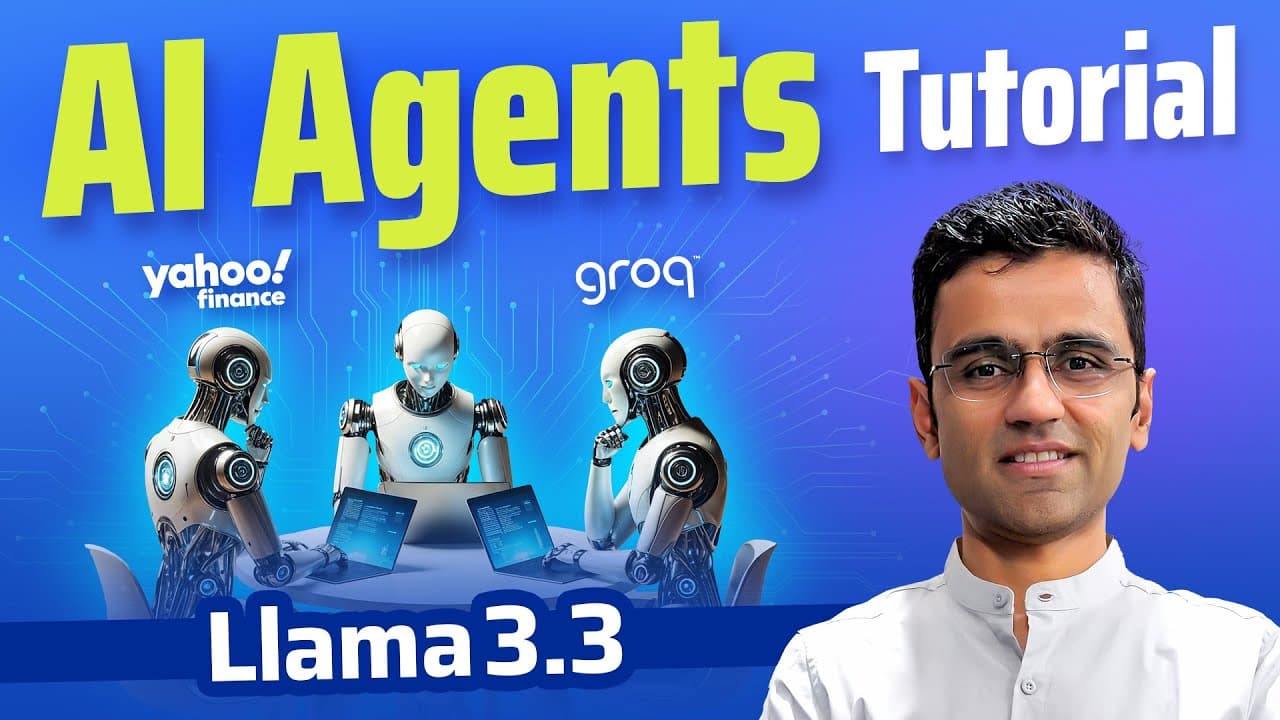
How to Build AI Finance Agents with Llama 3.3
TL;DR
Master the creation of AI finance agents using Llama 3.3 and the PhiData framework. This tutorial details the environment setup, building a basic Gro agent, and developing a finance agent to compare stock recommendations and fundamentals. Discover how to coordinate multiple agents and test them locally with an interactive UI.
Transcript
in this video we are going to build AI agent using open source llm Lama 3.3 and a framework called f data this will be a finance agent which will compare two stocks in terms of analyst recommendations and Company fundamentals later on we will build a team of Agents where One agent will be web search agent second agent will be Finance agent third on... Read More
Key Insights
- The tutorial focuses on building AI agents using the open-source Llama 3.3 model and the PhiData framework, specifically creating a finance agent for stock comparison.
- PhiData is highlighted as a clean and minimal API, with 2.8 million agents created using it as of November 2024, indicating its growing popularity.
- The tutorial provides a step-by-step guide on setting up the environment, including using Gro Cloud to handle the large Llama 3.3 model.
- Code Rabbit, an AI code review platform, sponsors the video, offering a free one-month subscription with a coupon code.
- The video demonstrates creating a simple Gro agent and a more complex finance agent, showing how to import necessary classes and set up API keys.
- The importance of using tools like Yahoo Finance for real-time data retrieval is emphasized, showcasing how agents utilize tools for specific tasks.
- The tutorial explains the creation of a team of agents, including a web search agent and a finance agent, coordinated by a team lead agent.
- The video concludes with an introduction to an agent UI for testing agents locally, featuring memory storage in a local SQL database.
Install to Summarize YouTube Videos and Get Transcripts
Explore YouTube Video Summarizer or Get YouTube Transcript Extractor
Questions & Answers
Q: What is the main focus of the tutorial?
The tutorial's main focus is on building AI agents using the Llama 3.3 model and the PhiData framework. It specifically demonstrates creating a finance agent to compare stocks based on analyst recommendations and company fundamentals, as well as setting up a team of agents for various tasks.
Q: Why is PhiData chosen over other frameworks?
PhiData is chosen for its clean and minimal API, making it easier to work with compared to other frameworks like Crew AI, Lang Chain, or Microsoft Autogen. Its popularity is also highlighted, with 2.8 million agents created using PhiData as of November 2024, indicating its growing acceptance in the industry.
Q: How does the tutorial handle the large Llama 3.3 model?
The tutorial uses Gro Cloud to handle the large Llama 3.3 model, as running it locally requires a significant amount of system resources. Gro Cloud is a free platform that supports Llama 3.3, allowing users to create an account, generate an API key, and run the model in the cloud.
Q: What is the role of Code Rabbit in the tutorial?
Code Rabbit, an AI code review platform, sponsors the video. It helps reduce code review time and potential bugs and is trusted by over a thousand organizations. The tutorial offers a special coupon code for a one-month free subscription to Code Rabbit, encouraging viewers to try the platform.
Q: What tools are used for real-time data retrieval in the finance agent?
The finance agent uses Yahoo Finance as a tool for real-time data retrieval. This tool allows the agent to fetch the latest stock prices, analyst recommendations, and company fundamentals, enabling the agent to provide up-to-date and accurate stock comparisons.
Q: How are the agents coordinated in the team setup?
In the team setup, a team lead agent coordinates the actions of a web search agent and a finance agent. The web search agent retrieves the latest news, while the finance agent gathers analyst recommendations. The team lead agent ensures that these agents work together to accomplish specific tasks efficiently.
Q: What is the significance of the agent UI introduced in the tutorial?
The agent UI introduced in the tutorial allows users to test their agents locally, providing a chat-like interface similar to ChatGPT. It features memory storage in a local SQL database, enabling users to interact with their agents and evaluate their performance in a controlled environment.
Q: What challenges are noted when using different LLMs?
The tutorial notes that different LLMs, like Llama 3.3 and GPT-4, can yield varying performance levels. Llama 3.3 may produce errors or inconsistent outputs, whereas GPT-4 is generally more reliable. It emphasizes that an agent's effectiveness largely depends on the underlying LLM's capabilities.
Summary & Key Takeaways
-
This tutorial guides beginners through building AI agents using the Llama 3.3 model and the PhiData framework, focusing on creating a finance agent to compare stocks based on analyst recommendations and company fundamentals.
-
The video explains setting up the environment, including using Gro Cloud for handling the large Llama 3.3 model, and demonstrates creating a simple Gro agent and a finance agent using various tools for data retrieval.
-
A team of agents is developed, including a web search agent and a finance agent, coordinated by a team lead agent, with an introduction to an agent UI for local testing and memory storage in a SQL database.
Read in Other Languages (beta)
Share This Summary 📚
Summarize YouTube Videos and Get Video Transcripts with 1-Click
Try YouTube Summary with ChatGPT & Claude or YouTube Transcript Generator
Explore More Summaries from codebasics 📚

Summarize YouTube Videos and Get Video Transcripts with 1-Click
Try YouTube Summary with ChatGPT & Claude or YouTube Transcript Generator