Kumbh Mela: 400 million to attend world's largest festival: BBC Learning English from the News
TL;DR
Kumbh Mela attracts 400 million attendees with rare planetary alignment.
Transcript
From BBC Learning English, this is Learning English from the News, our podcast about the news headlines. In this programme, 400 million people to attend the world's largest religious gathering, Kumbh Mela. Hello, I'm Phil. And I'm Georgie. In this programme, we look at one big news story and the vocabulary in the headlines that will help you unders... Read More
Key Insights
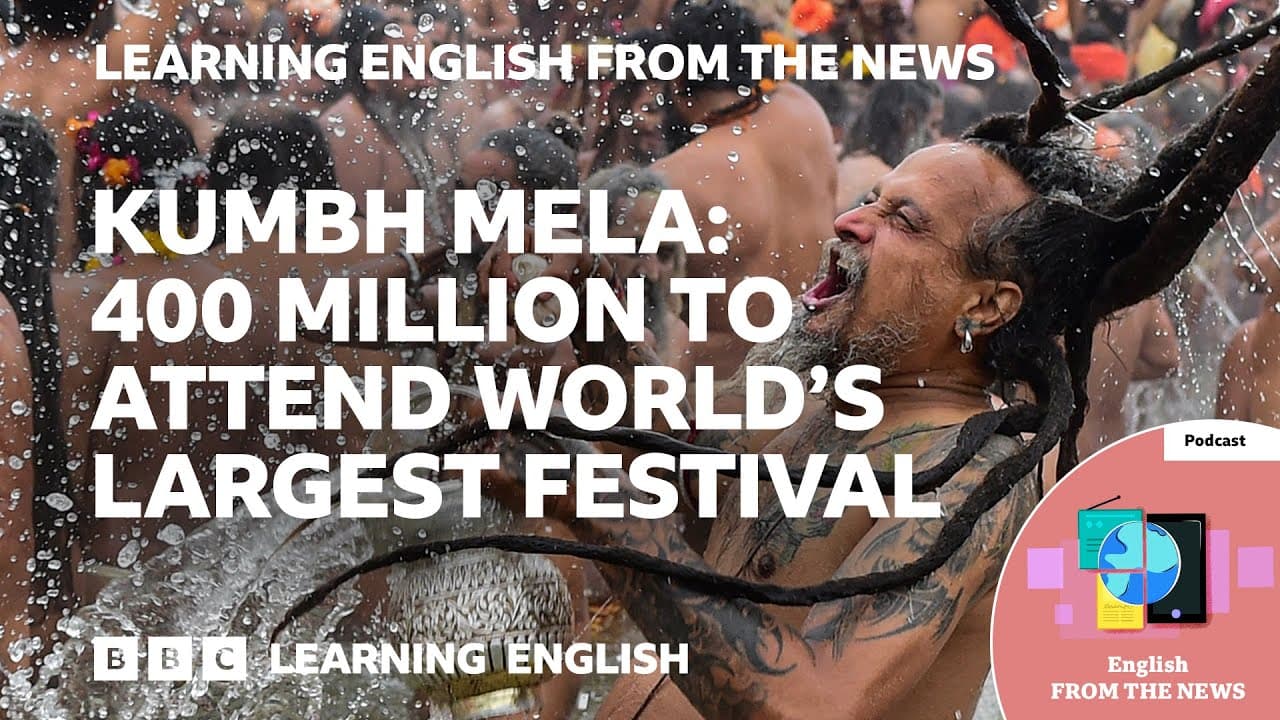
- The Kumbh Mela festival, held in Prayagraj, India, is the world's largest religious gathering, expecting 400 million attendees over 45 days.
- This year's Kumbh Mela is significant due to a rare alignment of the Sun, Moon, and Jupiter, occurring once every 144 years.
- The festival began on January 13th, with over 15 million pilgrims participating in a holy dip in the Ganges River despite the foggy and cold conditions.
- The term 'under way' signifies the commencement of the festival, highlighting the start of this significant event.
- The word 'dip' refers to the brief immersion of individuals in the sacred river, symbolizing a spiritual cleansing process.
- The festival's mythology involves a celestial battle between gods and demons over a pot of nectar, believed to purify souls.
- The term 'flock' describes the movement of millions of people gathering at the festival, showcasing its massive appeal.
- The idiom 'birds of a feather flock together' relates to the concept of people with similar interests gathering, much like the attendees of Kumbh Mela.
Install to Summarize YouTube Videos and Get Transcripts
Explore YouTube Video Summarizer or Get YouTube Transcript Extractor
Questions & Answers
Q: What makes this year's Kumbh Mela particularly significant?
This year's Kumbh Mela is particularly significant due to a rare alignment of the Sun, Moon, and Jupiter, an astronomical event that occurs only once every 144 years. This unique alignment enhances the spiritual importance of the festival, drawing a larger number of attendees seeking its auspicious benefits.
Q: How many people are expected to attend the Kumbh Mela festival?
The Kumbh Mela festival is expected to attract around 400 million people over its 45-day duration. This makes it the largest religious gathering in the world, highlighting its immense cultural and spiritual significance, as well as the logistical challenges involved in managing such a massive event.
Q: What is the significance of the holy dip during the Kumbh Mela?
The holy dip in the Ganges River during Kumbh Mela holds profound spiritual significance for Hindu pilgrims. It is believed that bathing in the sacred river during the festival cleanses individuals of their sins and purifies their souls, offering a chance for spiritual renewal and divine blessings.
Q: What challenges did authorities face on the first day of the festival?
On the first day of the Kumbh Mela festival, authorities faced challenges in managing the massive crowds. Over 15 million people attended, causing congestion as thousands attempted to enter an arena designated for holy men. The cold, foggy weather added to the difficulties in crowd control and logistics.
Q: What does the term 'under way' mean in the context of the festival?
In the context of the Kumbh Mela festival, 'under way' refers to the commencement or beginning of the event. It signifies that the festival has started and is in progress, marking the opening of a significant cultural and spiritual gathering that will unfold over several weeks.
Q: How is the word 'dip' used in the context of Kumbh Mela?
In the context of Kumbh Mela, 'dip' refers to the act of briefly immersing oneself in the Ganges River. This ritualistic act, known as taking a holy dip, is a key part of the festival, symbolizing spiritual cleansing and the washing away of sins for the millions of participants.
Q: What is the mythological story behind Kumbh Mela?
The mythological story behind Kumbh Mela involves a celestial battle between gods and demons over a pot of nectar. According to legend, the nectar was spilled into the river, and bathing in these waters during the festival is believed to offer spiritual purification and blessings, drawing millions to the event.
Q: How is the word 'flock' used in the context of the festival?
In the context of the Kumbh Mela festival, 'flock' is used as a verb to describe the movement of large groups of people gathering at the event. It highlights the mass appeal and the collective journey of millions of pilgrims who travel to participate in the spiritual and cultural activities of the festival.
Summary & Key Takeaways
-
Kumbh Mela, the largest religious gathering, occurs in Prayagraj, attracting millions due to a unique planetary alignment. This rare event, happening every 144 years, draws 400 million attendees over 45 days, showcasing its spiritual significance and cultural impact.
-
The festival began on January 13th, with over 15 million pilgrims taking a holy dip in the Ganges River. Despite cold and foggy conditions, the event proceeded, emphasizing the devotion of participants seeking spiritual cleansing.
-
Key vocabulary includes 'under way,' marking the festival's start, 'dip,' for the brief immersion in the river, and 'flock,' describing the mass gathering. The festival's mythology involves a celestial battle over nectar, believed to purify souls.
Read in Other Languages (beta)
Share This Summary 📚
Summarize YouTube Videos and Get Video Transcripts with 1-Click
Try YouTube Summary with ChatGPT & Claude or YouTube Transcript Generator
Explore More Summaries from BBC Learning English 📚

Summarize YouTube Videos and Get Video Transcripts with 1-Click
Try YouTube Summary with ChatGPT & Claude or YouTube Transcript Generator